札幌の英会話学校 AGREATDREAM 011-768-8116

Blog

  • The Meiji Period (September 1868 to July 1912) Japan

    The Meiji Period (September 1868 to July 1912) Japan

    The Meiji Period (September 1868 to July 1912) Japan

    Meiji

    list  Reiwa – Heisei – Showa – Taisho – Meiji  

    The Meiji period (明治時代 Meiji-jidai), also known as the Meiji era, is a Japanese era which extended from September 1868 through July 1912. This period represents the first half of the Empire of Japan. During this time society moved from being an isolated feudalism system to its modern form. Fundamental changes affected its social structure, internal politics, economy, military, and foreign relations.

    Meiji restoration and the emperor

    Learn about Japan’s Meiji period (September 1868-July 1912), significant cultural, political, & economic changes that occurred. Discover how the Meiji Emperor & government modernized/industrialized Japan, transforming it into a major world power.

    Main article: Abolition of the han system

    On February 3rd, 1867, fifteen-year-old prince Mutsuhito succeeded his father, Emperor Kōmei, to the Chrysanthemum Throne as the 122nd emperor.

    Imperial restoration occurred the next year, on January 3rd, 1868, with the formation of the new government. The Tokugawa Shogunate was overthrown with the fall of Edo in the summer of 1868, and a new era called Meiji, meaning “enlightened rule”, began.

    The first reform was the promulgation of the Five Charter Oath (五箇条の御誓文, Gokajō no Goseimon) in 1868, a general statement from the Meiji leaders that aimed to boost morale and win financial support for the new government. Its five provisions consisted of

    1. Establishment of deliberative assemblies
    2. Involvement of all classes in carrying out state affairs
    3. The revocation of sumptuary laws and class restrictions on employment
    4. Replacement of “evil customs” with the “just laws of nature” and
    5. An international search for knowledge to strengthen the foundations of imperial rule.

    Implicit in the Charter Oath was an end to exclusive political rule by the bakufu and a move toward more democratic participation in government. To implement the Charter Oath, leaders drafted a constitution with eleven articles. It established a new Council of State, legislative bodies, and systems of ranks for nobles and officials. The constitution also limited office tenure to four years, allowed public balloting, introduced a new taxation system, and imposed new local administrative rules.

    The Meiji Government

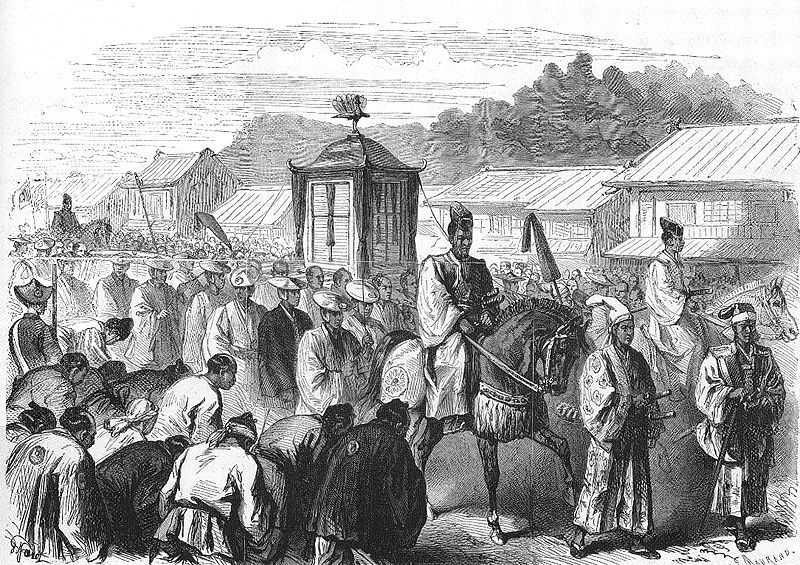
    The Meiji government assured the foreign powers that it would follow the old treaties negotiated by the bakufu. It announced that it would act in accordance with international law. Mutsuhito, who was to reign until 1912, selected a new reign title—Meiji, or Enlightened Rule. This was to mark the beginning of a new era in Japanese history. To further dramatize the new order, the capital was relocated from Kyoto, where it had been situated since 794. It was relocated to Tokyo (Eastern Capital), the new name for Edo. In a move critical for the consolidation of the new regime, most daimyo voluntarily surrendered their land and census records to the emperor in the abolition of the Han system, symbolizing that the land and people were under the emperor’s jurisdiction.

    Trivia: Kyo to → To kyo

    It looks like they just switched 2 parts of the name from Kyo-to to To-kyo in English but that’s not what happened.

    Kyoto: 京都
    Kyoto’s kanji translate to capital (京) where the Emperor lives (都).

    Tokyo: 東京
    Tokyo means “eastern (東) capital (京)”.

    The character 京 (jīng in Chinese) originated as a pictographic symbol representing a mound, made by humans, with an observation tower on top of it, used for political observation.

    The top “亠” part of the character is the shape of a roof of a building on a high ground.

    “口” is a castle wall around the settlement or capital.

    The “小” part represents the small hill.

    Since ancient times, people have preferred living on higher grounds where floods weren’t a problems and settlements on such grounds later on usually became the main cities. Hence we have this character.

    The character 京 gives a sense of “an elevated place” at its root.

    An illustration of the Meiji Restoration and the end of the Tokugawa shogunate in 1867 - The Tokugawa shogunate ends - Meiji joukyou - The Meiji Period

    The Meiji Restoration and the end of the Tokugawa shogunate in 1867: The fifteen-year-old Meiji Emperor, moving from Kyoto to Tokyo, at the end of 1868, after the fall of Edo.

    Confirmed in their hereditary positions, the daimyo became governors. The central government assumed their administrative expenses and paid samurai stipends. In 1871, prefectures replaced the han and authority continued to flow to the national government. Officials from the favored former han, such as Satsuma, Chōshū, Tosa, and Hizen staffed the new ministries. Formerly out-of-favor court nobles and lower-ranking but more radical, samurai replaced bakufu (tent government) appointees, daimyo and old court nobles as a new ruling class appeared.

    What is a daimyo/shogun?

    At the top of Japanese feudal society was the shogun. The shogun were the vassal lords, known as daimyo [DIME-yo]. The daimyo were large landholders who held their estates at the pleasure of the shogun. They controlled the armies that were to provide military service to the shogun when required.

    Emperor Meiji in his fifties

    (Syncretism is a union or attempted fusion of different religions, cultures, or philosophies — like Halloween, which has both Christian and pagan roots, or the combination of Aristotelian philosophy with the belief system of the early punk rock practitioners. )

    As the Meiji Restoration aimed to restore the emperor’s central role, leaders began building a Shinto-based state similar to the one that had existed 1,000 years earlier. However, because Shinto and Buddhism had blended into a syncretic belief over the centuries, they needed to separate the two and construct a new form of State Shinto. To do this, they created the Office of Shinto Worship, which even outranked the Council of State.

    At the same time, the government embraced the kokutai ideas promoted by the Mito school. These beliefs centered on Japan’s unique national identity, rooted in the emperor’s divine ancestry, the unbroken imperial line, and the unity of the people with the state. By supporting this ideology, leaders aimed to strengthen loyalty to the emperor and justify centralized rule. They also paid/funded Shinto teachers to help promote these values nationwide.

    Although the Office of Shinto Worship lost its high status in 1872, by 1877 the Home Ministry had taken full control of all Shinto shrines. In addition, officials granted recognition to certain Shinto sects, removed Shinto from Buddhist control, and restored its property. While Buddhism lost official support, it experienced a revival. Christianity was legalized, and Confucianism remained an important ethical influence. Over time, more intellectuals began to align themselves with Western thought and modern methods.


    list  Reiwa – Heisei – Showa – Taisho – Meiji  

  • Pleasant Surprises

    Pleasant Surprises

    Pleasant Surprises

    Pleasant Surprises

    Pleasant Surprises – I got a pleasant surprise a few day back when I got into the lift. A lady, I had never met before, greeted me in English and for some reason, it felt like I was back in Australia again. Her pronunciation was so nice. I wonder if she was born in Japan. I’ll have to ask her next time…

    Japan has changed a lot in the past 10 years and it won’t be long until more people start using English in these day-to-day situations.

    Glen

    AGreatDream.com


    japantoday.com

    You Really Don’t Need Japanese, Do You?

    “Of the roughly 20 countries I’ve been to, Japan is probably the most set up to accommodate people who don’t speak the local language. Many people live here with no more than a handful of simple phrases and do just fine. Lots of signs and menus are in English, and the entire population has received at least six years of English education. Even if you try to speak Japanese, it may not work. Sometimes no matter how perfectly you ask a question in Japanese, you’ll get an answer in English, or at least dumbed-down Japanese. Contrary to many countries that demand you speak the local language, Japan sometimes seems to prefer you don’t speak Japanese.”


  • Free Language Lessons – 06/22/11

    Free Language Lessons on 06/22/11 in Sapporo* | AGREATDREAM Language School

    Free Language Lessons

    Free Language Lessons: 06/22/11

    Offer Expired

    Sometimes I offer free language lessons during campaigns or to students that are involved in community work helping others.

    If you would like a free lesson please send me a message stating why and the type of community work you do.

    Contact Page

    We have had many request from people who are looking for free language software. The software listed on this website is free to use and can be updated by request as well.


    500 yen teacher training in Sapporo, Japan

    ETJ-Hokkaido (Facebook Page)


    Common English Idioms

    List of Common English Idioms and Phrases with Their Meaning

    • above board: honest, open
    • ad lib: improvise, interpolate
    • after all: in spite of the situation; nevertheless
    • against the grain: contrary to someone’s feelings, principles
    • all along: all the time
    • all ears: eager to listen
    • all of a sudden: no difference
    • all thumbs: clumsy
    • apple of one’s eye: very dear, precious
    • apple of discord: subject of envy or quarrel
    • as a rule: generally, usually
    • as far as I know: if I have correct information
    • as far as I am concerned: in my opinion
    • as for me/ as to me: in my opinion
    • as well: also, too
    • at first sight: from the first glance; at once; at first glance
    • at odds with: in disagreement with
    • at random: at this time
    • backseat driver: a passenger who tells you how to drive
    • ballpark figure: approximate estimate (in figures)
    • bark at the moon: do a useless thing; waste time
    • bark up the wrong tree: accuse or pursue the wrong person; misdirect one’s efforts
    • be about to: ready
    • be all in: be extremely tired
    • be back on one’s feet: healthy again or better financially
    • beat around the bush: avoid giving a clear/definite answer
    • be behind the times: be old-fashioned, outdated
    • be beside oneself: be very upset, nervous, worried
    • be better off: be in a better situation (financially)
    • be broke: have no money at all; be penniless, bankrupt
    • be hard on something or someone: treat roughly
    • be high on one’s list: be one of the most important things
    • be in charge of something: be responsible for
    • be in good health: be healthy
    • be in poor health: be not healthy
    • be in good shape: be physically fit; in good condition
    • be in bad shape: be in bad state; in bad condition
    • be in the red: be in debt
    • be on/at the point of something: be on the verge of something; be close to doing something
    • be out of date: be outdated
    • be out of sorts: be in bad temper
    • be pressed for time, for money: not to have enough time, money
    • be to blame: be responsible for a mistake, for something wrong
    • be touch and go: risky, dangerous; uncertain of the result
    • be up and around / about: able to be out of bed after an illness
    • be up to one’s ears in work: be very busy
    • beat around/about the bush: avoid giving a clear or definite answer
    • beat one’s brains out: make great efforts, often unsuccessfully
    • before long: soon
    • big shot: important person
    • bite off more than one can chew: try to do more than one can
    • bite the bullet: accept painful but necessary action
    • bite the dust: be killed; die; suffer defeat
    • bite the hand that feeds one: repay kindness with evil
    • black sheep: a good-for-nothing member of the family
    • blind date: a meeting between a man and a woman (who have never met before) arranged by their friends
    • blow it: lose the chance
    • bottom line: main result; main factor
    • break someone’s heart: hurt deeply
    • break the ice: overcome awkwardness or shyness
    • break the news (to someone): tell important news
    • bring home the bacon: earn the living for the family
    • by all means: definitely, certainly
    • by heart: by memorizing
    • by hook or by crook: by any possible means
    • by oneself (by myself, by himself, etc.): alone; on one’s own
    • by the way: incidentally
    • call a halt to something: terminate, stop something
    • call a spade a spade: use plain, direct words
    • call it a day: consider work finished for the day
    • call the shots: give orders; be in control of something
    • call the tune: give orders; be the most important person in some situation
    • carry weight: be important
    • castles in the air: daydreaming about success
    • catch someone’s eye: attract attention
    • catch one’s breath: stop and rest
    • catch someone off guard: catch someone unprepared
    • catch someone red-handed: find someone in the act of doing wrong
    • close call: a narrow escape; a bad thing that almost happened
    • come to one’s senses: act normally and reasonably again
    • come true: become reality
    • cross one’s mind: occur to someone
    • do one’s best: try very hard
    • do one’s bit: do what’s needed
    • do someone good: be good for someone
    • do something behind someone’s back: do (harmful) things secretively
    • down to earth: practical
    • draw the line: set a limit; impose a restriction
    • duty calls: must fulfill obligations
    • eat one’s words: take back one’s words
    • every now and then: occasionally
    • every other: every second one
    • fall in love (with): begin to love
    • fall out of love: stop loving
    • false alarm: untrue signal; untrue rumor
    • a far cry from something: not nearly as good
    • feel it in one’s bones: expect something bad to happen
    • feel like doing something: want to do; be inclined to do something
    • few and far between: rare, scarce
    • find fault with someone or something: criticize; complain about
    • first things first: important things come before others
    • fly off the handle: get angry
    • follow in someone’s footsteps: do the same thing
    • foot the bill: pay the bill
    • for good: forever
    • for the time being: for now; at this time
    • frame of mind: mental state
    • from now on: now and in the future
    • from the word go: from the very beginning
    • get a grip on oneself: take control of one’s feelings
    • get carried away: get too excited and enthusiastic about something
    • get cold feet: be afraid to do something
    • get even with someone: have one’s revenge
    • get in touch with someone: contact someone
    • get to the bottom of something: know deeply
    • get to the point: speak directly about the subject; come to the point
    • Give me a break!: Stop it! Enough!
    • give someone a hand: help someone
    • go back on one’s word: break a promise
    • go from bad to worse: become much worse
    • go to pieces: get very upset; fall apart
    • go with the flow: lead a quiet life
    • have a ball: have a good time
    • have a bone to pick with someone: complain or discuss something unpleasant
    • have a sweet tooth: love eating sweet things
    • have a word with someone: talk to someone
    • have no business doing something: have no right to do something
    • have one’s hands full: be very busy
    • hit the nail on the head: say exactly the right thing
    • hold one’s tongue: keep silent; refrain from speaking
    • ill at ease: uncomfortable
    • in advance: well before
    • in cold blood: mercilessly
    • in fact: actually; in reality
    • in hot water: in trouble; in a difficult situation
    • in someone’s shoes: in another person’s position
    • in the long run: in the end
    • in the same boat: in the same situation
    • in the clear: free from blame
    • it goes without saying: should be clear without words
    • jump at the opportunity: accept the opportunity eagerly
    • just as soon: prefer; would rather
    • just in case: to be on the safe side
    • keep a straight face: try not to laugh
    • keep company: accompany
    • keep in mind: bear in mind; consider; remember
    • keep one’s word: fulfill a promise
    • keep someone posted: inform someone
    • keep one’s fingers crossed: hope that nothing will go wrong
    • kill time: fill time; spend empty time
    • know the ropes: be very familiar with some business
    • lay one’s cards on the table: be frank and open
    • lay one’s life on the line: put oneself in a dangerous situation
    • lead a dog’s life: live in misery
    • leave word: leave a message
    • let go of something: release the hold
    • let one’s hair down: be relaxed and informal with other people
    • let someone know: inform someone
    • like father, like son: be like one’s parent in something
    • little by little: step by step; bit by bit; gradually
    • lose one’s temper: become angry
    • lose one’s way: get lost
    • lose track of someone: not to know where someone is
    • lucky break: a lucky chance
    • make a living: earn money to provide for life
    • make allowance(s) for something: take into consideration when judging
    • make a point of: be sure to do something intentionally
    • make friends: become friends
    • make fun of someone or something: laugh at; joke about
    • make room for someone: allow space for someone
    • make up one’s mind: decide
    • make yourself at home: be comfortable; feel at home
    • mean well: have good intentions
    • might as well: maybe it’s a good idea
    • never mind: don’t worry about it
    • now and again: occasionally; now and then
    • off the cuff: without preparation
    • off the point: beside the point
    • off the record: not for the public; unofficially
    • once and for all: decidedly
    • on credit: not having to pay cash right away
    • on edge: nervous, irritable
    • on guard: on the alert
    • on hand: available
    • on one hand/on the one hand: considering one side of the question
    • on one’s toes: alert, attentive, prepared for difficulties
    • on purpose: intentionally
    • on second thought: after thinking again
    • on the alert: on guard
    • on the carpet: called in by the boss for criticism
    • on the go: on the move; busy, active
    • on the other hand: considering the other side of the question
    • on the spot: right there
    • on the spur of the moment: without previous thought or plan
    • on the tip of one’s tongue: on the verge of saying but unable to remember
    • out of one’s mind: crazy
    • out of one’s way: away from one’s usual route
    • out of the question: not to be considered; impossible
    • pack rat: a person who saves lots of unnecessary things
    • pay attention: note something; be attentive to something
    • pick a fight: start a quarrel
    • put one’s foot down: object strongly
    • right away: immediately
    • ring a bell: remind someone of something familiar but half-forgotten
    • see red: become very angry
    • take a break: stop for rest
    • take it easy: relax; be calm
    • take something for granted: accept as given
    • take steps: take action; take measures
    • take time: take a long time
    • twist someone’s arm: force someone to agree
    • under the weather: feeling a little ill, a little unwell
    • up-and-coming: showing promise of future success
    • up in the air: undecided, unsettled
    • up to date: modern, latest, current
    • walk on air: be very happy
    • waste one’s breath: speak uselessly, to no purpose
    • watch one’s step: behave prudently; be careful
    • white lie: unimportant lie
    • word for word: in the same words
  • Words Starting With Q | Scrabble Words | Qq

    Words Starting With Q | Scrabble Words | Qq

    Words Starting With Q | Scrabble Words | Qq

    List of Words Starting with Qq

    Words starting with the letter q

    Learn over 300 words that start with Q, including definitions | Language School AGREATDREAM

    You will find a large list of words starting with the letter Q on this page. They are sorted by the number of letters they have. If you find any we have missed, please contact us so we can add them to the list.

    Grammar Study Resources Here >


    Official Scrabble Dictionary and Point Counter

    7 Letter Words – Words Beginning With Q – A List With Scores

    100 7-letter Words Starting With Q

    quizzed; quizzer; quizzes; quickly; quezals; quetzal; quokkas; quicken; quacked; quicker; quaking; quickie; quipped; quixote; quippus; quakily; quibble; quaffed; quipper; quavery; quaffer; qualify; quivery; qubytes; quondam; qabalah; quiches; quirked; quantum; quahaug; quaichs; quamash; queenly; quantic; quavers; quayage; quintic; quinces; qiviuts; quahogs; quadric; queuing; quivers; quaggas; quaighs; quomodo; qwertys; quakers; quorums; quakier; quohogs; quinary; quoting; quartic; quangos; quelled; quiring; quietly; qabalas; quashed; quality; quadded; queerly; quilled; qurshes; quinela; quilted; quillet; quinols; quintal; quintan; quintin; quoined; quinone; quinoid; quinine; quinins; quinnat; quinina; quillai; queller; quailed; quantal; queened; quanted; quashes; quasher; quintes; quintet; quarrel; querida; queered; quitted; quadrat; quartan; quoited; qindars; quintas; quassin; quirted

    Words Including Scrabble Points & Words With Friends Points

    Sorted by highest points

    quizzed 35 36; quizzer 34 35; quizzes 34 35;

    quickly 25 27; quezals 25 27; quetzal 25 27; quokkas 24 25; quicken 22 25; quacked 23 25; quicker 22 24; quaking 21 24; quickie 22 24; quipped 21 24; quixote 23 24; quippus 20 24; quakily 23 24; quibble 20 24; quaffed 23 24; quipper 20 23; quavery 22 23; quaffer 22 23; qualify 22 23; quivery 22 23; qubytes 21 22; quondam 19 22; qabalah 21 22; quiches 21 22; quirked 21 22; quantum 18 22; quahaug 20 22; quaichs 21 22; quamash 21 22; queenly 19 21; quantic 18 21; quavers 19 21; quayage 20 21; quintic 18 21; quinces 18 21; qiviuts 19 21; quahogs 20 21; quadric 19 21; queuing 17 21; quivers 19 21; quaggas 18 21; quaighs 20 21; quomodo 19 21; qwertys 22 21; quakers 20 21; quorums 18 21; quakier 20 21; quohogs 20 21; quinary 19 20; quoting 17 20; quartic 18 20; quangos 17 20; quelled 17 20; quiring 17 20; quietly 19 20; qabalas 18 20; quashed 20 20; quality 19 20; quadded 19 20; queerly 19 20; quilled 17 20;

    qurshes 19 19; quinela 16 19; quilted 17 19; quillet 16 19; quinols 16 19; quintal 16 19; quintan 16 19; quintin 16 19; quoined 17 19; quinone 16 19; quinoid 17 19; quinine 16 19; quinins 16 19; quinnat 16 19; quinina 16 19; quillai 16 19; queller 16 19; quailed 17 19; quantal 16 19; queened 17 19; quanted 17 19; quashes 19 19; quasher 19 19; quintes 16 18; quintet 16 18; quarrel 16 18; querida 17 18; queered 17 18; quitted 17 18; quadrat 17 18; quartan 16 18; quoited 17 18; qindars 17 18; quintas 16 18; quassin 16 18; quirted 17 18


    7 Letter Words – Words Beginning With Q

    Word, Scrabble Points, Words With Friends Points,
    Definition

    quizzed 35 36
    Past tense of quiz: To question or test someone’s knowledge, often in a playful or formal setting, e.g., the history teacher quizzed students everyday.

    quizzer 34 35
    A person who quizzes others, often someone who asks questions in a game, test or interview setting.

    quizzes 34 35
    Plural of quiz: Multiple instances of questioning or testing, e.g., weekly quizzes in a class.

    quickly 25 27
    To do something fast or in a swift manner; with speed, e.g., she finished her homework quickly.
    Quickly quickly QUICKLY
    quickly  比 more quickly  最 the most quickly
    副 速く、急いで、素早く
    1. Come here quickly.
    (急いでここに来なさい。)
    2. You should get there as quickly as possible.
    (できるだけ急いでそこにいくべきです。)

    quezals 25 27
    A variant spelling of quetzals: Plural of quetzal, a colorful Central American bird with a long tail and vibrantly colored feathers.

    quetzal 25 27
    A bird native to Central America (genus Pharomachrus), prized for its iridescent green and red plumage; also the currency of Guatemala.

    quokkas 24 25
    Plural of quokka: A small marsupial native to Australia, known for its friendly demeanor and often called “the happiest animal on Earth.”

    quicken 22 25
    To make something faster or to stimulate; also to become quicker, e.g., quicken the pace of a project.

    quacked 23 25
    Past tense of quack: To make the sound of a duck or, informally, to speak falsely (e.g., a quack doctor).

    quicker 22 24
    Comparative form of quick: Faster or more rapid, e.g., a quicker response time.

    quaking 21 24
    Present participle of quake: Trembling or shaking, often due to fear or cold, e.g., quaking in terror.

    quickie 22 24
    Something done quickly, often a brief or informal act, e.g., a quickie meeting; also slang for a brief sexual encounter.

    quipped 21 24
    Past tense of quip: To make a witty or clever remark, e.g., he always quipped about the weather.

    quixote 23 24
    Referring to Don Quixote, the fictional character from Cervantes’ novel, often used to describe someone overly idealistic or impractical.

    quippus 20 24
    Plural of quippu, a variant of quipu: An ancient Incan device used for recording information, consisting of knotted cords/rope.

    quakily 23 24
    In a quaky manner; trembling or shaking, often used to describe a voice or movement, e.g., speaking quakily from fear.

    quibble 20 24
    To argue or complain about trivial matters; also a minor objection, e.g., don’t quibble over details.

    quaffed 23 24
    Past tense of quaff: To drink something heartily or in large quantities, e.g., quaffed a glass of wine. quipper 20 23
    One who makes quips; a person known for witty or clever remarks.

    quavery 22 23
    Shaky or trembling, often used to describe a voice, e.g., a quavery tone due to nervousness.

    quaffer 22 23
    One who quaffs; a person who drinks heartily or enthusiastically.

    qualify 22 23
    To meet the requirements for something or to make something eligible, e.g., qualify for a competition; also to modify or limit, e.g., qualify a statement.

    quivery 22 23
    Shaking or trembling, similar to quavery but often implying more visible movement, e.g., quivery hands.

    qubytes 21 22
    A hypothetical or playful term, likely a blend of qubit (quantum bit, used in quantum computing) and byte, not standard but used in Scrabble contexts.

    quondam 19 22
    Former, ex- or erstwhile; something that once was but is no longer, e.g., a quondam friend.

    qabalah 21 22
    A variant spelling of Kabbalah: A mystical Jewish tradition involving esoteric teachings about the universe and God.

    quiches 21 22
    Plural of quiche: A savory French tart made with a pastry crust, eggs and fillings like cheese or vegetables.

    quirked 21 22
    Past tense of quirk: To twist or turn suddenly; also used to describe a facial expression, e.g., she quirked her eyebrow.

    quantum 18 22
    In physics, the smallest discrete unit of energy; also used broadly to mean a significant amount, e.g., a quantum leap in progress.

    quahaug 20 22
    A variant spelling of quahog: A type of edible clam found along the Atlantic coast of North America.

    quaichs 21 22
    Plural of quaich: A traditional Scottish drinking cup, often with two handles, used for communal toasting.

    quamash 21 22
    A variant spelling of camas: A North American plant (genus Camassia) with edible bulbs, historically a food source for Indigenous peoples.

    queenly 19 21
    In a manner befitting a queen; regal or majestic, e.g., her queenly presence.

    quantic 18 21
    A mathematical term for a homogeneous polynomial of two or more variables; also used in quantum physics contexts.

    quavers 19 21
    Plural of quaver: To tremble or shake (e.g., a voice); also a musical note (eighth note) in British English.

    quayage 20 21
    The fee charged for using a quay (a wharf or dock); also the area of a quay itself. The pronunciation of this word is “key”.

    quintic 18 21
    In mathematics, relating to a polynomial of degree five; also a noun for such a polynomial.

    quinces 18 21
    Plural of quince: A hard, yellow fruit used in cooking, often for jams or jellies; also the tree it grows on.

    qiviuts 19 21
    Plural of qiviut: The soft, warm underwool of a musk ox, often used in high-end clothing and textiles.

    quahogs 20 21
    Plural of quahog: Same as quahaug, an edible clam, scientifically known as Mercenaria mercenaria, native to North America’s Atlantic coast. It is also called a hard clam.

    quadric 19 21
    In mathematics, relating to a quadric surface or equation (degree two); also a noun for such a surface.

    queuing 17 21
    Present participle of queue: To line up or wait in a line, e.g., queuing for tickets.

    quivers 19 21
    Plural of quiver: To shake or tremble slightly; also a container for arrows.

    quaggas 18 21
    Plural of quagga: An extinct subspecies of zebra, native to South Africa, with stripes only on its front half.

    quaighs 20 21
    Plural of quaigh, a variant spelling of quaich: A traditional Scottish two-handled drinking cup.

    quomodo 19 21
    An archaic term meaning “the manner” or “how”; often used in Latin legal contexts.

    qwertys 22 21
    Plural of qwerty: Referring to the standard keyboard layout, often used as a shorthand for keyboards.

    quakers 20 21
    Plural of quaker: A member of the Religious Society of Friends, a Christian denomination; also a trembling motion.

    quorums 18 21
    Plural of quorum: The minimum number of members required to conduct a meeting or make decisions.

    quakier 20 21
    Comparative form of quaky: More trembling or shaky, e.g., a quakier voice.

    quohogs 20 21
    A variant spelling of quahogs: Plural of quahog, the North American clam.

    quinary 19 20
    Relating to the number five; fifth in a series or based on a system of five, e.g., a quinary numeral system.

    quoting 17 20
    Present participle of quote: To repeat or cite someone’s words, often with attribution.

    quartic 18 20
    In mathematics, relating to a polynomial of degree four; also a noun for such a polynomial.

    quangos 17 20
    Plural of quango: A quasi-autonomous non-governmental organization, often funded by the government but operating independently.

    quelled 17 20
    Past tense of quell: To suppress or subdue, e.g., quelled a rebellion.

    quiring 17 20
    Present participle of quire: To arrange paper into a quire (a set of folded sheets); also a term for a choir in archaic contexts.

    quietly 19 20
    In a quiet manner; without noise or disturbance, e.g., speaking quietly.

    qabalas 18 20
    Plural of qabala, a variant of Kabbalah: The mystical Jewish tradition of esoteric teachings.

    quashed 20 20
    Past tense of quash: To suppress or annul, e.g., quashed a rumor or a legal decision.

    quality 19 20
    The standard or degree of excellence of something; also an attribute, e.g., a quality product.

    quadded 19 20
    Past tense of quad: To divide into four parts; in slang, short for quadrupled or related to quadriceps exercises.

    queerly 19 20
    In a strange or unusual manner; also historically tied to queer as odd or, more recently, relating to non-normative gender/sexuality.

    quilled 17 20
    Past tense of quill: To write with a quill pen; also relating to something adorned with quills (e.g., a porcupine).

    qurshes 19 19
    Plural of qursh, a variant of kurus: A Turkish monetary unit, 1/100 of a lira.

    quinela 16 19
    A variant spelling of quiniela: A type of betting pool, often in horse racing, where you pick the first two finishers in any order.

    quilted 17 19
    Past tense of quilt: To sew layers of fabric together with padding, e.g., a quilted blanket.

    quillet 16 19
    An archaic term for a subtle argument or quibble; also a small piece of land in historical usage.

    quinols 16 19
    Plural of quinol, a variant of hydroquinone: A chemical compound used in photography and as an antioxidant.

    quintal 16 19
    A unit of weight, historically 100 pounds; also used in metric systems as 100 kilograms.

    quintan 16 19
    Recurring every fifth day (e.g., a quintan fever); derived from Latin for “fifth.”

    quintin 16 19
    A historical term for a type of tilting post used in medieval jousting practice; also a proper name variant.

    quoined 17 19
    Past tense of quoin: To secure or build with quoins (cornerstones or wedges), often in masonry.

    quinone 16 19
    A chemical compound derived from benzene, often yellow, used in dyes and tanning.

    quinoid 17 19
    Resembling quinone; a chemical term for compounds with a similar structure to quinone.

    quinine 16 19
    A bitter alkaloid extracted from cinchona bark, used to treat malaria and as a flavoring in tonic water.

    quinins 16 19
    Plural of quinin, a variant spelling of quinine: The malaria-treating alkaloid.

    quinnat 16 19
    Another term for the Chinook salmon, a large Pacific salmon species.

    quinina 16 19
    A variant spelling of quinine: The alkaloid used in medicine and beverages.

    quillai 16 19
    A variant spelling of quillaja: A South American tree (genus Quillaja) whose bark is used as a soap substitute.

    queller 16 19
    One who quells; a suppressor or subduer, e.g., a queller of riots.

    quailed 17 19
    Past tense of quail: To shrink back in fear or to lose courage, e.g., quailed at the challenge.

    quantal 16 19
    Relating to a quantum or discrete amount; often used in physics or biology (e.g., quantal release of neurotransmitters).

    queened 17 19
    Past tense of queen: To promote a pawn to a queen in chess; also to act in a queenly manner.

    quanted 17 19
    Past tense of quant: To propel a boat using a pole (quant), a term used in British English, especially in the Fens.

    quashes 19 19
    Third-person singular of quash: To suppress or annul, e.g., she quashes rumors.

    quasher 19 19
    One who quashes; a person or thing that suppresses or annuls.

    quintes 16 18
    Plural of quinte: In fencing, a defensive position (the fifth parry); also a sequence of five cards in piquet (a card game).

    quintet 16 18
    A group of five, often musicians or singers; also used in literature for a five-line stanza.

    quarrel 16 18
    An argument or disagreement; also an old term for a crossbow bolt.

    querida 17 18
    A Spanish term meaning “darling” or “beloved,” often used as a term of endearment.

    queered 17 18
    Past tense of queer: To spoil or disrupt, e.g., queered the plan; also tied to queer in the sense of non-normative identity.

    quitted 17 18
    Past tense of quit: To leave or abandon, e.g., quitted the job.

    quadrat 17 18
    In printing, a piece of metal used for spacing; in ecology, a square plot used for sampling plants or animals.

    quartan 16 18
    Recurring every fourth day (e.g., a quartan fever); derived from Latin for “fourth.”

    quoited 17 18
    Past tense of quoit: To throw or play with a quoit, a ring used in a traditional game similar to horseshoes.

    qindars 17 18
    Plural of qindar, a variant of qintar: An Albanian monetary unit, 1/100 of a lek.

    quintas 16 18
    Plural of quinta: A country estate or villa, often in Spanish or Portuguese contexts.

    quassin 16 18
    A bitter compound extracted from the quassia tree, used in herbal medicine and as an insecticide.

    quirted 17 18
    Past tense of quirt: To strike with a quirt, a short riding whip used in the American West.


    6 Letter Words – Words Beginning With Q – A List With Scores

    88 6-letter Words Starting With Q

    queazy; quezal; quacky; quartz; quippy; quokka; quicks; quacks; quippu; quirky; qualmy; quiffs; quench; quaggy; quaffs; qubyte; quitch; quaich; quiche; quaked; quaker; quaver; qiviut; quirks; quorum; quaigh; quipus; qualms; quagga; quahog; quarks; quiver; quohog; quakes; quince; quinic; qwerty; qurush; quango; qabala; qubits; quinsy; quinol; quills; queued; quinin; queasy; quolls; quells; quarry; quotha; quails; quinoa; quired; quinte; quinta; quints; qindar; queuer; queens; quilts; queans; quants; quanta; quelea; quoted; quaint; qualia; querns; queues; quoins; quotas; quotes; quoits; quoter; qanats; quaere; quasar; quarts; quarto; quarte; quatre; queers; quires; qintar; quiets; quests; quirts

    Word + Scrabble Points + Words With Friends Points

    queazy 27 27; quezal 24 26; quacky 24 25; quartz 24 25; quippy 22 24; quokka 23 24; quicks 21 23; quacks 21 23; quippu 19 23; quirky 22 22; qualmy 20 22; quiffs 21 22; quench 20 22; quaggy 20 22; quaffs 21 22; qubyte 20 21; quitch 20 21; quaich 20 21; quiche 20 21; quaked 20 21; quaker 19 20; quaver 18 20; qiviut 18 20; quirks 19 20; quorum 17 20; quaigh 19 20; quipus 17 20; qualms 17 20; quagga 17 20; quahog 19 20; quarks 19 20; quiver 18 20; quohog 19 20; quakes 19 20; quince 17 20; quinic 17 20; qwerty 21 20;

    qurush 18 19; quango 16 19; qabala 17 19; qubits 17 19; quinsy 18 19; quinol 15 18; quills 15 18; queued 16 18; quinin 15 18; queasy 18 18; quolls 15 18; quells 15 18; quarry 18 18; quotha 18 18; quails 15 17; quinoa 15 17; quired 16 17; quinte 15 17; quinta 15 17; quints 15 17; qindar 16 17; queuer 15 17; queens 15 17; quilts 15 17; queans 15 17; quants 15 17; quanta 15 17; quelea 15 17; quoted 16 17; quaint 15 17; qualia 15 17; querns 15 17; queues 15 17; quoins 15 17; quotas 15 16; quotes 15 16; quoits 15 16; quoter 15 16; qanats 15 16; quaere 15 16; quasar 15 16; quarts 15 16; quarto 15 16; quarte 15 16; quatre 15 16; queers 15 16; quires 15 16; qintar 15 16; quiets 15 16; quests 15 16; quirts 15 16


    6 Letter Words – Words Beginning With Q

    Word, Scrabble Points, Words With Friends Points
    Definition

    queazy 27 27
    A variant spelling of queasy: Feeling nausea or unease, e.g., queazy from the boat ride.

    quezal 24 26
    A variant spelling of quetzal: A colorful Central American bird (genus Pharomachrus) with long tail feathers.

    quacky 24 25
    Resembling or characteristic of a duck’s sound; also informal for something quack-like (e.g., a quacky remedy).

    quartz 24 25
    A hard, crystalline mineral form of silicon dioxide, often used in jewelry or clocks.

    quippy 22 24
    Full of quips; marked by witty or clever remarks, e.g., a quippy comedian.

    quokka 23 24
    A small Australian marsupial known for its friendly appearance, often called “the happiest animal.”

    quicks 21 23
    Plural of quick: Archaic term for living or sensitive flesh; also a variant of quicksand in some contexts.

    quacks 21 23
    Third-person singular of quack: To make a duck sound; also plural of quack (a fraudulent doctor).

    quippu 19 23
    A variant spelling of quipu: An Incan knotted-cord device for recording information.

    quirky 22 22
    Characterized by peculiar or unexpected traits, e.g., a quirky sense of humor.

    qualmy 20 22
    A variant of queasy: Feeling nausea or discomfort, e.g., qualmy after eating.

    quiffs 21 22
    Plural of quiff: A tuft of hair styled upward, especially on the forehead; also a British term for a fringe. quench 20 22
    To satisfy thirst or extinguish a fire, e.g., quench your thirst with water.

    quaggy 20 22
    Boggy or marshy; also soft and flabby, e.g., quaggy ground.

    quaffs 21 22
    Third-person singular of quaff: To drink heartily or in large amounts.

    qubyte 20 21
    A hypothetical term blending qubit (quantum bit) and byte, used in Scrabble but not standard.

    quitch 20 21
    A type of grass (Elymus repens) known as couch grass or twitch; to shake or get rid of.

    quaich 20 21
    A traditional Scottish two-handled drinking cup, often used for toasts.

    quiche 20 21
    A savory French tart with a pastry crust, filled with eggs, cheese, or vegetables.

    quaked 20 21
    Past tense of quake: To tremble or shake, e.g., quaked with fear.

    quaker 19 20
    A member of the Religious Society of Friends (Quakers), a Christian denomination; also one who quakes. quaver 18 20
    To tremble or shake (e.g., a voice); also a musical eighth note in British English.

    qiviut 18 20
    The soft underwool of the musk ox, prized for its warmth and used in textiles.

    quirks 19 20
    Plural of quirk: A peculiar habit or twist, e.g., her quirks make her unique.

    quorum 17 20
    The minimum number of members needed to conduct a meeting or make decisions.

    quaigh 19 20
    A variant spelling of quaich: A Scottish two-handled drinking cup.

    quipus 17 20
    Plural of quipu: Incan knotted-cord devices for recording data.

    qualms 17 20
    Plural of qualm: Feelings of unease or doubt, e.g., qualms about the decision.

    quagga 17 20
    An extinct zebra subspecies from South Africa, with stripes only on its front half.

    quahog 19 20
    An edible clam native to North America’s Atlantic coast.

    quarks 19 20
    Plural of quark: Fundamental particles in physics; also a type of cheese in German.

    quiver 18 20
    To tremble slightly; also a case for holding arrows. quohog 19 20
    A variant spelling of quahog: An edible North American clam.

    quakes 19 20
    Third-person singular of quake: To tremble or shake, e.g., the earth quakes.

    quince 17 20
    A hard, yellow fruit used in cooking; also the tree it grows on.

    quinic 17 20
    Relating to quinic acid, a compound found in coffee and some fruits.

    qwerty 21 20
    The standard keyboard layout, named for the first six letters on the top row.

    qurush 18 19
    A variant spelling of qirsh: A Saudi Arabian monetary unit, 1/100 of a riyal.

    quango 16 19
    A quasi-autonomous non-governmental organization, often government-funded but independent.

    qabala 17 19
    A variant spelling of Kabbalah: A mystical Jewish tradition of esoteric teachings.

    qubits 17 19
    Plural of qubit: A quantum bit, the basic unit of quantum computing.

    quinsy 18 19
    An inflammation of the throat, especially around the tonsils; also called peritonsillar abscess.

    quinol 15 18
    A variant of hydroquinone: A chemical compound used in photography and as an antioxidant.

    quills 15 18
    Plural of quill: Feathers used as pens; also the spines of a porcupine.

    queued 16 18
    Past tense of queue: To line up or wait in a sequence.

    quinin 15 18
    A variant spelling of quinine: An alkaloid used to treat malaria.

    queasy 18 18
    Feeling nausea or discomfort, e.g., queasy from motion sickness.

    quolls 15 18
    Plural of quoll: A carnivorous marsupial native to Australia and New Guinea.

    quells 15 18
    Third-person singular of quell: To suppress or subdue, e.g., she quells dissent.

    quarry 18 18
    A place where stone is extracted; also to pursue prey or a target.

    quotha 18 18
    An archaic expression meaning “indeed” or “forsooth,” often used ironically.

    quails 15 17
    Third-person singular of quail: To lose courage; also plural of quail (a small bird).

    quinoa 15 17
    A grain-like crop grown for its edible seeds, popular in health foods.

    quired 16 17
    Past tense of quire: To arrange paper into a quire (a set of sheets); also tied to choir in archaic use.

    quinte 15 17
    In fencing, the fifth parry; also a sequence of five cards in piquet.

    quinta 15 17
    A country estate or villa, often in Spanish or Portuguese contexts.

    quints 15 17
    Plural of quint: A set of five; also slang for quintuplets.

    qindar 16 17
    A variant of qintar: An Albanian monetary unit, 1/100 of a lek.

    queuer 15 17
    One who queues; a person waiting in line.

    queens 15 17
    Plural of queen: A female ruler or the most powerful piece in chess.

    quilts 15 17
    Third-person singular of quilt: To sew layers of fabric with padding.

    queans 15 17
    An archaic term for a young woman or sometimes a bold or impudent girl.

    quants 15 17
    Plural of quant: A pole for propelling a boat; also short for quantitative analysts.

    quanta 15 17
    Plural of quantum: Discrete units of energy in physics.

    quelea 15 17
    A type of small African weaver bird, often in large flocks.

    quoted 16 17
    Past tense of quote: To repeat or cite someone’s words.

    quaint 15 17
    Charmingly old-fashioned or unusual, e.g., a quaint village.

    qualia 15 17
    Plural of quale: The subjective qualities of experience, e.g., the redness of red.

    querns 15 17
    Plural of quern: A hand-operated millstone for grinding grain.

    queues 15 17
    Third-person singular of queue: To line up or wait in sequence.

    quoins 15 17
    Plural of quoin: Cornerstones or wedges used in masonry or printing.

    quotas 15 16
    Plural of quota: A fixed share or amount assigned, e.g., sales quotas.

    quotes 15 16
    Third-person singular of quote: To cite or repeat words.

    quoits 15 16
    Plural of quoit: Rings thrown in a traditional game similar to horseshoes.

    quoter 15 16
    One who quotes; a person who cites or repeats words.

    qanats 15 16
    Plural of qanat: Underground irrigation channels used in arid regions, especially in Iran.

    quaere 15 16
    A Latin term meaning “query” or “consider,” used in legal or scholarly contexts.

    quasar 15 16
    A highly luminous celestial object, believed to be powered by black holes at the center of galaxies.

    quarts 15 16
    Plural of quart: A unit of volume equal to a quarter of a gallon.

    quarto 15 16
    A book size resulting from folding paper twice to make four leaves; also a historical paper size.

    quarte 15 16
    In fencing, the fourth parry; a defensive position.

    quatre 15 16
    French for “four”; also a term in heraldry or card games.

    queers 15 16
    Third-person singular of queer: To spoil or disrupt; also tied to non-normative identity.

    quires 15 16
    Plural of quire: A set of 24 or 25 sheets of paper; also an archaic term for choir.

    qintar 15 16
    An Albanian monetary unit, 1/100 of a lek.

    quiets 15 16
    Third-person singular of quiet: To make calm or silent.

    quests 15 16
    Third-person singular of quest: To search for something, e.g., quests for treasure.

    quirts 15 16
    Third-person singular of quirt: To strike with a short riding whip.


    5 Letter Words – Words Beginning With Q – A List With Scores

    56 5-letter Words Starting With Q

    quack; quick; quaky; quiff; quaff; quake; qophs; qualm; quipu; quark; quirk; qubit; quips; query; qursh; queys; quoth; quays; quoll; quill; quell; quash; quags; quins; quale; quant; quint; quail; quads; quoin; quods; quids; quilt; quern; quean; queue; queen; quoit; quasi; quart; quass; quota; qaids; qanat; quote; quits; quite; qadis; quiet; quate; quais; queer; quirt; quare; quire; quest

    Word, Scrabble® Points, Words With Friends® Points

    Sorted by highest points

    quack 20 22; quick 20 22; quaky 21 21; quiff 20 21; quaff 20 21;

    quake 18 19; qophs 19 19; qualm 16 19; quipu 16 19; quark 18 19; quirk 18 19; qubit 16 18; quips 16 18; query 17 17; qursh 17 17; queys 17 17; quoth 17 17; quays 17 17; quoll 14 17; quill 14 17; quell 14 17; quash 17 17; quags 15 17; quins 14 16; quale 14 16; quant 14 16; quint 14 16; quail 14 16; quads 15 16; quoin 14 16; quods 15 16; quids 15 16; quilt 14 16; quern 14 16; quean 14 16; queue 14 16; queen 14 16; quoit 14 15; quasi 14 15; quart 14 15; quass 14 15; quota 14 15; qaids 15 15; qanat 14 15; quote 14 15; quits 14 15; quite 14 15; qadis 15 15; quiet 14 15; quate 14 15; quais 14 15; queer 14 15; quirt 14 15; quare 14 15; quire 14 15; quest 14 15


    5 Letter Words – Words Beginning With Q

    Word, Scrabble Points, Words With Friends Points
    Definition

    Word, Scrabble® Points, Words With Friends® Points

    quack 20 22
    The sound a duck makes; also a fraudulent practitioner, e.g., a quack doctor.

    quick 20 22
    Fast or swift; also living flesh under a fingernail, e.g., a quick response.

    quaky 21 21
    Trembling or shaky, e.g., a quaky voice from nervousness.

    quiff 20 21
    A tuft of hair styled upward, especially on the forehead; a British term for a fringe.

    quaff 20 21
    To drink heartily or in large quantities, e.g., quaff a mug of ale.

    quake 18 19
    To tremble or shake, often due to fear or an earthquake, e.g., quake with terror.

    qophs 19 19
    Plural of qoph: The 19th letter of the Hebrew alphabet; also a name in Scrabble.

    qualm 16 19
    A feeling of unease or doubt, e.g., qualms about the decision.

    quipu 16 19
    An Incan knotted-cord device used for recording information.

    quark 18 19
    A fundamental particle in physics; also a type of soft cheese in German.

    quirk 18 19
    A peculiar habit or twist, e.g., a quirk of fate.

    qubit 16 18
    A quantum bit, the basic unit of quantum computing.

    quips 16 18
    Plural of quip: Witty or clever remarks, e.g., trading quips at a party.

    query 17 17
    A question or inquiry, e.g., raise a query about the schedule.

    qursh 17 17
    A variant of qirsh: A Saudi Arabian monetary unit, 1/100 of a riyal.

    queys 17 17
    Plural of quey: A variant of whey, the liquid remaining after milk curdling.

    quoth 17 17
    Archaic past tense of quethe: To say or speak, e.g., quoth the raven.

    quays 17 17
    Plural of quay: A wharf or dock for loading ships.

    quoll 14 17
    A carnivorous marsupial native to Australia and New Guinea.

    quill 14 17
    A feather used as a pen; also a porcupine spine.

    quell 14 17
    To suppress or subdue, e.g., quell a rebellion.

    quash 17 17
    To suppress or annul, e.g., quash a rumor or court ruling.

    quags 15 17
    Plural of quag: A marshy or boggy area.

    quins 14 16
    Plural of quin: Slang for quintuplets or a set of five.

    quale 14 16
    A subjective quality of experience, e.g., the redness of red (philosophical term).

    quant 14 16
    A pole for propelling a boat; also short for quantitative analyst.

    quint 14 16
    A set of five; also slang for quintuplet.

    quail 14 16
    To lose courage; also a small game bird.

    quads 15 16
    Plural of quad: Short for quadrilateral, quad bike, or quadriceps muscle.

    quoin 14 16
    A cornerstone or wedge, used in masonry or printing.

    quods 15 16
    Plural of quod: Slang for prison or jail (British English).

    quids 15 16
    Plural of quid: British slang for a pound sterling; also a chew of tobacco.

    quilt 14 16
    A padded blanket made by sewing layers of fabric together.

    quern 14 16
    A hand-operated millstone for grinding grain.

    quean 14 16
    An archaic term for a young woman or impudent girl.

    queue 14 16
    A line of people or things waiting; also to wait in line.

    queen 14 16
    A female ruler; also the most powerful chess piece.

    quoit 14 15
    A ring thrown in a traditional game similar to horseshoes.

    quasi 14 15
    Seemingly or apparently but not really, e.g., quasi-legal.

    quart 14 15
    A unit of volume, a quarter of a gallon.

    quass 14 15
    A fermented Russian beverage made from rye or barley.

    quota 14 15
    A fixed share or amount assigned, e.g., a sales quota.

    qaids 15 15
    Plural of qaid: A North African tribal or military leader.

    qanat 14 15
    An underground irrigation channel, especially in arid regions like Iran.

    quote 14 15
    To repeat or cite someone’s words, e.g., quote a proverb.

    quits 14 15
    Even or settled, e.g., call it quits; also third-person of quit.

    quite 14 15
    To a certain extent or completely, e.g., quite tired.

    qadis 15 15
    Plural of qadi: An Islamic judge or magistrate.

    quiet 14 15
    Silent or calm, e.g., a quiet room.

    quate 14 15
    A dialectal or archaic form of quiet, meaning calm.

    quais 14 15
    Plural of quai: A French term for quay or wharf.

    queer 14 15
    Strange or odd; also a term for non-normative gender/sexuality.

    quirt 14 15
    A short riding whip used in the American West.

    quare 14 15
    An Irish dialect form of queer, meaning odd or strange.

    quire 14 15
    A set of 24 or 25 sheets of paper; also an archaic term for choir.

    quest 14 15
    A search or pursuit, e.g., a quest for knowledge.


    4 Letter Words – Words Beginning With Q – A List With Scores

    15 4-letter Words Starting With Q

    quiz; qoph; quip; quey; quag; quay; quod; quid; quin; quad; qaid; quit; qadi; quai; qats.

    Scrabble Points, Words With Friends Points

    Sorted by highest points

    quiz 22 23;

    qoph 18 18; quip 15 17; quey 16 16; quag 14 16; quay 16 16; quod 14 15; quid 14 15; quin 13 15; quad 14 15; qaid 14 14; quit 13 14; qadi 14 14; quai 13 14; qats 13 13


    4 Letter Words – Words Beginning With Q

    15 4-letter Words, 
    Scrabble Points, Words With Friends Points,
    Definition

    Word, Scrabble® Points, Words With Friends® Points

    quiz 22 23
    A test or questioning, often playful or educational, e.g., a trivia quiz.

    qoph 18 18
    The 19th letter of the Hebrew alphabet, often transliterated as “q.”

    quip 15 17
    A witty or clever remark, e.g., a sarcastic quip.

    quey 16 16
    A variant of whey: The liquid remaining after milk curdles; also a young cow in Scottish dialect.

    quag 14 16
    A marshy or boggy area, short for quagmire.

    quay 16 16
    A wharf or dock for loading ships, typically made of stone or concrete.

    quod 14 15
    British slang for prison or jail, e.g., sent to quod.

    quid 14 15
    British slang for a pound sterling; also a chew of tobacco.

    quin 13 15
    Slang for a quintuplet or a set of five, often in card games.

    quad 14 15
    Short for quadrilateral, quadriceps, or a four-wheeled vehicle (ATV).

    qaid 14 14
    A North African tribal or military leader, also spelled caïd.

    quit 13 14
    To leave or abandon, e.g., quit a job.

    qadi 14 14
    An Islamic judge or magistrate, also spelled kadi.

    quai 13 14
    A French term for a quay or wharf, often along a river.

    qats 13 13
    Plural of qat (also khat): A plant chewed for its stimulant effects in East Africa and the Middle East.


    3 Letter Words – Words Beginning With Q – A List With Scores

    3 3-letter Words Starting With Q

    qua; qis; qat

    Word, Scrabble® Points, Words With Friends® Points

    qua 12 13; qis 12 12; qat 12 12


    3 Letter Words – Words Beginning With Q

    3 3-letter Words,
    Scrabble Points, Words With Friends Points,
    Definition

    Word, Scrabble® Points, Words With Friends® Points

    qua 12 13
    In the capacity of; as being, e.g., qua artist, she excels (from Latin).

    qis 12 12
    Plural of qi: The vital energy in Chinese philosophy, believed to flow through the body.

    qat 12 12
    A plant (Catha edulis) chewed for its stimulant effects in East Africa and the Middle East; also spelled khat.


    2 Letter Words – Words Beginning With Q – A List With Scores

    Word, Scrabble® Points, Words With Friends® Points

    qi 11 11


    2 Letter Words – Words Beginning With Q

    Word, Scrabble Points, Words With Friends Points
    Definition

    Word, Scrabble® Points, Words With Friends® Points

    qi 11 11
    The vital energy or life force in Chinese philosophy, believed to flow through the body; also spelled chi or ch’i.


  • Extra TOEIC Quizzes

    Extra TOEIC Quizzes | 札幌 英会話 AGREATDREAM

    Extra TOEIC Quizzes

    Extra TOEIC Quizzes

    I have made and uploaded a few new TOEIC quizzes for registered members. Check them out if you have time. You can see a sample of the TOEIC quiz if register.

    Sapporo Eikaiwa and Language School AGreatDream

    Glen


    The Test of English for International Communication (TOEIC) is “an English language test designed specifically to measure the everyday English skills of people working in an international environment.”


    Why should you do the TOEIC test?

    It is a globally recognized assessment to evaluate the English skills of non-native English learners.o

    It is increasingly being demanded by business corporations that seek individuals that are highly competent in English to support international projects and overseas business expansions.

    In this world of globalization, you will be able to gain more linguistic skills to communicate effectively both in the work place and in your private life.

    As we are well-aware, the job market is highly competitive and you need a competitive advantage to be distinct from other job applicants. Getting a high TOEIC score will support you to be highlighted from other job applicants, so that will be noticed by hiring managers.

    A high TOEIC score will demonstrate to your hiring managers and superiors at work that you have made an effort to improve your skills and to achieve self-development. It will enhance your image and lead to better career prospects.

    How should you prepare for the TOEIC Test?

    The above key points will undoubtedly motivate you to get a high score on your TOEIC test. Although there might be many methods to improve your skills, here are some ways that can help you to get a high TOEIC score.

    Learn new vocabulary: set a goal of learning 10 new words each day. After you understand the meaning of the words, apply them in a sentence. See whether you can make grammatically correct sentences with them.

    Read the business news section of newspapers and renowned business magazines each week, and become familiar with the business terms used in corporate settings.

    Listen to English news and other English programs on TV or on the web to improve your TOEIC listening skills.

    Do many TOEIC practice tests every day under time restrictions. If you get a low score in a specified area of the TOEIC test, concentrate on improving that area more. Do many questions related to that question style.

    Gain more knowledge of English grammar rules and commonly used English phrases.

    Listen to the key information of the TOEIC listening tests such as Who? What? When? Where? Why? Most of the questions will be based on the answers to these questions.

    Maintain a high motivation and have confidence that you can get a high score in the TOEIC test!

    Our objective is to provide you with resources and mock TOEIC tests so that you will be fully prepared to face the actual test without any fear. Also in the future, we hope to add more articles and tips on how to get a high score.


    TOEIC part 7 overview

    1.1. Description of the task

    In TOEIC part 7, you will read ten single passages, 2 double passages, and 3 triple passages. You will be asked 2-4 questions about each single passage and 5 questions about each double and triple passage. For each question, choose the answer that you think fits best according to the text.
    TOEIC Part 7 overview TOEIC Part 7 overview

    1.2. Types of passages in TOEIC part 7

    Ads – Faxes – Memos – Letters – Emails – Notices – Articles – Announcements

    1.3. Types of questions in TOEIC PART 7

    There are 4 types of questions in TOEIC part 7: – Specific questions:
    How much is the product?
    How many kinds of … ?
    What percentage of the … ?
    When was the e-mail sent?
    How often / How long / Who … ?

    Main idea questions:
    What is being advertised?
    What’s the purpose of the letter?
    What’s the main idea of the article?
    What is being discussed?
    What is the reason for this correspondence?

    Inference questions: Who might use the product?

    Who would be most likely to read this advertisement? + What is not mentioned as a way to promote the new product in X Hotel?

    Vocabulary questions:
    The word “promotion” in paragraph 1, line 5 is closet in meaning to …
    The phrase “for rent” is closet in meaning to ….

    Techniques to get a high score in TOEIC reading part 7

    2.1. Skimming

    a. What is skimming?

    Skimming is reading rapidly to get the general ideas of the text. In TOEIC Reading, you are required to use this method frequently.

    b. When do we need to use skimming?

    – Skimming to identify the significance of the text as well as important information

    – Skimming to identify key words

    – After skimming a paragraph in the passage, you can know whether it’s necessary to read this part carefully.

    c. How to do skimming?

    – Firstly, read the topic of the text in TOEIC Part 7. This is the most concise summary of the text.

    – Read the introduction or overview.

    – Read the first paragraph of the text carefully.

    – Check headlines and at the same time find the correlation between them.

    – Read the first sentences of the remaining paragraphs.

    NOTE:

    The main idea of each paragraph often lies in the first sentence. If the text begins with a question or a quote, the main idea may lay in the last sentence. – Pay attention to: + Information answering WH-question words such as who, what, when, why and how. + Proper noun + Capitalized, italic, bold and underlined words – Read the entire last paragraph.

    TOEIC reading part 7 tips

    TOEIC Part 7 reading tips

    2.2. Scanning

    a. What is scanning?

    Scanning is reading a text quickly in order to find specific information.

    b. How to do scanning?

    – It’s necessary to know what information you are looking for. If you identify what information you need to look for, it will be easier to find keywords in the text of TOEIC part 7.

    – Guess what types of information in the text are and where they are included.

    – Analyze the organization of the text before scanning.

    – Quickly look at many lines at once.

    – Once you locate the sentence containing needed information, stop and read that entire sentence.

    2.3. Paraphrasing

    Paraphrasing is expressing the meaning of (the writer or speaker or something written or spoken) using different words.

    a. Use synonym Example:

    – a car exhibition → an auto show – to identify problems in the system → to expose defects in the system – Vehicular access will be temporarily restricted. → Some roads will be closed for a certain period of time.

    b. Use antonym Example:

    – The construction will improve the traffic flow. → The construction will ease traffic congestion.
    – The museum is open to the public Tuesday through Saturday. → The museum is closed to the public on Monday.

    c. Transform from concrete nouns into common nouns Example:

    – She is eating an apple. → She is eating a fruit.
    – He bought a microwave oven. → He purchased a kitchen appliance.

    d. Transform from common nouns into concrete nouns Example:

    – fossil fuels → coal, oil, and gas
    – footwear → shoes, sandals, boots

    e. Change parts of speech Example:

    – to take occasional walks → to walk occasionally
    – to dress comfortably → to wear comfortable clothing

    f. Use different structures Example:

    – Street parking is available, but limited. → Visitors may have difficulty finding a place to park.
    – Competitive salary is based on the level of prior experience → Pay depends on how much experience the applicant has.

    Methods to deal with passages in TOEIC part 7

    3.1. Methods to deal with single passages

    • Determine types of passages (article, ad, announcement, etc) by looking at the title. – What is the purpose of the passage? Who wrote? Writing for whom? What is the main idea of each paragraph? – Read the questions and sort them out. Deal with questions in the order: specific questions – main idea questions – inference questions – vocabulary questions. – Looking for keywords (pay attention to paraphrasing) – Read carefully lines containing keywords and choose the best answer.
      Methods to deal with passages in toeic part 7 Methods to deal with passages in TOEIC part 7

    3.2. Methods to deal with double/triple passages

    Determine types of passages (memo, article, schedule, email, review, etc)

    – What is the purpose of the passage?

    Who wrote?

    Writing for whom?

    What is the connection between passages?

    – Read the questions and sort them out.

    Deal with questions in the order: specific questions – main idea questions – inference questions – vocabulary questions.

    – Look for keywords (pay attention to paraphrasing)

    – Read carefully for lines containing keywords and choose the best answer.

    Tricks in TOEIC part 7

    4.1. Correct answer is not clearly presented

    Example:

    All passengers are informed that photography in the immigration area is not permitted. Also, make sure that you have your passport and completed customs form ready for the officer. Proceed to the immigration desk only when instructed to come forward. Only one person at a time will be served, apart from families travelling with children under age of 10.

    Why was the notice written?

    To give instructions on filling out a form
    To announce changes in departure policies
    To provide guidelines for an immigration check.

    Analyzing options:

    To give instructions on filling out a form → not mentioned → wrong
    To announce changes in departure policies → wrong
    To provide guidelines for an immigration check – You may not be sure whether “guidelines” are correct or not, however, “immigration” is mentioned many times in the text and the options A and B are wrong. Thus, the best answer is C.

    In short, the correct answer may not be clearly presented to trick candidates.

    ➨ How to avoid the trick: Get rid of clearly wrong answers

    4.2. Long and short passages are miscellaneously arranged

    Example:

    To: Justin Roberts, Director of Admissions at Rivers University
    From: Daniel Newman, Headmaster of Sunnyside High School
    Date: March 14th, 2017
    Subject: Sabrina Gouveia

    Dear Mr. Roberts

    When Ms. Gouveia first entered Sunnyside High as a ninth grader, I was initially impressed by her enthusiasm. She was willing to participate in all the possible event and activities that our school offered. She is a well-rounded person with a winning personality. Her friend and instructors praise her for being selfless, loving and optimistic. The atmosphere she creates makes everyone around her delighted. Ms. Gouveia is a very competent scholar. She is one the very few twelfth graders here who has never received a grade below A- during her high school career. Granting her an opportunity to become a part of Rivers University will not only give Ms. Gouveia a chance to shine even brighter but it will also allow Rivers University to gain a talent that will raise its prominence.

    Please contact me if you have any questions about Ms. Gouveia. I am happy to aid her in any way possible

    Sincerely,

    Daniel Newman

    Headmaster Sunnyside High School

    1. What is the purpose of the e-mail?

    A. To ask about a person’s personality.
    B. To provide information about an instructor’s high school grades.
    C. To announce the events that the school offers.
    D. To recommend a student to a college.

    2. What is indicated about Mr. Newman?

    A. He is Ms. Gouveia’s colleague.
    B. He works as a principal at a high school.
    C. He has received good grades in high school.
    D. He is familiar with Mr. Roberts.

    ➨ Trick: Many passages in Toeic part 7 are long but only ask two questions like the above example. Many people spend time reading every single word in the passage. This is not necessary.

    ➨ How to avoid the trick: Read questions first, then underline keywords and find information in the passage. In conclusion, this article is a brief information about TOEIC Part 7.

    An Easy Quiz

    A: Excuse me, may I speak with Mr. Glen Rowell, President of Sky Corporation?

    B: I’m sorry, but may I ask with whom I am speaking?

    A: This is Akiko Sato, Assistant Deputy Director of L-Plaza.

    B: What is the purpose of the call?

    A: I would like to invite President Rowell to this month’s meeting.

    B: Just a moment, please.

    Who called B?

    1. Glen Rowell 2. Akiko Sato 3. Company Vendor 4. Your Mom
  • New English/Japanese Textbooks & Resources

    New English/Japanese Textbooks & Resources

    English Japanese textbooks, advanced-vocabulary

    Textbooks: 7 new Eiken books, one English Q&A book, and many more (^-^)

    These new textbooks/books will be a nice addition to the ever expanding library.  I just need to index what is in them now. It’s amazing how heavy 3 piles of books can get. I must have been lifting 30 kilos or more.

    Our online English study project/competition will be starting soon. Feel free to start now if you like. * Touch typing / study software *

    Glen

    Sapporo Eikaiwa AGreatDream.com


    Effective textbook reading

    Effective textbook reading is a key study skill for student success. Nearly every class makes you read them.

    “Makes” is the right word here. “Requires,” “forces,” or “insists” will also work. Few people read textbooks unless they have to. If you read textbooks for fun, shoot me an email. I need to interview you, because I don’t think you exist.

    Reading textbooks is weird. That’s right – weird. Granted, we all have to read them. But even you bookworms – the kinds of people who devour the Twilight books in one week, or Harry Potter, or the Hunger Games books – know that textbooks are a bit weird.

    Think about it. Textbooks are the only books you read today that have pictures on nearly every page (Dr. Seuss fans excluded). In fact, should you be forced to read a textbook without pictures, you are in real trouble. Those books get seriously tough. Nevertheless, understanding how to read a textbook is vital.

    The goal of a textbook is simple: inform and educate.

    The goal of the Harry Potter books is very different. Novels tell stories. Textbooks communicate ideas through explanations of information. Because of this, you need a different strategy for reading textbooks. Follow these four easy steps to get on your way.

    Textbooks

    1. Don’t read front to back (aka, READ BACKWARDS)

    Reading a textbook chapter front to back ensures that you will waste time.

    I know it’s counter-intuitive to not read a book front to back, but don’t do it. Mystery novels stink when you read the back first, as do good thriller movies. If you read the last page of a Sherlock Holmes novel before you read the story, it won’t be that good. If you know Bruce Willis is dead, don’t watch the 6th Sense.

    But textbooks are rarely building to a suspenseful twist at the end. I promise. I’ve read a lot. They don’t come with surprise endings. “And then, Abraham Lincoln dodged the bullet!” Yep, that’s never going to be in a textbook.

    Want to try this strategy? Try reading your textbook chapter in this order:
    Go to the questions at the end first. Read them, answer them to the best of your ability, and then begin your actual reading strategies. This will sort of “prime the engine” of retention.
    Next, read the final summary of the chapter. This will give you a general background as to the Big Ideas in the chapter.
    Third, look at the headings and subdivision of the chapter.
    Fourth, read the chapter introduction.
    From that point you can then work through the chapter from front to back. By taking this out-of-order strategy, you are focusing not on the chronological order, but rather connecting the ideas found in the chapter together. This is infinitely more important than reading things in the order they were written.

    2. Read for Big Ideas

    Textbooks are extremely thorough. You, while needing thoroughness, are not going to be able to absorb every tiny detail found in a chapter. You have to focus on what’s most important. See our posts on filtering for more info on this.

    Textbooks are great because they explain those Big Ideas in context, but make sure you don’t get lost in the minutiae. Read for the Big Ideas first and foremost and you’ll be able to sift through the mountain of information available.

    In textbooks, Big Ideas are easy to spot because they are often in bold print or section headings. Look for the complete sentence thought that summarizes and drives each subdivision and you’ll have identified the Big Ideas.

    3. Read for Key Details

    Big Ideas need support. Otherwise they’re just opinions. After you identify each Big Idea, make note of the supporting details that fill out and help the Big Idea make sense.

    While this looks different in each subject, they should be relatively easy to pick out. Key people, places, and events often make up the key details in history books. Grammar rules are the important details frequently in grammar books. For languages, vocab are some of the most important key details of the chapter. Check your notes against the questions at the end of the chapter. If they reflect the same key details, you know you are barking up the right tree.

    4. Read the book once but your notes multiple times

    You should never have to read a chapter more than once (in theory). If you’ve done your reading well and taken notes as you read, you have a record of the thoughts being communicated.

    Granted, it takes a while to adapt to this approach. Don’t be upset if you have a time of adjustment before being able to read a chapter only once.

    But if you put in the work now to get used to reading a textbook more effectively, consider the time you’ll save in the long-run. We promise you’ll see the benefits quickly. For those of you who are already using this type of active textbook reading strategy, congratulations on making the honor without losing your social life. Well done.

  • 熟語 | Idioms and Phrases

    熟語 | Idioms and Phrases

    熟語 | Idioms and Phrases | Colloquial and Slang Vocabulary

    熟語 – idioms〔語句の文字通りの意味からは類推できない意味を持つようになった表現。〕& phrases


    Why learn idioms?

    Learning idiomatic expressions is a very important part of the language-learning process. Much of everyday speech is based on colloquial and slang vocabulary – much of this vocabulary is based on idioms.

    Our collection of English idioms will teach you the type of language that native speakers use every day. You will become more fluent in English and will be able to communicate better.


    Double Click Popup Dictionary* Computers Only

    English to Japanese Dictionary:

    Double click on any English word, other than a link or page title, to check the meaning in Japanese. A separate popup dictionary page will open.


    Idioms & Phrases: Free Study List

    Set 1

    1. About time:
      Nearly time, high time.
      “It’s about time you bought a new car!“
    2. Absence makes the heart grow fonder:
      Proverb that means that our feeling for those we love increases when we are apart from them.
      “You know what they say? Absence makes the heart grow fonder.“
    3. (To) act high and mighty:
      To act proudly and arrogantly.
      Vocalist Kyle Medina comments, “I wrote this song mainly about how people act high and mighty, talk a ton of negativity and trash, but are essentially not as holier than thou as they present themselves.“
    4. Actions speak louder than words:
      Proverb meaning that’s it’s better to do something about a problem than to talk about it.
    5. Act one’s age:
      To behave in a more mature way. Frequently said to a child or teen.
      “Bill, stop throwing rocks! Act your age!“
    6. Add fuel to the fire:
      To make a bad problem even worse.
      “You don’t need to add fuel to the fire!“
    7. Add insult to injury:
      To make a bad situation even worse.
    8. Against the clock:
      To attempt to do something “against the clock” is to attempt to do something as fast as possible usually before a deadline.
    9. All-out:
      Complete. Very strong.
      “They did an all-out search for the missing boy and they found him.“
    10. All set:
      Ready (to go).
      “All set?“
    11. All thumbs:
      Awkward. Clumsy.
    12. A little bird told me:
      When someone says “a little bird told me” it means they don’t want you to know who told them.
    13. All in a day’s work:
      Typical. Normal. Expected.
      “Talking to famous celebrities is all in a day’s work for some Hollywood reporters.“
    14. (From) all walks of life:
      (From) all social, economic, and ethnic groups.
      “People from all walks of life voted for him, but he still lost the presidential election.“
    15. Apple of someone’s eye:
      Someone’s favorite person (and sometimes thing).
      “Sarah was the apple of Tom’s eye for quite a long time. He was very much in love with her.“
    16. Armed to the teeth:
      Heavily armed.
      “The rebels were armed to the teeth.“
    17. At all hours (of the night):
      Very late at night, throughout the night.
      “Her boyfriend would call her at all hours of the night.“
    18. At each other’s throats:
      Fighting or arguing heavily.
      “They were at each other’s throats. The arguments never stopped.“
    19. At this stage:
      At this point.
      “At this stage, it’s difficult to say who will win the election.“
    20. (a) ball-park figure:
      A rough estimate.
      “Can you give me a ball-park figure of what this project will cost?“
    21. (To get on the) bandwagon:
      To begin to like something/start doing something because it’s popular, “hip“, or everyone else is doing it.
      “You don’t need to get on the bandwagon!“
    22. (To) bank on something:
      To count or rely on something.
    23. (To) bark up the wrong tree:
      To ask the wrong person. To make the wrong choice.
      “The gangster told the cops they were barking up the wrong tree in thinking he was responsible for the robbery.“
    24. (A) basket-case:
      A very nervous person, someone at the verge of being neurotic.
      “All the stress from the divorce turned John into a basket case.“
    25. (To) be a fan of someone/ something:
      To like, idolize, admire someone/ or something.
      “I’m not a big fan of heavy metal music.“

    Set 2

    1. Be in one’s element:
      To be completely comfortable doing something; To do something that comes very naturally to someone.
      “When it comes to speaking in public, the Senator is in his element.“
    1. Be up to no good:
      To be planning something bad, mischievous, etc.
      “I could tell from the look in his eyes that he was up to no good.“
    1. Beat around the bush:
      To avoid getting to the point.
      “Stop beating around the bush and tell me what you really think.“
    1. Beg to differ:
      A polite way of saying “to disagree“, most often heard in the phrase “I beg to differ!“
    1. Behind (someone):
      In the past.
      “I used to smoke, drink and take drugs, but all that is behind me now.“
    1. Believe it or not:
      Used at the beginning sentence to state that something is true whether one chooses to believe it or not.
      “Believe it or not, I still care for her.“
    1. Big fish in a little sea:
      A person who’s famous / well-known but only in an unimportant place (city or area).

      I remember I was twelve when my mother asked me:
      “Son, do you want to be a big fish in a little sea, or a little fish in a big sea?”
      -Without hesitation I smiled and replied:
      “Mom, I just want to swim.”
      True story.
      Craig Paddon Cricket (March 30th, 2025)
    1. (To have a) big mouth:
      To not be able to keep a secret.
      “Don’t tell her anything. She’s got a really big mouth.”
    1. Big-shot (noun/adjective):
      An important person.
      “All the big-shots at headquarters never listen to what we have to say.”; “A big-shot reporter.”
    2. (A) Bimbo:
      A foolish/empty girl. The term “male bimbo” is also used.
      “John only talks about his car and his clothes – he’s a real male bimbo.”
    3. (The) birds and the bees:
      Sex. Human reproduction.
      “It’s about time I talked to my son about the birds and the bees.”
    4. (A) bite to eat:
      A snack, some food.
      “Let’s go grab a bite to eat before we go to the game.”
    5. Bite the hand that feeds you:
      To do harm to someone who helps you.
    6. Bite one’s tongue:
      To struggle not to say something that you want to say.
      “I wanted to tell her everything, but I had to bite my tongue because I had promised Bill I would not (tell her).”
    7. Black sheep (of the family):
      The worst, least accepted member of a family.
    8. (A) blast:
      A great time. A fun time.
      “We had a blast at the party last night.”
    9. Blow someone’s cover:
      To reveal someone’s secret, or true identity.
      “The spy was very careful not to blow her cover.”
    10. Break even:
      To neither win nor lose.
      “Michael thought he would lose $200, but he ended up breaking even.”
    11. Break new ground:
      To do something that hasn’t been done before. To innovate.
      “Dr. Davis was breaking new ground in cancer research.”
    12. (To) break someone’s heart:
      To cause someone (strong) emotional pain.
      “Fiona broke James’ heart when she refused to marry him.”
    13. (To) break the news to someone/ to break “it” to someone:
      To tell someone some important news, usually bad news.
      “I hate to be the one to break it to you, but your wife has been cheating on you.”
    14. Burst into tears:
      To start crying suddenly.
    15. Call it a day:
      To end work and go home.
      “Let’s call it a day. It’s getting late.”
    16. (To) carry a tune:
      To be able to sing on key (accurately).
      “She has an awful voice! She can’t carry a tune.”

    Set 3

    (To) cash in on something:
    To profit from something.
    “The actor wanted to cash in on his popularity by opening a restaurant.”

    (A) catch:
    When talking about wives, husbands, girlfriends, etc., people sometimes say “He’s quite a catch” or “She’s quite a catch” – which means “He/she is a great partner – it’s good to be in a relationship with him/her (usually because of his/her personality, money, or looks)”

    (To) catch someone’s eye:
    To get someone’s attention through eye contact.

    (A) cheap drunk:
    Also knows as “a cheap date”. A person who becomes drunk after only one or two drinks.
    “Victor had one gin and tonic and was already slurring – what a cheap drunk!”

    (A) clean bill of health:
    A report from the doctor that one’s health is good. Good results from a doctor’s medical examination.
    “I went in for my yearly physical and got a clean bill of health from Dr. Jones”.

    (To) clear the table:
    To remove all dishes, cutlery, etc. from a table after a meal.

    (A) close call:
    Something that is close to danger or an accident.
    “That was a close call! The train almost hit the motorbike.”

    Coast-to-coast:
    From the Atlantic to the Pacific coast in the United States.
    “Our car made the coast-to-coast trip in 70 hours”.

    (To) come away empty handed:
    To return without anything. To expect to receive something but to end up receiving nothing.
    “The union workers came away empty handed from the negotiations.”

    Come to an end:
    To finish. To stop.
    “When the road came to an end, we turned left.”

    Come out of the closet:
    To reveal that one is gay.

    Come to think of it:
    I just remembered.
    “Hey, come to think of it, I do have a sleeping bag you can borrow.”

    (To) come up short:
    To not quite achieve one’s goal.
    “The students tried to raise $1,000 for the school play, but they came up short.”

    Come what may
    Whatever happens. No matter what happens.

    Copycat (noun or adjective)
    Someone who imitates/mimics another person *not really used in a positive sense*

    (To) cover a lot of ground:
    To go through a lot of information.
    “We’ve covered a lot of ground in my English class in the past two months.”

    (To) cover for someone:
    To make excuses for someone or to conceal someone’s errors.

    (At the) crack of dawn:
    Right at dawn (when the sun comes up).
    “We left at the crack of dawn.”

    (To) crash:
    Sleep. Go to bed.

    (To) cramp someone’s style:
    To limit someone in some way. To limit someone from expressing themselves fully.

    Cry one’s eyes out:
    To cry hard.
    “When her grandfather died, she cried her eyes out for three days straight.”

    (To) cut class:
    To not go to class. To skip going to class.
    “Jacob was a very bad student. He was always cutting class to go smoke with his buddies.”

    (To) cut loose:
    To act or speak freely, without holding back ( = without restraint).
    “When the three of us are together we really cut loose.”

    (A) cut above (something):
    Superior/ better (than something).
    “The commercial said that this car company is ‘a cut above the rest’.”


    Set 4

    (To) die of boredom:
    To be very bored.
    “Science Shows You Can Die of Boredom, Literally.”

    (A) dead ringer:
    A look-alike.
    “He’s a dead ringer for Jude Law” (He looks exactly like Jude Law).

    Dirt cheap:
    Very cheap (inexpensive).
    “The hotel we stayed in was dirt cheap, but our room was very nice.”

    (A) dog’s age:
    A very long time.
    “I haven’t seen him in a dog’s age.”

    Don’t hold your breath:
    Don’t wait for it to happen because it probably won’t.
    “You think David will break up with Tina? Don’t hold your breath!”

    Don’t let it get you down:
    Don’t let it upset you. Don’t allow it to make you feel bad.

    Do the dishes:
    To wash the dishes.
    “Did you do the dishes?”

    (A) downer:
    An event that causes one to be sad.
    “Your girlfriend broke up with you? What a downer!”

    Down the drain:
    Wasted. Lost forever.
    “I tried for five years to run this business and now I’m bankrupt. Five years down the drain.”

    (A) drag:
    Boring; a disappointment.
    “The party was a real drag” or “My car broke down… What a drag!”

    (To) drive a hard bargain:
    To be firm when bargaining about something. You drive a hard bargain = It’s hard to win when bargaining with you.
    “You drive a hard bargain, but alright, I’ll pay you $10 for the lamp.”

    (To) drive someone crazy:
    To make someone very agitated, upset, or emotional (either in a good or bad way).
    “That teacher is so awful! He drives me crazy with his attitude.”

    Drop it:
    To stop talking about something. “I told you to drop it! I don’t want to talk about it.”

    Drown one’s sorrows:
    To get/ become drunk.

    (To) drop the ball:
    To make a mistake. (WARNING: This idiom is overused in the business world).
    “So it was John’s fault? Yes, John really dropped the ball on this one.”

    (A) dream come true:
    A great thing. A dream or wish that has become reality.
    “Living in California is like a dream come true.”

    Down in the dumps:
    Sad. Depressed.

    (To) dump someone: (very informal):
    To end a relationship with someone; to break up with someone. To stop seeing someone (romantically).
    “She dumped me.”


    Earful:
    a strong verbal scolding.
    “Katie’s father really gave her an earful when she came home at 4 AM.”

    Easy:
    Not so fast. Calm down!
    “Easy! Don’t eat so fast!”

    (As) easy as pie:
    Very easy.

    Easy come, easy go:
    PROVERB. Said to explain the loss of something that was very easily obtained in the first place.

    Easy-going:
    Tolerant. Laid-back. Relaxed.

    (To) eat one’s heart out:
    To be envious or jealous.
    “Eat your heart out Frank, I’m going to Paris!”

    Eat out of someone’s hands:
    To do whatever someone else wants.
    “James would do anything for Vicky. She had him eating out of her hands.”

    (To) eat one’s words:

    To admit that what one said was wrong.
    “You think I won’t be able to find work in one week? I’m going to make you eat your words.”

    Elbow room:
    Enough space (room) to feel comfortable.

    Enough is enough:
    That is enough and there should be no more.

    (To) enter one’s mind:
    To cross one’s mind. To start thinking about something. “You want me to become a doctor? The thought never even entered my mind.”

    Everything but the kitchen sink:
    Almost everything one can think of.

    Every so often:
    Once in while. Occasionally.

    Every other:
    Every second. Alternate.
    “In Los Angeles, every other person is an actor.”

    Expecting:
    Pregnant.


    Face the music:
    To accept the (unpleasant) consequences of what you have done.

    (To) fall flat (on one’s face):
    Fail. To be unsuccessful.
    “The play fell flat on its face.”

    Fair-weather friend
    A person who is only your friend when things are going well for you.

    Feel like a new person:
    To feel refreshed, rejuvenated.

    (To) fall into place:
    To become organized. To fit together.
    “Once I started meditating, everything in my life began to fall into place.”

    Fall short:
    To lack something.
    “We tried to raise fifty thousand dollars, but we fell short by about ten thousand.”

    (A) falling out:
    A disagreement/break in a friendship.
    “We had a falling out over what she said.”

    (A) far cry:

    Very different (often in a worse way).
    “This wine is nice, but it’s a far cry from the wine we had yesterday.”

    (To) feel like a new person:

    To feel refreshed, rejuvenated.

    (To) feel out of place:

    To feel like you don’t belong.
    “We went to Mary’s party last night. There were many strange people there and I felt a little out of place, so we left.”

    (A) Fifth wheel:

    Useless, out of place, unnecessary.
    “There were only couples there… I felt like a fifth wheel.”

    (To) fill someone’s shoes:

    To replace someone. To do something someone else used to do.
    “Cathy has been working here for 20 years. It’s going to be hard to find someone to fill her shoes.”

    (A) fine line:
    Not much difference.
    “Sometimes there’s a fine line between love and infatuation.”

    First and foremost:
    First and most importantly.

    First thing:
    Before anything else.
    “Call me first thing tomorrow morning.”

    Fish for a compliment:
    To try very hard to get a compliment from someone.

    (To) fix someone (some food – like cocoa, oatmeal, etc.):
    To prepare (some food) for someone.
    “I’ll fix you a cup of cocoa.”

    Flat broke:
    Very poor. Having absolutely no money.

    (To) follow one’s heart:
    To act according to your feelings/ emotions.
    “I couldn’t decide what to do so I just followed my heart.”

    Food for thought:
    Something to think about.

    (A) fork in the road:
    A point when a road splits in two directions.

    Free and easy:
    Casual. Not very serious.
    “Sarah was looking for a free and easy relationship.”

    (A) fresh pair of eyes:
    A new reader, someone who hasn’t seen something before.
    “Hey can you come check out this report? We need a fresh pair of eyes.”

    (A) full plate:
    A busy schedule.
    “Mark can you help me with this project? Not really, I’ve got a full plate right now.”

    Fun and games:
    Playing around. Time spent doing worthless things.
    “OK, Neil, the fun and games are over. It’s time to get down to work.”


    Get a move on:
    To go or do something quickly; to get going.
    Hey if we want to make the 8:00 PM show we should get a move on.

    Get carried away:
    Exaggerate; go too far; become emotional.
    I got carried away and bought 10 shirts!
    She got carried away when she started talking about the war.

    (To) get caught up:
    To become involved, especially emotionally.
    I just got caught up in his plan and couldn’t think straight.

    Get cold feet:
    To become timid or frightened.
    I usually get cold feet when I have to speak in public.

    (To) get down to business:
    To start working seriously.
    Enough playing around – let’s get down to business.

    (To) get that all the time:
    To hear something constantly.
    Hey, you really look like Brad Pitt! Yeah, I get that all the time.

    Get one’s foot in the door:
    To get started in a process. To attain a favorable position which will help one work toward a goal.
    “I’m trying to find a better job, but I can’t get my foot in the door. (To) get one’s fill of something:
    To have enough of something. To have a lot of something.
    “She’s had her fill of trouble lately.”

    (To) get on someone’s nerves:
    Annoy someone. Bother or irritate someone.

    Get rid of (something/someone):
    To eliminate, throw away or hide something.
    “This detergent gets rid of dirt better than any other one that I’ve used.”, “Get rid of the cigarette – your mother’s coming!”

    Get something off one’s chest:
    To say something that has been on your mind. To say something that has been bothering you.
    “Did you tell her about Hawaii? Yes, and I felt much better once I got that off my chest.”

    (To) get the blues:
    To become sad or depressed.

    (To) get something straight:
    To clarify something. To understand something clearly.

    Give someone a call:
    To call someone (on the telephone).

    (To) give someone the benefit of the doubt:
    To believe in someone despite information that makes them seem guilty of something.
    “Hey, don’t believe the rumors – give him the benefit of the doubt.”

    (To) give someone a piece of one’s mind:
    To bawl someone out. To let someone know how one really feels. “After that driver took my parking spot, I really gave him a piece of my mind.”

    (A) go-getter:
    an aggressive employee, a hard worker. “Jim is a real go-getter. He’s always taking the initiative.”

    (To) go Dutch:
    To go halves.
    When a group of people go out and everyone pays for him/herself.

    (To) go overboard:
    To do too much. To exaggerate.
    “They really went overboard with the party preparations.”

    Go up in flames:
    To burn. To be consumed in flames.

    (To) go over something with a fine toothed comb:
    To go over something very carefully, esp. checking for errors.
    “Here’s the report – Make sure to go over it with a fine toothed comb.”

    (To) go to someone’s head:
    To make someone overly conceited or proud.
    “That award that he won really went to his head.”

    A golden opportunity:
    A good chance to succeed, a good investment.
    “I didn’t have money to buy that restaurant. I missed a golden opportunity.”


    Half-baked:
    Foolish.

    Hand-me-down:
    Usually said of clothing that has been passed on from one person to another.
    “A hand-me-down dress.”

    Hands down:
    Easily. By far.
    “She is hands down the most beautiful girl in class.”

    Hang on:
    Be prepared for fast and/or rough movement.

    (To) hang on someone’s every word:
    To listen very carefully to someone.
    “Grandpa was telling a story and the kids were hanging on his every word.”

    (To) hate someone’s guts:
    To hate someone very much.

    (To) have a big mouth:
    To be a gossiper. To be a person who can’t keep a secret.
    “Don’t tell her anything! She has a big mouth.”

    (To) have a lot going for (someone):
    To have a lot of good things in one’s life. To have many things working to one’s benefit.
    She has a lot going for her. She’s smart, attractive and has a good job.

    Have a sweet tooth:
    To love to eat candy or other sweets.
    I have a sweet tooth.

    (To) have an edge:
    Have an advantage.

    Have mixed feelings (about something):
    To be unsure or uncertain about something.
    I’m having mixed feeling about going there.

    (To) have one’s hands full:
    To be busy, occupied with some kind of activity, work, etc.
    I have my hands full with my three children.

    (To) have one’s heart set on something:
    To really want something to happen. To expect something to happen.
    Julie has her heart set on going to London this summer.

    (A) hit:
    A popular song or film.
    Titanic was a hit (movie).

    Hit the spot:
    To satisfy a need exactly. To be exactly right (often said about food or drinks).
    That was a delicious meal. It hit the spot.

    (To) hit bottom:
    To reach the lowest point.

    (To) hit the road:
    To leave, start on a trip, etc.
    It’s already 9:00 AM. We have to hit the road soon!

    (To) hit a snag:
    To run into a problem.
    The project hit a snag when testing failed to produce favorable results.

    Hold on!
    Wait.
    Hold on, I’ll be with you in just a moment.

    (To be) homesick:
    To miss one’s home, country, city, etc.
    “Francesca is really homesick. She really wants to go back to Italy.”

    How on earth… ? How in the world… ?
    When asking a question, “How on earth…” and “How in the world…” emphasize the fact that something incredible or very hard to believe happened.
    “How on earth did you get that job? (it was very hard to get)”
    “How on earth did you fix that car!? (it was impossible to fix)” etc.


    If worst comes to worst:
    If things get really bad.
    “If worst comes to worst, we can always fire him.”

    Ill-at-ease:
    Uncomfortable.
    “She seemed to be ill-at-ease talking to the doctor about her problems”.

    In bad taste:
    Rude. Vulgar. Obscene.
    “John’s jokes are always in bad taste.”

    In broad daylight:

    Publicly visible in the daytime.
    “This city is very dangerous. You can get robbed in broad daylight.”

    In good shape/ condition:

    Physically and functionally sound and sturdy. “Shape” is generally used more for people.
    “The car is in good condition. Bill is in good shape.”

    In mint condition:

    In perfect condition (not used for people).

    In no mood to do something:

    To not feel like doing something. To not want to do something.
    “I’m in no mood to cook dinner tonight.”

    In season:

    Currently available for selling (often said of fresh fruit and vegetables).
    “Tomatoes are very cheap now because they’re in season.”

    In stock:

    Available for purchase, as in goods in a store.
    “Do you have any more of these books in stock? No, I’m sorry we don’t.”

    In the air:

    Everywhere. All around.

    In the long run:

    Over a long period of time. Ultimately.
    “He smokes a lot now, and I’m afraid that in the long run it will cost him his health.”

    In the same boat:

    In the same situation (usually negative).

    In and out:

    Coming in and going out often.
    “She’s been in and out all day.”

    In with:

    Friendly with. Friends with.
    “At high school he was in with the wrong crowd. That’s why he always got in trouble.”

    In advance:

    Ahead of time.


    Jam-packed:

    Very crowded.
    “The stadium was jam packed on Saturday.”

    (To) jam on the brakes:

    To hit/ step on the brakes suddenly to stop the car.

    Jack-of-all-trades:

    A person who knows how to do a lot of different things.

    (To) jump all over someone/ jump down someone’s throat:

    To criticize or blame someone.
    “As soon as I brought up going out with my friends, she jumped all over me.”

    (To) jump the gun:

    To get something started too soon. To start too soon.
    “We have to do a lot more work before we launch this product. We don’t want to jump the gun.”

    (To) jump at:

    To quickly accept.
    “The journalist jumped at the chance to interview Madonna.”

    Just about:

    Almost.
    “I’m just about finished.”

    Just now:

    Just a minute ago.

    Just what the doctor ordered:

    Exactly what is needed.
    “This vacation is great! It’s just what the doctor ordered.”


    (To) keep a low profile:

    To lay low. To not attract attention to oneself by talking loudly, dressing in flashy clothes, causing trouble, etc.
    “The bank robbers knew that they had to keep a low profile until they crossed the border.”

    (To) keep an eye on:

    To watch. To pay attention to.
    “I have to go to the store. Can you please keep an eye on the baby for 10 minutes?”

    (To) keep a straight face:

    To force oneself not to laugh, even though one wants to.
    “He was saying the stupidest things, and I was finding it hard to keep a straight face.”

    (To) keep one’s cool:

    To remain calm.

    (To) keep one’s word:

    To uphold one’s promise.
    “He’s a very honorable person who always keeps his word.”

    (To) keep someone posted:

    To keep someone informed.

    (To) keep someone up:

    To not allow someone to sleep.
    “The neighbors’ party kept me up all night.”

    (To) keep something to oneself:

    To not let others know about something. To not reveal something.
    “Hey, don’t tell anyone about your time in prison. Keep it to yourself.”

    (To) keep track of:

    To maintain a record of.
    “I don’t know where all my money goes. It’s hard to keep track of my expenses.”

    (A) kept man/woman:

    Someone who is in a relationship where the other person pays for everything.
    “Stephen’s girlfriend always pays for everything. He’s such a kept man.”

    (To) kick back:

    To relax.

    (To) kick oneself:

    To regret.

    (To) kill time:

    To waste time.

    Knock it off!:

    Stop it!

    Knock on wood:

    A phrase said to cancel out (imaginary) bad luck.

    (To) know something inside-out:

    To know something completely and thoroughly.
    “Let me show you around – I know this neighborhood inside-out.”

    (To) know the score:

    To know the facts. To know how things go.

    Know-it-all:

    A person who acts like they know everything.
    “Robert is so conceited! Yeah, he’s a real know-it-all.”


    (A) lady-killer:

    A handsome man; a man who charms women. This does NOT mean “killer of ladies!” :)

    Last but not least:

    Last in order but not last in importance.
    “Last but not least I’d like to thank my parents.”

    Last ditch (adj.):

    Final (*has a slight connotation of “desperate”*).
    “They made a last-ditch effort to win the game, but came up short.”

    (To) lay a finger on someone:

    To touch someone even very slightly.
    “If you so much as lay a finger on him, you will be in trouble.”

    (To) lay low:

    SEE “Keep a low profile”

    (To) leave a bad taste in someone’s mouth:

    To leave a negative impression on someone.

    (To) leave someone high and dry:

    To leave someone helpless.
    “Don’t leave me high. Don’t leave me dry.” – Radiohead

    (To) leave someone in peace/ alone:

    To stop bothering someone.
    “Leave me alone! I don’t want to talk to anyone.”

    (To) let off steam:

    To release energy or anger.
    “Victor went drinking, and got into a fight. That’s OK, he’s just letting off a little steam.”

    (To) let someone off the hook:

    To release someone from responsibility.
    “Natalie said she didn’t want to wash the dishes, but her mom didn’t let her off the hook.”

    (To) let something slide:

    To neglect something. To ignore something.
    “I’m going to let it slide this time, but next time be more careful!”

    (A) lift:

    A ride.
    “She gave me a lift to the airport.”

    Little by little:

    Slowly, gradually.
    “Little by little she started to like living in New York City.”

    (A) little off:

    Not quite even, normal.
    “There was something a little off about the way she was behaving.”

    (To) lock horns:

    To argue; have a dispute; disagree.

    (To) look the other way:

    To ignore something on purpose.
    “In some countries, customs officials can be paid to look the other way.”

    (A) long shot:

    Something that has a slim (small) chance of happening. “They might win, but it’s a long-shot.”

    (To) lose (someone):

    This is often used when someone is chasing someone OR being chased by someone. If you’re being chased by someone and you manage to get away you can say – “I lost him!” – The person chasing you can say the same thing – “I lost him” :)

    (To) lose one’s temper:

    To become angry.

    (To) lose one’s train of thought:

    To forget what one was thinking/ talking about.
    “What was I saying? I lost my train of thought.”

    Lost in thought:

    Busy thinking.

    (To) lower one’s voice:

    To talk more softly.
    “Lower your voice, my parents are asleep.”

    (A) lucky break:

    Good luck, good fortune.
    “I was supposed to speak at the meeting today, but I found out it was cancelled. What a lucky break!”


    (To) make a beeline for:

    To head directly to.
    “Whenever he comes into the cafeteria, he makes a beeline for the fried shrimp.”

    (To) make a bundle:

    To make a lot of money (one time). “I made a bundle when I sold my Microsoft stock last month.”

    (To) make a long story short:

    To bring a story to an end; To sum things up.

    (To) make a pass at someone:

    To make romantic advances. To “hit on”.
    “Karl was fired because he made a pass at his co-worker Fiona.”

    (To) make believe:

    To pretend.
    “When your friends come, let’s make believe ( = pretend) we don’t know each other.”

    (To) make ends meet:

    To have enough money to pay one’s basic expenses; to just to get by. “This town is so expensive that it’s hard to make ends meet sometimes.”

    (To) make good money:

    To make a lot of money (regularly).
    “Shawm doesn’t like his job, but he makes good money.”

    (To) make light of something:

    To treat something as if it were trivial or unimportant.
    “Don’t make light of the situation – it’s more serious than you think.”

    (To) make life miserable for someone:

    To cause someone lots of problems.
    “Patricia’s boss is making life miserable for her.”

    (To) make up one’s mind:

    To make a decision.
    “I’ve made up my mind – I’m moving to Costa Rica.”

    (To) make oneself at home:

    To feel as comfortable as one would being at home. “During your visit just make yourself at home.”

    (To) make someone’s head spin:

    To make someone dizzy or disoriented.
    “All that alcohol made my head spin.”

    (To) make something from scratch:

    To make something by starting with the basic ingredients.
    “Did you bake that cake? No, I made it from scratch.”

    (To) meet someone halfway:

    To compromise with someone.
    “They settled the argument by deciding to meet each other halfway.”

    (To) mention something in passing:

    To mention something casually.

    (The) middle of nowhere:

    A very isolated place. “Our car broke down in the middle of nowhere. The nearest town was 100 miles away!”

    (To) mind one’s own business:

    Not to interfere/ get involved in the business of others. “Sometimes it’s best to mind your own business.”

    Money talks:

    Having money helps one get things done.

    (There’s) more than meets the eye:

    More complicated/more interesting. “There’s more than meets the eye when it comes to Maria = Maria is more interesting (or complicated, depending on the context) than she appears.”

    (To) move up in the world:

    To increase one’s standing socially, etc. To become successful.

    (A) must:

    Necessary. “In Los Angeles, having a car is a must.”


    neck and neck:

    Very close (almost even), as in a race. “The two candidates were running neck and neck a month before the election.”

    neck of the woods:

    Area. Part of a country.
    “What’s happening in your neck of the woods?”

    (To) need a hand:

    To need help.

    Neither here nor there:

    Not relevant.
    All of a sudden he started talking about his car – a topic which was neither here nor there.

    Nest egg:

    Saved money.

    Never mind:

    Don’t worry about it.
    “Did you pick up my photos? Never mind, I’ll do it myself tomorrow.”

    (To) nip something in the bud:

    To end something at an early stage.

    No laughing matter:

    A very serious matter.
    “Hey, why are you smiling? This is no laughing matter!”

    No picnic:

    Not easy. Very difficult and problematic.
    Let me tell you, driving in that snowstorm was no picnic.

    No rush:

    You don’t have to hurry.
    Do you want this done by this evening? No, there’s no rush. You can finish it tomorrow.

    No skin off my nose:

    I don’t care because it doesn’t affect me.

    No sweat:

    Easy to do; no problem

    No wonder:

    It’s not surprising.
    He only slept for two hours last night? No wonder he’s so tired.

    (To) not be born yesterday:

    To be experienced, knowledgeable.
    “Of course I know that trick! I wasn’t born yesterday.”

    Not in the least?:

    Not at all.
    “Were you surprised that he failed the FCE? Not in the least.”

    Not likely:

    Probably will not happen.
    “You think George will learn a lesson from this? Not likely.”

    Not much of:

    Pretty bad.
    “He’s not much of a cook, but at least he tries.”

    Now and then:

    Occasionally.

    Not wrong:

    Correct.
    間違っていない。


    Odd man out:

    An unusual or atypical person (or thing).
    “In a high school where everyone was tough, I was the odd man out.”

    Off-color:

    Rude. Vulgar.

    Off-duty:

    Not working at one’s job.
    “the policeman couldn’t help me because he was off-duty.”

    Off the air:

    No longer on TV (or the radio).
    “They took that show off the air in November because nobody watched it.”

    Off the hook:

    No longer having to do something, no longer blamed or under suspicion.
    “Ok, you’re off the hook. Your brother says he’ll clean the bathroom.”

    Off the record:

    Unofficially.

    Off the top of one’s head:

    Spontaneously. Without thinking too much. “How many cafes are there in this town? Off the top of my head I can think of about 6.”

    On one’s mind:

    Occupying someone’s thoughts. Being thought about.
    “You were always on my mind.”

    (To do something) on one’s own accord:

    Willingly, without anyone forcing one to do something. “Did you make him apologize? No, he did it on his own accord.”

    On second thought:

    Having given something more thought.
    “On second thought, maybe you should sell your house and move into an apartment.”

    On the go:

    Busy. Moving around busily.
    “Jim is always on the go. He can never find time to talk to me.”

    On the house:

    Something that is given away free by a merchant. “How much for the apple? Don’t worry. It’s on the house!”

    On the loose:

    (Most often used speaking about criminals) – free; not captured; “The bank robbers are still on the loose.”

    On the tip of one’s tongue:

    About to be said. Almost remembered.

    On the wagon:

    Not drinking alcohol.
    “Hey let’s go out for a couple of beers tonight. I can’t – I’m on the wagon.”

    Once in a while:

    Occasionally.

    On the surface:
    Superficially; Considering only the obvious details, like appearance of someone or something.

    Other side of the tracks:
    The poorer part of a town.

    Out cold:
    Unconscious.
    “The boxer was out cold.”

    Out of sorts:
    Not quite oneself; In a bad/strange mood.
    “Tom has been out of sorts recently.”


    (A) pain in the butt:
    A problematic person/thing. Chronic complainer. “I hate doing my taxes. It’s such a pain in the butt.” “Stop being such a pain in the butt – all you do is complain!”

    (To) pass the buck:
    To blame someone else.

    (To) pass the time:
    To do something to keep busy. “What do you do to pass the time around here?”

    (A) pat on the back:
    A sign of approval – “To give someone a pat on the back” means to show them that you approve of something that they did.

    (To) pay an arm and a leg/ pay a fortune:
    To pay a lot of money.
    “I hate to have to pay an arm and a leg for a tank of gas.”

    (A) peeping Tomm:
    Someone who looks through people’s windows.

    (A) piece of cake:
    Very easy.
    “Hey how did you do on the test? Good – it was a piece of cake for me.”

    (To give someone) a piece of one’s mind:
    To scold, reprimand someone (for something they did).
    “After I found out how badly Peter had treated his girlfriend, I gave him a piece of my mind.”

    (To) pitch in:
    To help with something (especially financially).
    “Let’s all pitch in and buy him a nice present.”

    (To) pick up the tab:
    To pay a bill.
    “John, you picked up the tab last time – Let me pay this time.”

    (To) play second fiddle to someone:
    To be second in importance to someone.
    “Sam didn’t join the team because they already had a star and Sam didn’t wanted to play second fiddle to anyone.”

    (To) play something by ear:
    To improvise. To see how things go and make a decision later.
    “What do you want to do tonight? I don’t know, let’s just play it by ear.”

    (To) play it safe:
    To act or be safe. To do something safely.

    (To) play the field:
    To date many different people instead of going steady. “After Mary broke up with Jim, she started playing the field.”

    (A) poker face:
    A face with no expression. Also common is “to be poker-faced.”

    preachy:
    An adjective that describes someone (or something) that tries to preach how one should live, etc. eg. “A preachy movie”

    Pressed for time:
    In a hurry.

    (To) promise someone the moon:
    To promise someone lots of extravagant things (unrealistically).
    “He promised her the moon, but couldn’t deliver on any of his promises.”

    (To) puke:
    Vomit or throw up.

    Pull someone’s leg:
    To kid, or play a joke on someone.

    (To) pull a fast one:
    To cheat or to deceive.

    Pure gold:
    If something is “pure gold” it is “the best”, “fantastic”, “amazing”.

    (To) push one’s luck:
    To expect continued good fortune.

    (To) put up a good fight:
    To try very hard.
    “Well, although my team lost, they put up a good fight, so I’m not upset.”


    Quick study:
    Someone who is able to memorize or learn something quickly and easily. “I was worried she wouldn’t be able to get up to speed quickly enough, but she proved to be a quick study.”

    Quite a few:
    Many.
    “There were quite a few people at the concert yesterday.”

    Quite a bit:
    A lot.

    (As) quiet as a mouse:
    Very quiet.

    Quick on the uptake:
    Quick to understand.

    Quick and dirty:
    Fast and simple, not very sophisticated.


    (To) rack one’s brain:
    To try very hard to think of something.
    “I racked my brain but I couldn’t remember his name.”

    (To) rain cats and dogs:
    To rain very hard.
    “It was raining cats and dogs last night.” NB: *Although this is a fun idiom, in our opinion it is ARCHAIC = it’s best to say “It was raining very heavily” instead*

    Rain or shine:
    No matter what the weather is like.

    (To) raise (some) eyebrows:
    To shock.
    “The art show raised some eyebrows due to its explicit content.”

    (A) redneck:
    Generally refers to someone who has either bigoted or narrow-minded opinions. Often used in the context of people who live in small towns or in the country.

    (To) read between the lines:
    To try to understand what is meant by something that is not written/said clearly. “Linda tried to be cheerful and said she was okay, but reading between the lines, I could see she was really upset.”

    (A) regular guy:
    A normal, average man (said in a fairly positive way). “John? I don’t know, I guess he’s just a regular guy.”

    (To) rest one’s case:
    When someone says “I rest my case”, it means that you both have just witnessed proof that their point of view/argument is correct.

    Right off the bat:
    Right away. Immediately. First thing.

    (To) ring in the new year:
    To celebrate the beginning of the New Year at midnight on December 31st.

    (To) ring a bell:
    To remind, vaguely recognize something. “Have you ever listened to Alex Chilton? I’m not sure – the name rings a bell, though. ( = I think I’ve heard the name before)” or “I’m sorry, that doesn’t ring a bell = I’m sorry I don’t recognize/know that”

    (A) rip-off or (To) rip-off:
    “A” rip-off is something that costs more than it should. “The popcorn prices at the movie theater are a rip-off”. “To” rip someone off means to steal from someone, or to cheat someone.
    “The mechanic ripped me off. He was supposed to give me back a 20 and he only gave me back 10.”

    (To) risk one’s neck (to do something):
    To risk (sometimes physical) harm to accomplish something.
    “He’s always been very mean to me. I don’t plan to risk my neck to save his job.”

    (To) rob the cradle:
    To go out with (or marry) someone who is much younger than you are.
    “Victor’s new wife is 25 years younger than him. Talk about robbing the cradle!”

    (To) rock the boat:
    To disturb an otherwise stable situation.

    Rotten:
    Bad, nasty.
    “I’ve done a lot of rotten things in the past.”

    (To) rub someone the wrong way:
    To irritate someone.
    “I’m not going out if your cousin is going. She really rubs me the wrong way.”

    (To) rub elbows with someone:
    To associate with someone.
    “When her singing career took off, Kathleen was able to rub elbows with the rich and famous.”

    (To) run a fever:
    To have a fever.

    (To) run in the family:
    To happen/ occur often in the family (through generations).
    “Frank is always so angry. Yeah, his bad temper runs in the family.”


    Safe and sound:
    Safe. Unharmed.
    “It was a rough trip but we got there safe and sound.”

    (To) save money for a rainy day:
    To reserve something for some future need.
    “I’ve saved a little money for a rainy day.”

    (To) save the day:
    To produce good results when bad results are expected.
    “Colin saved the day by remembering to bring the map.”

    (A) score to settle:
    To get even. To pay someone back for something negative that they did.
    “Don’t stop me. I have a score to settle with him.”

    (To) scratch the surface:
    To begin finding out about something.

    Second nature (to someone):
    Easy and natural. “Scoring goals is second nature to him.”

    (To) see eye to eye on something:
    To have a similar opinion on something.
    “Despite their differences, the two candidates in fact see eye to eye on most issues.”

    (To) see fit:
    To deem, believe to be appropriate.
    “You can do that any way you see fit.”

    (To) see the writing on the wall:
    To see that something is going to happen.

    (To) serve someone right:
    To serve as appropriate punishment for someone.
    “They put him in jail for 5 years? Serves him right!”

    (To) set foot somewhere:
    To go or enter somewhere.
    “If I were you I wouldn’t set foot in that town.”

    (To) set one’s sights on something:
    To select something as one’s goal.

    (A) shot in the arm:
    A boost.
    “The good financial news was a real shot in the arm for Steve’s company.”

    (To) sit on one’s hands:
    To do nothing.

    (To) sit tight:
    To wait (patiently).
    “Sit tight, your mother will be here soon.”

    Skeleton(s) in the closet:
    A shocking/ disturbing secret.

    (To) sleep on something:
    To think about something overnight.
    “I’m not sure if I want to buy this car. I think I should sleep on it.”

    (To) stand up for something:
    To fight for, support.
    “The elected official promised to stand up for the poor.”

    (To) stir up trouble:
    To cause trouble.
    “Sometimes I think she gets great pleasure from stirring up trouble.”

    Sucker:
    A gullible person or someone who is easily impressed by something ( eg. “a sucker for gadgets” = someone who is easily impressed by gadgets)

    Suit yourself:
    Have it your way; As you wish; “I wouldn’t walk around that neighborhood at night, but if you really want to, suit yourself.”

    (To) swallow something hook, line, and sinker:
    To believe something (usually a lie) completely. “Margaret told him a flat-out ( = complete and utter) lie and he swallowed it hook line and sinker.”


    (To) take it:
    To endure trouble, criticism, or abuse.
    “Say whatever you want about me, I can take it.”

    Take it easy!
    Relax! (Also used in “to take it easy” = to relax, to spend a day relaxing, etc.)

    Take it or leave it:
    To accept it the way it is or to forget it.
    “That’s my final offer. Take it or leave it.”

    (To) take it’s toll:
    To cause damage (or loss).
    “The long hours he puts in at work have begun to take their toll on his health.”

    (To) take something/ someone for granted:
    To accept something/ someone (without gratitude) as a matter of course.
    “We tend to take a lot of things for granted.”

    (To) take something lying down:
    To endure something unpleasant without fighting back.
    “I’m not going to take this type of treatment lying down!”

    (To) take something with a grain of salt:
    Not to take something that someone says too seriously.

    (To) take someone under one’s wing:
    To protect (and teach) someone.
    “Arthur took the new employee under his wing and taught him everything he knew.”

    (To) take the rap (for something):
    To accept responsibility, admit that one is guilty of something.
    “I thought that Bill was responsible, but his friend Tom took the rap for the mixup.”

    (To) think straight:
    To think clearly.
    “I was so tired that I couldn’t think straight.”

    (To) throw someone for a loop:
    To confuse or shock someone.
    “His last comment really threw me for a loop… I had no idea what he meant!”

    (To) tie the knot:
    To get married.

    (To) tighten one’s belt
    To spend less money.
    “After Becky lost her job, we really had to tighten our belts for a while.”

    To save his/her life:
    At all/ completely.
    “She can’t sing to save her life.”

    Told you so!:
    Basically when someone says “told you so!”, it’s like saying “See – I was right!”.

    Tongue in cheek:
    Joking.
    “Quentin made a tongue-in-cheek remark to his dad.”

    (To) touch on (something):
    To mention/talk about.
    “During the meeting, we touched on the plans to rebuild the school.”

    True to one’s word:
    Keeping one’s promise.
    “I wasn’t sure he would pay me, but he turned out to be true to his word.”

    (To) try your luck:
    To attempt something. To try to see if you can do/win something.
    “I’m going to try my luck at the slot machines.”

    (To) try someone’s patience:
    To do something annoying that may cause someone to lose patience.

    (To) turn a blind eye to something:
    To ignore something and pretend you did not see it.
    “The usher turned a blind eye to the boy who snuck into the theater.”

    (To) turn one’s back on (something/someone):
    To forget or ignore (something/someone)
    “You should never turn your back on your friends.”

    (To) two-time someone:
    To be in a relationship and to have another boyfriend/girlfriend without telling your first boyfriend/girlfriend.
    “I dumped him when I found out he was two-timing me with Mary.”


    Under construction:
    Being built or repaired.
    “This road has been under construction for six months.”

    Under fire:
    Being attacked.
    “The soldiers came under fire when they approached the city.”

    Under the table:
    Illegally.
    “Many illegal immigrants try to find work under the table.”

    Under the weather:
    Sick. Ill.
    “I’m feeling a bit under the weather today.”

    Up and about:
    Recovered from an illness.
    “Hey it’s nice to see you up and about. You must feel a lot better.”

    Up for grabs
    Available for anyone to try to get.
    “The Swedish telecom market is still up for grabs.”

    Up in the air:
    Uncertain.
    “His future at this company is up in the air.”

    Uptight:
    Conservative, nervous, nit-picky. “Stop being so uptight, relax a bit!”

    Up to it:
    Capable of, fit for.
    “Do you feel up to playing a game of tennis?”

    Up to one’s neck in something:
    Very much involved in something. To have a lot of something.
    “I can’t go out tonight. I’m up to my neck in work.”

    Up to par:
    Meeting normal standards.

    (To) use every trick in the book:
    To use every method possible.


    (To) vanish into thin air:
    To disappear without leaving a trace.

    Variety is the spice of life:
    Proverb meaning life is made more interesting by doing new or different things.

    Very last:
    The last.
    “We were able to buy the very last tickets to the concert.”

    Very well:
    OK. Agreed.

    Vicious circle:
    Sequence of cause and effect with bad results.
    He had fallen into a vicious circle of drinking too much and then losing his job and then drinking even more.


    Wait-and-see attitude:
    A skeptical attitude. An attitude where someone will just wait and see what happens.

    (To) wait tables:
    To work as a waiter/ waitress in a restaurant.

    (To) wait on someone hand and foot:
    Do anything someone asks you; serve someone very well.
    I don’t mind making you coffee, but don’t expect me to wait on you hand and foot!

    (To) wash one’s hands of someone/something:
    To end one’s association with someone or something.
    I washed my hands of Tom. I wanted nothing more to do with him.

    Washed-up:
    No longer important/ in good form.
    Why do you hang out with that washed-up actor?

    (To) waste one’s breath:
    To talk in vain; to waste one’s time talking.

    Way to go!
    Good job! Congratulations! (*sometimes used sarcastically*)

    Wear and tear:
    Damage as a result of normal use.
    They put a lot of wear and tear on their truck during their long road trip.

    (To) wear out one’s welcome:
    To stay too long (at an event, at someone’s house, etc.)
    “Let’s only stay with them for 2 days – I don’t want us to wear out our welcome.”

    Well-off:
    Wealthy.
    “Her parents are well-off.”

    Wet blanket:
    A person who discourages others from having fun.

    What makes someone tick:
    What motivates someone.
    “He’s such a mysterious guy. I don’t quite know what makes him tick.”

    What’s with (someone)?:
    What’s wrong with (someone)?
    “What’s with you? You’ve been acting strange all day!”

    (A) whole lot:
    A lot, too many.
    “There aren’t a whole lot of good restaurants in this neighborhood = There aren’t too many good restaurants in this neighborhood”

    (To be) wide awake:
    To be completely awake.
    “Were you sleeping? No, I was wide awake.”

    (A) wild goose chase:
    A futile/hopeless pursuit.
    “We thought he gave us a good lead, but it ended up being a wild goose chase.”

    (At one’s) wits’ end:
    If you’re “at your wits’ end” it means that you’ve tried everything to fix, solve a problem or to come up with a solution, and you’re almost going crazy from being unable to do this.

    With no strings attached:
    Unconditionally.

    (To) work out for the best.
    To work out in the best possible way.
    “It seems bad now, but things will work out for the best.”


    X marks the spot:
    This is the exact spot.


    Year-round:
    Operating all year.
    “This facility is open year-round.”

    Yes-man:
    A person who tries to be liked by agreeing with everything said, especially by a boss.

    You bet!
    Yes! Sure! I agree! No problem!

    You can say that again:
    That’s true (stress on “that”).
    “It sure is hot today! You can say that again! Got any drinks?”

    You can’t teach an old dog new tricks:
    A proverb meaning that old people can’t learn anything new.

    You don’t say:
    Used to show surprise at something that is being said.
    “You don’t say! He was really struck by lightning?”

    Your guess is as good as mine:
    I don’t know any better/ more than you know.


    (To) zero in on something:
    To aim or focus directly on something.
    “I would like to zero in on another important issue.”

    (To) zonk out:
    To fall asleep.

    English Idioms | Idioms and Phrases
  • 札幌市すすきの・ススキノ・豊水すすきの

    札幌市すすきの・ススキノ・豊水すすきの

    札幌市すすきの・ススキノ・豊水すすきの

    Here are some photographs I have taken is the Susukino and Housui Susukino area.


    すすきの と 豊水すすきの の 写真


    豊水すすきの駅(ほうすいすすきのえき)は、札幌市中央区南6条西2丁目にある、札幌市営地下鉄東豊線の駅である。駅番号はH09。

    Housui Susukino’s subway station number is H09.

  • 英文法 不可算名詞 How to Use Uncountable Nouns

    英文法 不可算名詞 How to Use Uncountable Nouns

    英文法 不可算名詞を使う場合 How to Use Uncountable Nouns

    不可算名詞 (Uncountable Nouns)

    不可算名詞(Uncountable Nouns)

    英文法 不可算名詞(Uncountable Nouns)


    1. 不可算名詞を使う場合

    (1) 複数という観念がない

    (2) 一般的には冠詞を付けず、特定する事由があれば、定冠詞 the を付ける(詳しくは、英文法インデックス 定冠詞 を参照)

    (3) one、two … と数えることができず、質問するときには、 How many … ? ではなく、 How much … ? の形をとる


    2. 不可算名詞には little、less、least と much を使います。可算名詞に付ける few、fewer、fewest やmany は使いません。

    × He had few choice but to make a deal.→ ○ He had little choice but to make a deal.

    × There is not many time left.→ ○ There is not much time left.


    3. ビジネスの場面などで使われる、主な不可算名詞

    • They had difficulty in finding an accommodation in Sapporo near the station.
    • A fair amount of money goes on an advertising and sales promotion.
    • I want an advice on how to manage the proposed redevelopment project.
    • Glen Rowell was asked for an advice after one of the lectures at Hokudai.
    • The explosion at the plant caused a damage estimated at 770 million yen.
    • He’s trying to find an employment in Okinawa.
    • We spend 250 million yen a year on an equipment.
    • Please send me an information about vacations in Italy.
    • You’d better take out an insurance against fire and earthquakes.
    • Most farm workers are assisted by a machinery in Japan.
    • The call box was filled with signs and a merchandise.
    • I have been making a money month after month.
    • A News, especially good news, travels fast.
    • The wine bottle was labeled “A Produce of France”.
    • The teacher made a progress in education.
    • We’re carrying out a research to find a medicine to cure diabetes.
    • I tend to play for a safety.
    • There was a scope for improvement in our work.
    • He is without a transport because the company car is being repaired.
    • It was a very hard work completing the project in two weeks.

    a an 違い

    英語の a と an は、どちらも「1つの〜」という意味の不定冠詞です。
    違いは 意味ではなく、発音のしやすさだけです。

    • 子音で始まる音 → a
    • 母音で始まる音(a, e, i, o, u の音) → an
      ポイントは “文字” ではなく “音” です。

    例:音で判断するパターン

    a を使う(子音の音で始まる)

    • a cat
    • a book
    • a university(最初の音が /juː/「ユ」=子音)

    an を使う(母音の音で始まる)

    • an apple
    • an egg
    • an idea
    • an hour(h を発音しない → 最初の音が /aʊ/)

    university /juː/(ユ) a university
    umbrella /ʌ/(ア) an umbrella

    hour /aʊ/(アウ)an hour
    hotel /h/(発音する) a hotel(※英式では an hotel も古い形で存在)


    不可算名詞
    (Uncountable Nouns / Non-count Nouns)


    Uncountable nouns (non-count nouns) are substances, concepts, etc., that we cannot divide into separate elements. We cannot “count” them. For example, we cannot count “milk”. We can count “bottles of milk” or “liters of milk” / “litres of milk”, but we cannot count “milk” itself. Here are some more uncountable nouns:

    • music, art, love, happiness
    • advice, information, news
    • furniture, luggage
    • rice, sugar, butter, water
    • electricity, gas, power
    • money, currency

    We usually treat uncountable nouns as singular. We use a singular verb. For example:

    • This news is very important.
    • Your luggage looks heavy.

    We do not usually use the indefinite article a/an with uncountable nouns. We cannot say “an information” or “a music”. But we can say a something of:

    • a piece of news
    • a bottle of water
    • a grain of rice

    We can use some and any with uncountable nouns:

    • I’ve got some money.
    • Have you got any rice?

    We can use a little and much with uncountable nouns:

    • I’ve got a little money.
    • I haven’t got much rice.

    不可算名詞リスト(Uncountable Nouns List)


    advice, air, alcohol, anger, art, baggage, beef, blood, butter, cash, chaos, cheese, chewing gum, clothing, coffee, conduct, confusion, cotton, courage, damage, education, electricity, entertainment, equipment, experience, fiction, flour, food, forgiveness, fresh air, furniture, gold, gossip, grass, ground, happiness, heat, history, homework, honey, hope, hospitality, ice, importance, information, jewelry, justice, knowledge, laughter, leisure, lightning, literature, love, luck, luggage, machinery, mail, meat, melancholy, milk, mist, money, music, news, noise, oil, oxygen, paper, patience, pay, peace, pepper, petrol, plastic, pork, power, pressure, progress, rain, recognition, research, rice, sadness, safety, salt, sand, scenery, shopping, silver, snow, soap, softness, space, speed, steam, sugar, sunshine, tea, tennis, thunder, time, toothpaste, traffic, vinegar, violence, warmth, washing up, water, weather, wind, wine, wood, wool, work…

    “2 coffees please.” really means “2 cups of coffee please.” Here we are counting the cups, not the coffee in the cups.

    不可算名詞 grammar countable and uncountable nouns 2 coffees 2 cups of coffee

    Vertical List of Uncountable Nouns


    A
    advice
    air
    alcohol
    anger
    art

    B
    baggage
    beef
    blood
    butter

    C
    cash
    chaos
    cheese
    chewing gum
    clothing
    coffee conduct
    confusion
    cotton
    courage

    D
    damage

    E
    education
    electricity
    entertainment
    equipment
    experience

    F
    fiction
    flour
    food
    forgiveness
    fresh air
    furniture

    G
    gold
    gossip
    grass
    ground

    H
    happiness
    heat
    history
    homework
    honey
    hope
    hospitality

    I
    ice
    importance
    information

    J
    jam
    jewelry
    justice

    K
    knowledge

    L
    laughter
    leisure
    lightning
    literature
    love
    luck
    luggage

    M
    machinery
    mail
    meat
    melancholy
    milk
    mist
    money
    music

    N
    news
    noise

    O
    oil
    oxygen

    P
    paper
    patience
    pay
    peace
    pepper
    petrol
    plastic
    pork
    power
    pressure
    progress

    R
    rain
    recognition
    research
    rice

    S
    sadness
    safety
    salt
    sand
    scenery
    shopping
    silver
    snow
    soap
    softness
    space
    speed
    steam
    sugar
    sunshine

    T
    tea
    tennis
    thunder
    time
    toothpaste
    traffic

    V
    vinegar
    violence

    W
    warmth
    washing up
    water
    weather
    wind
    wine
    wood
    wool
    work


    return

    Related: Countable Nouns/

  • 英文法 可算名詞 Countable Nouns

    英文法 可算名詞 Countable Nouns

    英文法 可算名詞 Countable Nouns

    英文法 可算名詞 Countable Nouns

    英文法 可算名詞(Countable Nouns)


    1. 可算名詞の場合

    (1)複数形で用いられることがあります。

    (2)単数であれば不定冠詞 a/an が付き、複数であれば冠詞なしとなります。

    (3)One …、Two … と数え、聞くときは How much ~ ? ではなくて How many ~ ? という形をとります。


    2. 可算名詞の複数形には few、fewer、fewest、さらには many が付きます。(little、less、least と much は、不可算名詞にのみ付くものです)。

    X We bought less than seven pens.
    ○ We bought fewer than seven pens.
    買ったペンは7本以下。

    X You need a little dollars to buy a pen.
    ○ You need a few dollars to buy a pen.
    ペンを買うには数ドル必要です。

    X There are much textbooks on the desk.
    ○ There are many textbooks on the desk.
    机の上にはたくさんの教科書が置かれています。


    3. 冠詞をどう付けるか

    冠詞 (kanshi) : 英単語 article 複数形 articles

    「どれ」ということなく取り上げるときは、不定冠詞 a/an を付けます。

    I have negotiated a bank loan.

    「どれ」であるかわかっているものとして取り上げるときは、定冠詞 (詳しくは、英文法インデックス 定冠詞 を参照)を付けます。

    I have renegotiated the bank loan.

    一般論として語るときは複数にします。

    At the moment it is easy to get bank loans.


    Applying for a Bank Loan: 冠詞 (kanshi) : 英単語 article 複数形 articles

    この椅子が欲しいです。
    I want the chair. = I want this chair. / I want that chair.

    椅子が欲しいです。
    I want a chair. = I want any chair.
    a = 一脚(複数から)


    単語リスト(Word List)


    りんご
    an apple / some apples

    バナナ
    a banana / some bananas

    茄子〈アメリカ英語〉
     an eggplant / some eggplants

    茄子〈イギリス英語・主に英〉
    an aubergine / some aubergines

    パイン
    a pineapple / some pineapples

    トマト
    a tomato / some tomatoes

    花
    a flower / some flowers

    オレンジ
    an orange / some oranges

    グレープ
    a grape / some grapes

    西洋ナシ
    a pear / some pears

    ケーキ
    a cake / some cakes

    メロン
    a melon / some melons

    パイ
    a pie / some pies

    さくらんぼ
    a cherry / some cherries

    玉ねぎ
    an onion / some onions


    可算名詞のクイズ (Quiz 1)


    質問(QUESTIONS)


    ※線をクリックすると過去形動詞が表示されます。

    答えは:a, an または nothing

    1.) ___________ cat

    2.) ___________ rice

    3.) ___________ orange

    4.) ___________ university

    5.) ___________ pencil

    6.) ___________ eraser

    7.) ___________ bank loan

    8.) ___________ umbrella

    9.) ___________ apple

    10.) ___________ textbook

    11.) ___________ cake


    可算名詞のクイズ (Quiz 2)


    1. 

    ___ rain

    2. 

    ___ idea

    3. 

    ___ chicken

    4. 

    ___ rice

    5. 

    ___ tomato

    6. 

    ___ flour

    7. 

    Pass ___ salt, please.


    問題解答(ANSWERS TO QUIZ 1)


    1). a cat

    2). rice

    3). an orange

    4). a university (phonics: long u (yu). 「ゆ」の発音です。)

    5). a pencil

    6). an eraser

    7). a bank loan

    8). an umbrella

    9). an apple

    10). a text book

    11). a cake 又は cake

  • 英文法 動詞過去形 Past Tense Verbs

    英文法 動詞過去形 Past Tense Verbs

    英文法 動詞過去形 Past Tense Verbs

    Past Tense Verbs

    「文法&語法について」のトップページへ


    動詞一覧へ | クイズへ


    英文法 過去形(Past Tense)

    過去形は、もう済んでしまった話として、現在との連続性が断たれている事柄を取り上げるときに使う時制です。 例えば、I worked there for 15 years. と言われたとすれば、もうそこでは働いていないことがわかります。これに対して、現在完了形を使って I have worked there for 15 years. というのであれば、 現在との連続性がある時制なので、今もそこで働いていることになります。 同様に、I lost his notes of the meeting. と I have lost his notes of the meeting. を比べた場合では、 後者ではノートをいまだに発見していないことがわかるのに対し、前者ではともかく「なくした」という済んだ話がわかるだけで、その後、発見したかもしれませんし、いまだに発見していないかもしれないということになります。

    ~ed の発音について


    食べる → 食べた

    ↓


    飲む → 飲んだ

    ↓


    Click here to see a list and test at the bottom of this page.


    単語リスト(Word List)


    動詞一覧


    arose(起こった), babysat(子どもの世話をした), beat(かき混ぜた), became(になった), bent(曲った), began(始まった), bet(賭けに負けた), bound(縛りつけた), bit(噛んだ), bled(血が出った), blew(消した), broke(壊した), bred(繁殖した), brought(持ってきた), broadcast(放送した), built(作った), bought(買った), caught(捕まえた), chose(選んだ), came(来た), cost(かかった), cut(切った), dealt(取引した), dug(掘った), did(した), drew(描いた), drank(飲んだ), drove(運転した), ate(食べた), fell(落ちた), fed(食べ物をあげた), felt(感じた), fought(喧嘩した), found(見つかった), flew(飛んだ), forbade(禁じた), forgot(忘れた), forgave(許した), froze(凍った), got(手に入れた), gave(あげた), went(行った), grew(成長した), hung(掛けた), had(持っていた), heard(聞いた), hid(隠れた), hit(叩いた), held(持った), hurt(痛んだ), was(でした), kept(動作を続けた), knew(知った), laid(寝かした), led(導いた), left(去った), lent(貸した), let(させた), lay(横になった), lit(灯りをつけた), lost(負けた), made(作った), meant(意味した), met(会った), paid(払った), put(置いた), quit(辞めた, 止めた), read(読んだ), rode(乗った), rang(鳴った), rose((陽が)昇った), ran(走った), said(言った), saw(見た), sold(売った), sent(送った), set(整えた), shook(振った), shone(光った), shot(撃った), showed(見せた), shut(閉めた、閉まった), sang(歌った), sank(沈んだ), sat(座った), slept(寝た), slid(滑った), spoke(話した), spent((お金を)使った), spun(回った), spread(広げた), stood(立った), stole(盗んだ), stuck(貼り付けた), stung(刺さった), struck(叩いた), swore(誓った), swept(掃除した, 掃き掃除をした), swam(泳いだ), swung(振った), took(取った), taught(教えた), tore(破った, 引きちぎった), told(教えた), thought(考えた), threw(投げた), understood(理解した), was, were(でした), woke(起きた), wore(着た), won(勝った), withdrew(引き下がる), wrote(書いた)

    TOPへ


    動詞(Verb) → 過去形(Past Simple) → 過去分詞形(Past Participle)


    A B C D E F G H I K L M P Q R S T U W

    A

    am was been

    arise arose arisen

    B

    babysit babysat babysat

    be were been

    beat beat beaten

    become became become

    bend bent bent

    begin began begun

    bet bet bet

    bind bound bound

    bite bit bitten

    bleed bled bled

    blow blew blown

    break broke broken

    breed bred bred

    bring brought brought

    broadcast broadcast broadcast

    build built built

    buy bought bought

    C

    catch caught caught

    choose chose chosen

    come came come

    cost cost cost

    cut cut cut

    D

    deal dealt dealt

    dig dug dug

    do did done

    draw drew drawn

    drink drank drunk

    drive drove driven

    E

    eat ate eaten

    TOP▲

    F

    fall fell fallen

    feed fed fed

    feel felt felt

    fight fought fought

    find found found

    fly flew flown

    forbid forbade forbidden

    forget forgot forgotten

    forgive forgave forgiven

    freeze froze frozen

    G

    get got gotten

    give gave given

    go went gone

    grow grew grown

    H

    hang* hung hung

    have had had

    hear heard heard

    hide hid hidden

    hit hit hit

    hold held held

    hurt hurt hurt

    I

    is was been

    K

    keep kept kept

    know knew known

    L

    lay laid lain

    lead led led

    leave left left

    lend lent lent

    let let let

    lie ** lay lain

    light lit lit

    lose lost lost

    TOP▲

    M

    make made made

    mean meant meant

    meet met met

    P

    pay paid paid

    put put put

    Q

    quit quit quit

    R

    read *** read read

    ride rode ridden

    ring rang rung

    rise rose risen

    run ran run

    S

    say said said

    see saw seen

    sell sold sold

    send sent sent

    set set set

    shake shook shaken

    shine shone shone

    shoot shot shot

    show showed shown

    shut shut shut

    sing sang sung

    sink sank sunk

    sit sat sat

    sleep slept slept

    slide slid slid

    speak spoke spoken

    spend spent spent

    spin spun spun

    spread spread spread

    stand stood stood

    steal stole stolen

    stick stuck stuck

    sting stung stung

    strike struck struck

    swear swore sworn

    sweep swept swept

    swim swam swum

    swing swung swung

    TOP▲

    T

    take took taken

    teach taught taught

    tear tore torn

    tell told told

    think thought thought

    throw threw thrown

    U

    understand understood understood

    W

    wake woke woken

    wear wore worn

    win won won

    withdraw withdrew withdrawn

    write wrote written

    TOP▲


    これで動詞過去形の単語練習が出来ました。次はゲームにチャレンジしましょう!


    動詞過去形 クイズ ♪(Quiz)

    線をクリックすると過去形動詞が表示されます。


    A B C D E F G
    H I K L M
    P Q R S T U W

    A B C D E F G H I K L M P Q R S T U W

    A


    am → ___________


    arise → ___________


    B


    babysit → ___________


    be → ___________


    beat → ___________


    become → ___________


    bend → ___________


    begin → ___________


    bet → ___________


    bind → ___________


    bite → ___________


    bleed → ___________


    blow → ___________


    break → ___________


    breed → ___________


    bring → ___________


    broadcast → ___________


    build → ___________


    buy → ___________


    C


    catch → ___________


    choose → ___________


    come → ___________


    cost → ___________


    cut → ___________


    D


    deal → ___________


    dig → ___________


    do → ___________


    draw → ___________


    drink → ___________


    drive → ___________


    E


    eat → ___________

    TOPへ


    F


    fall → ___________


    feed → ___________


    feel → ___________


    fight → ___________


    find → ___________


    fly → ___________


    forbid → ___________


    forget → ___________


    forgive → ___________


    freeze → ___________

    G

    get → ___________


    give → ___________


    go → ___________


    grow → ___________

    H

    hang → ___________


    have → ___________


    hear → ___________


    hide → ___________


    hit → ___________


    hold → ___________


    hurt → ___________

    I

    is → ___________

    K

    keep → ___________


    know → ___________

    L

    lay → ___________


    lead → ___________


    leave → ___________


    lend → ___________


    let → ___________


    lie → ___________


    light→ ___________


    lose → ___________

    TOPへ

    M

    make → ___________


    mean → ___________


    meet → ___________

    P

    pay → ___________


    put → ___________

    Q

    quit → ___________

    R

    read → ___________


    ride → ___________


    ring → ___________


    rise → ___________


    run → ___________

    S

    say → ___________


    see → ___________


    sell → ___________


    send → ___________


    set → ___________


    shake → ___________


    shine → ___________


    shoot → ___________


    show → ___________


    shut → ___________


    sing → ___________


    sink → ___________


    sit → ___________


    sleep → ___________


    slide → ___________


    speak → ___________


    spend → ___________


    spin → ___________


    spread → ___________


    stand → ___________


    steal → ___________


    stick → ___________


    sting → ___________


    strike → ___________


    swear → ___________


    sweep → ___________


    swim → ___________


    swing → ___________

    TOPへ

    T

    take → ___________


    teach → ___________


    tear → ___________


    tell → ___________


    think → ___________


    throw → ___________

    U

    understand → ___________

    W

    wake → ___________


    wear → ___________


    win → ___________


    withdraw → ___________


    write → ___________


    これで動詞過去形の単語練習が出来ました。次はゲームにチャレンジしましょう!


    動詞過去形 back 「文法&語法について」のトップページへ

    TOPへ

  • 文法 ダブル短縮 | Double Contractions – Grammar

    文法 ダブル短縮 | Double Contractions – Grammar

    文法 ダブル短縮 | Double Contractions – Grammar

    文法 ダブル短縮 | Double Contractions - Grammar

    「文法&語法について」のトップページへ
    Grammar List, Top Page

    ダブル短縮リスト 一覧

    Suffix-Prefix Double Contractions:

    suffix-prefix double contractions are formed from two contractions where the suffix of one contraction is the prefix of the other:

    she + would + have = she’d + would’ve = she’d’ve

    Prefix-Prefix Double Contractions:
    prefix-prefix double contractions, are formed from two contractions that share a prefix:

    they + will + have = they’ll + they’ve = they’ll’ve

    Peculiar Cases:

    double contractions where one of the contractions isn’t arrived at formulaically makes the double contraction peculiar:

    he will not = he’ll not = he’lln’t
    he will not = he won’t = he’on’t

    both cases are included for completeness

    Other Double Contractions:

    colloquial, archaic, slang, and other types of double contractions are included from the “double contraction” Wikipedia category

    ダブル短縮 | DOUBLE CONTRACTIONS

    単語、ダブル短縮、例文

    ‘e’s
    he’s

    ’tisn’t (archaic)
    it is not
    As escaped slave John Little reportedly said “’Tisn’t he who has stood and looked on that can tell you what slavery is — ’tis he who has endured.”

    ’twasn’t
    it was not
    “’Twasn’t always thus.”

    ‘twouldn’t (non standard)
    it would not
    “’twouldn’t be the first time I was wrong tho.” (Running Dogs, 2017).

    bo’s’n (plural bo’s’ns)
    boatswain
    “Thankee, sir,” continued the bo’s’n’s mate, oblivious to the sarcasm. (Brady, Cyrus Townsend, 1902, Woven With the Ship: A Novel of 1865).

    she’d’ve (colloquial)
    she would have
    “She’d’ve clobbered him, as she did before.” (Joe Biden, 2017).

    mustn’t’ve
    must not have
    “Hm okay so it mustn’t’ve have anything to do with the phone call then? Did your husband lodge an amendment on July 1st or shortly after?” (JakeP2908, 20 July 2021).

    wouldn’t’ve
    would not have
    “If I hadn’t been sitting right next to her, I wouldn’t’ve minded calling her up on my cellphone to talk to her.” Fictionaut: Hip-Hop Lit: New and Noteworthy

    ya’ll’ll
    ya (you) all will
    “I know what I seen’t, and soon ya’ll’ll see.” Michael Gene Sullivan: Experts Insist Recent Sightings of Mythical “Democratic Spine” Just Another Hoax

    A List of 52 Double Contractions in English

    This list below includes unusual combinations specific to certain areas around the world. It is not really a study list but just a list of possible combinations. If you know of any other double contractions please post a message below so they can be added to the list.

    ‘

    • ‘e’ll = he’ll = he will
    • ‘e’s
    • ’tisn’t
    • ’twasn’t
    • ‘twon’t
    • ‘twou’d
    • ‘twou’dn’t
    • ‘twouldn’t

    C

    • can’t’ve
    • cou’dn’t
    • couldn’t’ve

    D

    • d’y’all

    H

    • ha’p’orth
    • ha’p’orths
    • hadn’t’ve
    • he’d’ve
    • he’ll’ve
    • he’sn’t

    I

    • I’d’ve
    • I’ll’ve
    • I’ven’t
    • it’d’ve
    • it’sn’t

    M

    • mightn’t’ve
    • mustn’t’ve

    O

    • oughtn’t’ve

    S

    • sha’n’t
    • she’d’ve
    • she’ll’ve
    • she’sn’t
    • shou’dn’t
    • shouldn’t’ve

    T

    • that’d’ve
    • that’ll’ve
    • they’d’ve
    • they’ll’ve
    • ’tweren’t

    W

    • we’d’ve
    • we’ll’ve
    • we’ven’t
    • who’d’ve
    • won’t’ve
    • wou’dn’t
    • wouldn’t’ve

    Y

    • y’ain’t
    • y’all’d
    • y’all’ll
    • y’all’re
    • y’all’ve
    • you’d’ve
    • you’ll’ve
    • you’ven’t

    短縮のページへ戻る
    Go Back to the List of Single Contractions

    Return 「文法&語法について」のトップページへ
    Grammar List, Top Page

  • 高校3年レベルの単語一覧

    高校3年レベルの単語一覧

    高校3年生の単語リスト(Word List)

    中学1年 中学2年 中学3年

    高校1年 高校2年 高校3年

    札幌英会話スクール AGREATDREAM
    ☆高校3年レベルの単語一覧☆
    中学英語の学習・復習に。
    品詞ごとに分類しています。
    Double click English words for a dictionary and example sentences.
    PCのみ英単語をダブルクリックすると辞書と例文の機能を使うことができます。

    高校3年レベルの単語一覧

    動詞 
    Verbs 
    日本語 
    Japanese 
    ローマ字 
    Romaji 
    acknowledge  …の存在
    [正しさ]を認める
    ___ no sonzai [tadashisa] (w)o mitomeru
    adjust …を調節する ___ (w)o chousetsu suru
    adjust (adapt) 順応する jyunnou suru
    advise …にアドバイスする[勧める] ___ ni adobaisu suru [susumeru]
    amuse …を楽しませる ___ (w)o tanoshimaseru
    analyze …を分析する ___ (w)o bunsekisuru
    assure …に~だとして安心させる ni ~datoshite anshin saseru
    astonish …をびっくりさせる ___ (w)o bikkuri saseru
    beg …を乞う ___ (w)o kou
    bend …を曲げる ___ (w)o mageru
    blink まばたきをする
    まばたき
    mabataki (w)o suru
    mabataki
    bow お辞儀をする
    お辞儀
    ojigi (w)o suru
    ojigi
    broadcast …を放送する ___ (w)o housou suru
    burst 破裂する
    …を破裂させる
    haretsu suru
    ___ (w)o haretsu saseru
    bury …を埋める ___ (w)o umeru
    capture …を捕える ___ (w)o toraeru
    cease …をやめる
    終わる
    ___ (w)o yameru
    owaru
    celebrate …を祝う ___ (w)o iwau
    characterize …を特徴づける ___ (w)o tokucho zukeru
    cling しがみつく
    固執する
    shigami tsuku
    koshuu suru
    commit <罪など>を犯す [tsumi nado] (w)o okosu
    confine …を限る
    …を閉じこめる
    ___ (w)o kagiru
    ___ (w)o tojikomeru
    confirm …を確認する ___ (w)o kakunin suru
    confront …を直面させる ___ (w)o chokumen saseru
    constitute …を構成する ___ (w)o kousei suru
    convert …を変える
    変わる
    ___ (w)o kaeru
    kawaru
    cultivate …を耕作する
    …を栽培する
    ___ (w)o kousaku suru
    ___ (w)o saibai suru
    cure …を治療する ___ (w)o chiryo suru
    dare 思い切って…する
    生意気にも…する
    omoikitte ___ suru
    namaikinimo ___ suru
    delay …を遅らせる ___ (w)o okuraseru
    deliver …を配達する ___ (w)o haitatsu suru
    depress …を落胆させる ___ (w)o rakutan saseru
    devise …を考え出す ___ (w)o kangaedasu
    diminish 減る
    …を減らす
    heru
    ___ (w)o herasu
    disagree 一致しない icchi shinai
    discourage …をがっかりさせる ___ (w)o gakkari saseru
    dominate …を支配する ___ (w)o shihai suru
    dwell 住む sumu
    eliminate …を取り除く ___ (w)o torinozoku
    embarrass …を恥ずかしがらせる
    …にばつの悪い思いをさせる
    ___ (w)o hazukashigaraseru
    ___ ni batsunowaruiomoiwo saseru
    endure …に耐える ___ ni taeru
    ensure …を確実にする
    …を保証する
    ___ (w)o kakujitsu ni suru
    ___ (w)o hoshou suru
    equip …に備え付ける[身につけさせる] ___ ni sonaetsukeru [minitsukesaseru]
    evolve 進化する shinka suru
    exhaust …を疲れ果てさせる
    …を使い果たす
    ___ (w)o tsukarehate saseru
    ___ (w)o tsukaihatasu
    exhibit …を表に出す
    …を展示する
    ___ (w)o omote ni dasu
    ___ (w)o tenji suru
    fascinate …を魅了する ___ (w)o miryou suru
    float 浮かぶ ukabu
    fold …を折りたたむ ___ (w)o oritatamu
    found …を設立する ___ (w)o setsuritsu suru
    fulfill …を果たす
    …をかなえる
    ___ (w)o hatasu
    ___ (w)o kanaeru
    gaze じっと見つめる jitto mitsumeru
    generate …を発生させる ___ (w)o hassei saseru
    grasp …をつかむ
    …を理解する
    ___ (w)o tsukamu
    ___ (w)o rikai suru
    guarantee …を保証する ___ (w)o hoshou suru
    guard …の警護[監視]をする/
    警護者
    監視者
    ___ no keigo [kanshi] (w)o suru
    / keigosha
    kanshisha
    illustrate …を詳しく説明する ___ (w)o kuwashiku setsumei suru
    imitate …を模倣する ___ (w)o mohou suru
    impose …を課す ___ (w)o kasu
    inclined 傾いている
    傾向がある
    katamuiteiru
    keikou ga aru
    industrialize …を産業化[工業化]する ___ (w)o sangyouka [kougyouka] suru
    inspire …を鼓舞する ___ (w)o kobu suru
    interfere 干渉する
    阻害する
    kanshou suru
    sogai suru
    interrupt …の邪魔をする
    …を中断させる
    ___ no jama (w)o suru
    ___ (w)o chuudan saseru
    investigate (…を)調査する ___ (w)o] chousa suru
    justify …を正当化する ___ (w)o seitouka suru
    leap 跳ぶ tobu
    melt 溶ける
    …を溶かす
    tokeru
    ___ (w)o tokasu
    misunderstand …を誤解する ___ (w)o gokai suru
    neglect …の世話を怠る
    …を省みない
    ___ no sewa (w)o okotaru
    ___ (w)o kokorominai
    nod うなずく unazuku
    offend …の気分を害する ___ no kibun (w)o gaisuru
    originate 起こる
    生じる
    okoru
    shoujiru
    overlook …を見落とす
    …を見過ごす
    ___ (w)o miotosu
    ___ (w)o misugosu
    owe …に金を借りている ___ ni kane (w)o kariteiru
    pour …を注ぐ ___ (w)o sosogu
    pray 祈る inoru
    proceed 進む susumu
    protest 抗議する
    抗議
    kougi suru
    kougi
    rank 階級
    地位
    kaikyuu
    chii
    relieve …を和らげる
    …から取り除く
    ___ (w)o yawarageru
    ___ kara torinozoku
    request …を依頼する
    依頼
    ___ (w)o iraisuru
    irai
    resist …を拒む
    …に抵抗する
    ___ (w)o kobamu
    ___ ni teikou suru
    resolve …を解決する
    決心する
    ___ (w)o kaiketsu suru
    kesshin suru
    restrict …を制限する ___ (w)o seigen suru
    retain …を保持する ___ (w)o hoji suru
    review 論評
    批評/
    …を論評する
    …を検討する
    ronpyou
    hihyou/
    ___ (w)o ronpyou suru
    ___ (w)o kentou suru
    ruin …を台無しにする ___ (w)o dainashi ni suru
    scare …を怯えさせる
    …をびっくりさせる
    ___ (w)o obiesaseru
    ___ (w)o bikkuri saseru
    scatter …をまき散らす ___ (w)o makichirasu
    scream 金切り声を上げる kanakirigoe (w)o ageru
    secure …を確保する
    …を安全にする/
    ゆるぎない
    ___ (w)o kakuho suru
    ___ (w)o anzen ni suru/
    yuruginai
    specialize 専門にする
    専攻する
    senmon ni suru
    senkou suru
    spoil …を台無しにする ___ (w)o dainashi ni suru
    strengthen …を強化する ___ (w)o kyouka suru
    substitute …を代わりに使う/
    代わり
    ___ (w)o kawari ni tsukau /
    kawari
    suppress …を抑える ___(w)o osaeru
    swallow …を飲み込む ___ (w)o nomikomu
    sweep …を掃く
    …を掃くように動かす
    ___ (w)o haku/
    ___ (w)o haku you ni ugokasu
    trace …の跡[起源]を辿る/
    跡
    痕跡
    ___ no ato [kigen] (w)o tadoru
    ato
    konseki
    undergo …を経験する __ (w)o keiken suru
    urge …を(強く)促す[要請する]/願望 ___ (w)o [tsuyoku] unagasu [yousei suru]/ganbou
    wander ぶらつく
    放浪する
    buratsuku
    hourou suru
    weigh …の重さがある ___ no omosa ga aru
    whisper ささやく sasayaku
    yell 大声を上げる oogoe (w)o ageru
    名詞 
    Nouns 
    日本語 
    Japanese 
    ローマ字 
    Romaji 
    absence 不在
    欠如
    fuzai
    ketsujo
    accent (ことばの)なまり
    抑揚
    (kotoba no) namari
    yokuyou
    acceptance 受け入れ ukeire
    access アクセス
    使用[閲覧]する機会[権利]
    akusesu
    shiou [etsuran] suru kikai [kenri]
    acquaintance 知り合い shiriai
    affection 愛情 aijyou
    aggression 攻撃性 kougekisei
    alarm 懸念/
    …に懸念を抱かせる
    kenen /
    …ni kenen (w)o idakaseru
    ambition 夢
    大望
    yume
    taibou
    appetite 食欲 shokuyoku
    application 応用
    適用
    ouyou
    tekiyou
    appointment 約束 yakusoku
    arrangement 準備
    取り決め
    junbi
    torikime
    athlete 運動選手 undou senshu
    avenue …通り
    大通り
    …doori
    oodoori
    band (音楽の)バンド
    一団
    (ongaku no) bando
    ichidan
    border 国境 kokkyou
    burden 重荷
    負担
    omoni
    futan
    campaign 政治的運動 seiji teki undou
    candidate 候補者
    志願者
    kouhosha
    shigansha
    cash 現金 genkin
    category 部門
    部類
    bumon
    burui
    cave ほら穴 horaana
    cell 細胞 saibou
    charm 魅力/
    …を魅了する
    miryoku /
    …(w)o miryou suru
    colleague 同僚 douryou
    colony 植民地 shokuminchi
    committee 委員会 iinkai
    companion 連れ
    仲間
    tsure
    nakama
    comparison 比較 hikaku
    complaint 不満 fuman
    complexity 複雑さ fukuzatsusa
    composition 構成
    楽曲
    kousei
    gakkyoku
    confusion 混乱 konran
    construction 建設
    構造
    kensetsu
    kouzou
    contract 契約 keiyaku
    convention しきたり
    (大規模な)会議
    shikitari
    (daikibo na) kaigi
    courage 勇気 yuuki
    crash 衝突/
    衝突する
    shoutotsu
    shoutotsu suru
    crew 乗組員
    一団
    norikumiin
    ichidan
    critic 批評家
    批判者
    hihyouka
    hihansha
    description 説明
    描写
    setsumei
    byousha
    dialect 方言
    なまり
    hougen
    namari
    dignity 威厳
    尊厳
    igen
    songen
    disadvantage 不利
    デメリット
    furi
    demeritto
    dispute 争議
    口論
    sougi
    kouron
    division 分割
    部門
    bunkatsu
    bumon
    divorce 離婚 rikon
    document 文書 bunsho
    ecology 生態(学) seitai (gaku)
    economics 経済学 keizai gaku
    editor 編集者 henshuusha
    emotion 感情 kanjou
    emperor 皇帝
    天皇
    koutei
    tennou
    enterprise 会社
    事業
    kaisha
    jigyou
    enthusiasm 情熱
    熱意
    jyounetsu
    netsui
    equality 平等 byoudou
    era 時代 jidai
    exception 例外 reigai
    executive 幹部
    重役
    kanbu
    jyuuyaku
    expense 費用
    出費
    犠牲
    hiyou
    shuppi
    gisei
    explosion 爆発 bakuhatsu
    extinction 絶滅 zetsumetsu
    facility 施設
    設備
    shisetsu
    setsubi
    fairy 妖精 yousei
    flame 炎 honoo
    fortune 運
    財産
    un
    zaisan
    foundation 土台
    根拠
    設立
    dodai
    konkyo
    setsuritsu
    frontier 国境
    辺境
    kokkyou
    henkyou
    fund 資金
    基金
    shikin
    kikin
    funeral 葬式 soushiki
    fur 毛皮 kegawa
    furniture 家具
    調度品
    kagu
    choudo hin
    garbage (生)ゴミ
    くず
    (nama) gomi
    kuzu
    gene 遺伝子 idenshi
    globe 地球 chikyuu
    grave 墓/
    深刻な
    haka /
    shinkoku na
    ground 根拠
    理由
    konkyo
    riyuu
    harmony 調和 chouwa
    harvest 収穫/
    …を収穫する
    shuukaku
    …(w)o shuukaku suru
    honor 名誉
    敬意
    meiyo
    keii
    hunger 飢え
    空腹
    ue
    kuufuku
    immigration (他国からの)移住 (takoku kara no) ijyuu
    impulse 衝動 shoudou
    incident 事件 jiken
    infant 幼児 youji
    inhabitant (ある場所の)居住者
    生息動物
    (aru basho no) ijyuusha
    seisoku doubutsu
    injury けが kega
    insect 昆虫 konchuu
    insight 深く正確な理解
    洞察(力)
    fukaku seikaku na rikai
    dousatsu (ryoku)
    instinct 本能 honnou
    institution 制度
    慣習
    (重要な)施設
    seido
    kanshuu
    (jyuuyou na) shisetsu
    instrument 道具
    器具
    dougu
    kigu
    insurance 保険 hoken
    introduction 紹介
    導入
    shoukai
    dounyuu
    investment 投資 toushi
    liberty 自由 jiyuu
    limitation 制限
    制約
    seigen
    seiyaku
    load 積み荷/
    …を積む
    tsumini /
    …(w)o tsumu
    location 位置
    場所
    ichi
    basho
    logic 論理
    理屈
    ronri
    rikutsu
    lord 封建君主
    …卿
    (大文字で)神
    houkenkunshu
    …kyou
    (oomoji de) kami
    lung 肺 hai
    luxury 贅沢
    贅沢品
    zeitaku
    zeitakuhin
    mail 郵便/
    …を投函する
    yuubin /
    …(w)o toukan suru
    mammal 哺乳動物 honyuu doubutsu
    mineral 鉱物 koubutsu
    minority 少数派 shousuuha
    mood 気分 kibun
    motive 動機 douki
    myth 神話 shinwa
    neighbor 近所の人 kinjyo no hito
    nerve 神経 shinkei
    obligation 義務 gimu
    orbit 軌道 kidou
    output 生産量
    産出量
    seisanryou
    sanshutsuryou
    owner 所有者 shoyuusha
    participant 参加者 sankasha
    passion 熱望
    強い関心
    netsubou
    tsuyoi kanshin
    patience 辛抱強さ
    忍耐
    shinbou zuyosa
    nintai
    perception 洞察(力)
    知覚
    dousatsu (ryoku)
    chikaku
    perspective 見地
    視座
    kenchi
    shiza
    pile 積み重ね
    「山」
    tsumikasane
    “yama”
    pioneer 開拓者
    先駆者
    kaitakusha
    senkusha
    poison 毒 doku
    portion 部分 bubun
    possession 所有
    所有物
    shoyuu
    shoyuubutsu
    preference 好み konomi
    prejudice 先入観
    偏見
    senyuukan
    henken
    privilege 特権 tokken
    profession 職業 shokugyou
    pronunciation 発音 hatsuon
    prospect 見通し
    見込み
    mitooshi
    mikomi
    punishment 罰 batsu
    pursuit 追跡
    追求
    tsuiseki
    tsuikyuu
    ray 光線 kousen
    recognition その人[それ]だとわかること sono hito [sore] dato wakaru koto
    reference 言及
    参照
    genkyuu
    shanshou
    reflection 反映
    反射
    hanei
    hansha
    relief 安堵
    軽減
    ando
    keigen
    requirement 要求される事柄
    必要なもの
    youkyuu sareru kotogara
    hitsuyou na mono
    resident 居住者 kyojyuusha
    ritual 儀式 gishiki
    root 根
    根源/
    …を根づかせる
    ne
    kongen /
    …(w)o nezukaseru
    sacrifice 犠牲/
    …を犠牲にする
    gisei
    …(w)o gisei ni suru
    scholar 学者 gakusha
    seed 種子 shushi
    servant 使用人
    お手伝い
    shionin
    otetsudai
    shade 日陰 hikage
    shame 恥
    不名誉
    残念なこと
    haji
    fumeiyo
    zannen na koto
    shelter 避難
    避難場所
    hinan
    hinan basho
    shore 岸
    海岸
    kishi
    kaigan
    similarity 類似(点) ruiji (ten)
    site 場所
    用地
    basho
    youchi
    specialist 専門家
    専門医
    senmonka
    senmoni
    statistics 統計 toukei
    steam 蒸気 jyouki
    strip 細長い一片[地域]/
    …をはぎ取る
    hosonagai ippen [chiiki] /
    …(w)o hagi toru
    stuff モノ mono
    suburb 郊外 kougai
    tale お話 ohanashi
    telescope 望遠鏡 bouenkyou
    tension 緊張 kinchou
    territory 領土 ryoudo
    text 本文
    書かれたもの
    honbun
    kakareta mono
    tide 潮
    風潮
    shio, (ushio)
    fuuchou
    tip 先
    先端
    saki
    sentan
    tone 音
    音色
    (声・ことばの)調子
    oto
    neiro
    (koe, kotoba no) choushi
    traffic jam 交通渋滞 koutsuujyuutai
    tragedy 悲劇 higeki
    trail 通った跡
    でこぼこ道
    tootta ato
    dekoboko michi
    trait 特性
    特徴
    tokusei
    tokuchou
    transportation 輸送 yusou
    trap わな
    …をわなにかける
    wana
    ___ (w)o wananikakeru
    treasure 宝
    財宝
    takara
    zaihou
    trial 裁判
    試み
    saiban
    kokoromi
    trick …をだます/
    手品
    こつ
    …(w)o damasu /
    tejina
    kotsu
    unemployment 失業 shitsugyou
    version …版
    別形式
    …ban
    betsukeishiki
    virtue 徳
    美徳
    長所
    toku
    bitoku
    chousho
    volunteer ボランティア
    志願兵
    borantia
    shiganhei
    voyage 航海 koukai
    wage 賃金 chingin
    weapon 武器 buki
    Westerner 西洋人
    西部に住む人
    seiyoujin
    seibu ni sumu hito
    形容詞 
    Adjective 
    日本語 
    Japanese 
    ローマ字 
    Romaji 
    absolute 絶対的な
    完全な
    zettai teki na
    kanzen na
    abstract 抽象的な chuushou teki na
    accustomed 慣れている narete iru
    additional 追加の tsuika no
    adequate 十分な jyuubun na
    aggressive 攻撃的な
    積極的な
    kougekiteki na
    sekkyoku teki na
    amazing びっくりするような bikkurisuru you na
    annual 毎年の maitoshi no
    apparent 外見上の
    明らかな
    gaikenjyou no
    akiraka na
    artificial 人工的な jinkou teki na
    Atlantic 大西洋の taiseiyou no
    atomic 原子の
    原子力の
    genshi no
    genshiryoku no
    awful ひどい hidoi
    based 基づいている motozuite iru
    brilliant すばらしい subarashii
    calm 穏やかな
    落ち着いた
    odayaka na
    ochitsuita
    casual 何気ない nanigenai
    civil 公民の
    (軍事に対し)民間の
    koumin no
    (gunji ni taishi) minkan no
    classical 古典の
    古典的な
    koten no
    koten teki na
    definite 明確な meikaku na
    delicate 微妙な bimyou na
    democratic 民主主義の
    民主的な
    minshushugi no
    minshu teki na
    desirable 望ましい nozomashii
    dirty 汚れた yogoreta
    distinct はっきり異なる hakkiri kotonaru
    elaborate 手の込んだ te no konda
    electrical 電気の denki no
    elementary 初歩の
    基本の
    shoho no
    kihon no
    equivalent 等しい
    同等の
    hitoshii
    doutou no
    evident 明らかな akiraka na
    exact 正確な seikaku na
    excessive 過度の kado no
    external 外部の gaibu no
    frequent 頻繁な hinpan na
    generous 気前のよい kimae no yoi
    genuine 本物の
    偽りのない
    honmono no
    itsuwari no nai
    grand 壮大な soudai na
    guilty 有罪の yuuzai no
    identical 全く同じ mattaku onaji
    inevitable 避けられない sakerarenai
    inferior 劣った ottota
    initial 当初の tousho no
    inner 内部の naibu no
    intimate 親密な shinmitsu na
    invisible 見えない mienai
    keen 切望した
    熱意のある
    setsubou shita
    netsui no aru
    latest 最新の
    最近の
    saishin no
    saikin no
    legal 法律の
    合法な
    houritsu no
    gouhou na
    liberal (他の思想に)寛大な
    自由主義的な
    (hoka no shisou ni) kandai na
    jiyuushugi teki na
    located (ある場所に)位置する (aru basho ni) ichisuru
    logical 論理的な ronriteki na
    long-term 長期的な choukiteki na
    massive 巨大な
    大規模な
    kyodai na
    daikibo na
    mature 成熟した seijuku shita
    mechanical 機械の
    機械的な
    kikai no
    kikaiteki na
    minor 小さな
    重要度の低い
    chisa na
    jyuuyoudo no hikui
    mutual 相互の sougo no
    numerous 多数の tasuu no
    odd 変な
    奇数の/
    (oddsで)可能性
    hen na
    kisuu no /
    (odds de) kanousei
    overwhelming 圧倒的な attouteki na
    painful 苦痛な kutsu na
    passive 受身の
    消極的な
    ukemi no
    shoukyokuteki na
    peculiar 奇妙な kimyou na
    permanent 永久の
    常設の
    eikyuu no
    jyousetsu no
    plain 簡素な
    無地の/高原
    kanso na
    muji no /
    kougen
    precious 貴重な kichou na
    precise 正確な seikaku na
    precisely 正確に seikaku ni
    prime 主要な
    最重要の
    shuyou na
    saijuuyou no
    principal 第一の
    主要な/
    校長
    学長
    dai ichi no
    shuyou na /
    kouchou
    gakuchou
    profound 深い
    大きな
     fukai
    ookina
    racial 人種の jinshu no
    rational 理性的な risei teki na
    raw 生の
    原料のままの
    nama no
    genryou no mama no
    relative 相対的[比較的]な soutai teki [hikaku teki] na
    reliable 頼りになる taiyori ni naru
    remote 遠い tooi
    routine いつもの/いつもの手順 itsumono /
    itsumono tejun
    rude 失礼な shitsurei na
    satisfactory 満足のいく manzoku no iku
    sensible 分別[判断力]がある funbetsu [handanryoku] ga aru
    spare 予備の/<時間・手間>をさく yobi no / <jikan, tema> (w)o saku
    spiritual 精神の
    精神的な
    seishin no
    seishin teki na
    steady 着実な chakujitsu na
    strict 厳しい
    厳密な
    kibishii
    genmitsu na
    subtle 微妙な bimyou na
    sufficient 十分な jyuubun na
    tremendous 非常に大きな hijyou ni ooki na
    tropical 熱帯(地方)の nettai (chihou) no
    ultimate 究極の kyuukyoku no
    uncomfortable 心地の悪い kokochi no warui
    unexpected 予期せぬ yokisenu
    unlikely 可能性が低い kanousei ga hikui
    unpleasant 不愉快な fuyukai na
    verbal ことばの
    口頭での
    kotoba no
    koutou deno
    visual 視覚の
    視覚的な
    shikaku no
    shikakuteki na
    widespread 広範囲に渡る kouhani ni wataru
    副詞 
    Adverbs 
    日本語 
    Japanese 
    ローマ字 
    Romaji 
    aloud 声に出して koe ni dashite
    altogether 完全に kanzen ni
    barely かろうじて karoujite
    commonly 一般に ippan ni
    consequently その結果 sono kekka
    deliberately 故意に koi ni
    effectively 効果的に kouka teki ni
    essentially 本質的に honshitsu teki ni
    firmly 堅く
    堅固に
    kataku
    kenko ni
    increasingly ますます masumasu
    literally 文字通りに moji doori ni
    practically 実質的に
    ほとんど
    jisshitsu teki ni
    hotonto
    primarily 主として shuto shite
    readily すぐに sugu ni
    regardless かかわらず
    関係なく
    kakawarazu
    kankei naku
    regularly 規則的に
    定期的に
    kisokuteki ni
    teiki teki ni
    roughly 大雑把に oozappa ni
    socially 社会的に shakaiteki ni
    steadily 着実に chakujitsu ni
    traditionally 伝統的に dentou teki ni
    undoubtedly 疑いなく utagai naku
    接続詞・前置詞 
    Conjunction/Preposition 
    日本語 
    Japanese 
    ローマ字 
    Romaji 
    whereas …である一方で …dearu ippou de
    beneath …の下に …no shita ni

    中学1年 中学2年 中学3年 
    高校1年 高校2年 高校3年 

    高校3年生の集合写真・教室
  • 高校2年レベルの単語一覧 | 2nd Year Senior High School English Word List

    高校2年レベルの単語一覧 | 2nd Year Senior High School English Word List

    高校 英単語: 高校2年レベルの単語一覧

    中学1年 中学2年 中学3年

    高校1年 高校2年 高校3年

    札幌英会話スクール AGREATDREAM
    ☆高校2年レベルの単語一覧☆
    中学英語の学習・復習に。
    品詞ごとに分類しています。

    高校2年レベルの単語一覧 | 2nd Year Senior High School English Word List

    動詞(Verb) 日本語(Japanese) ローマ字(Romaji)
    abandon ___ を捨て去る ___ (w)o sutesaru
    absorb ___ を吸収する ___ (w)o kyuushuu suru
    absorb ___ を没頭させる ___ (w)o bottou saseru
    accomplish ___ を成し遂げる ___ (w)o nashitogeru
    accompany ___ に付き添う ___ ni tsukisou
    accuse ___ を非難[告発]する ___ (w)o hinan [kokuhatsu] suru
    adapt ___ を適合[適応]させる ___ (w)o tekigou [tekiou] saseru
    admire ___ をすばらしいと思う
    ___ を賞賛する (polite)
    ___ (w)o subarashii to omou
    ___ (w)o shousan suru
    admit ___ を認める ___ (w)o mitomeru
    adopt ___ を自分のものにする ___ (w)o jibun no mono ni suru
    advertise ___ を宣伝する
    ___ を[広告]する
    ___ (w)o senden suru
    ___ (w)o koukoku suru
    afford ___ の余裕がある ___ no yoyuu ga aru
    aim ねらいをつける
    目的
    nerai (w)o tsukeru
    mokuteki
    alter ___ を変える ___ (w)o kaeru
    annoy ___ をいらだたせる ___ (w)o iradataseru
    appeal 訴える uttaeru
    arise 起こる okoru
    arise 生じる shoujiru
    arrange (___ を)計画する
    (___ を)準備する
    ___ (w)o keikaku suru
    ___ (w)o junbi suru
    associate ___ を結びつけて考える ___ (w)o musubi tsukete kangaeru
    attach ___ を貼り付ける
    ___ を取り付ける
    ___ (w)o haritsukeru
    ___ (w)o toritsukeru
    attend ___ に出席する ___ ni shuseki suru
    attract ___ を引きつける ___ (w)o hikitsukeru
    behave 振る舞う furumau
    bind ___ を縛りつける ___ (w)o shibari tsukeru
    block ___ を妨げる ___ (w)o samatageru
    blow (___ を)吹く/打撃 (___ (w)o) fuku / dageki
    borrow ___ を借りる ___ (w)o kariru
    breathe 呼吸をする kokyuu (w)o suru
    collect ___ を集める
    ___ を徴収する
    ___ (w)o atsumeru
    ___ (w)o choushuu suru
    combine ___ を結合させる ___ (w)o ketsugou saseru
    command ___ に[を]命じる/行使する力 ___ ni [(w)o] meijiru / koushi suru chikara
    compete 競争する kyousou suru
    complain 不満を言う fuman (w)o iu
    compose ___ を構成する
    <曲や詩>を作る
    ___ (w)o kousei suru
    <kyoku ya shi> (w)o tsukuru
    concentrate 集中する shuuchuu suru
    conclude 締めくくる
    ___ という結論を下す
    shime kukuru
    ___ toiu ketsuron (w)o kudasu
    confuse ___ を混乱させる ___ (w)o konran saseru
    connect ___ をつなげる ___ (w)o tsunageru
    considerable かなりの kanari no
    consist 成り立つ
    存在する
    naritatsu
    sonzai suru
    construct ___ を組み立てる
    ___ を建造する
    ___ (w)o kumitateru
    ___ (w)o kenzou suru
    contribute 寄付する
    貢献する
    kifu suru
    kouken suru
    convey ___ を伝える,___ を運ぶ ___ (w)o tsutaeru
    ___ (w)o hakobu
    convince ___ に納得させる ___ ni nattoku saseru
    cope 対処する taisho suru
    criticize ___ を批判する ___ (w)o hihan suru
    decision 決定
    決心
    kettei
    kesshin
    declare ___ を宣言する ___ (w)o sengen suru
    decrease 減少する/減少 genshou suru / genshou
    defeat ___ を負かす ___ (w)o makasu
    defend ___ を守る ___ (w)o mamoru
    deny ___ を否定する ___ (w)o hitei suru
    derive ___ を引き出す ___ (w)o hikidasu
    devote <時間・努力>を注ぐ <jikan, doryoku> (w)o sosogu
    disappoint ___ をがっかりさせる ___ (w)o gakkarisaseru
    discuss ___ について議論する ___ ni tsuite giron suru
    dislike ___ を嫌がる/嫌悪 ___ (w)o  iyagaru / keno
    display ___ を展示する/展示 ___ (w)o tenji suru / tenji
    distinguish ___ を区別する ___ (w)o kubetsu suru
    disturb ___ の平穏を妨げる ___ no heion (w)o samatageru
    divide ___ を分割する ___ (w)o bunkatsu suru
    educate ___ を教育する ___ (w)o kyouiku suru
    emerge 現れる arawareru
    emphasize ___ を強調する ___ (w)o kyouchou suru
    employ ___ を雇う ___ (w)o yatou
    enable ___ に可能にさせる ___ ni kanou ni saseru
    encounter ___ に遭遇する ___ ni sougu suru
    entertain ___ を楽しませる ___ (w)o tanoshimaseru
    estimate ___ を推定する
    ___ を見積もる/推定
    ___ (w)o suitei suru
    ___ (w)o mitsumoru / suitei
    examine ___ を検査する,___ を調べる ___ (w)o kensa suru
    ___ (w)o shiraberu
    expand ___ を拡大する ___ (w)o kakudai suru
    explore ___ を探索[探検]する ___ (w)o tansaku [tanken] suru
    export ___ を輸出する/輸出 ___ (w)o yushutsu suru / yushutsu
    expose ___ を明らかにする
    ___ をさらす
    ___ (w)o akiraka ni suru
    ___ (w)o sarasu
    extend 延びる
    ___ を拡張する
    nobiru
    ___ (w)o kakuchou suru
    fix ___ を固定する
    ___ を修理する
    ___ (w)o kotei suru
    ___ (w)o shuuri suru
    frighten ___ をおびえさせる
    ___ を怖がらせる
    ___ (w)o obie saseru
    ___ (w)o kowagaraseru
    govern ___ を統治する ___ (w)o touchi suru
    graduate 卒業する sotsugyou suru
    greet ___ にあいさつをする ___ ni aisatsu (w)o suru
    handle ___ を手で扱う
    ___ にうまく対処する
    ___ (w)o te de atsukau
    ___ ni umaku taisho suru
    hang ___ つるす
    ___ を絞首刑にする
    ___ (w)o tsurusu
    ___ (w)o koushukei ni suru
    hate ___ をひどく嫌う ___ (w)o hidoku kirau
    hesitate ためらう tamerau
    hire ___ を雇う ___ (w)o yatou
    identify ___ を見分ける ___ (w)o miwakeru
    ignore ___ を無視する ___ (w)o mushi suru
    imply ___ をほのめかす ___ (w)o honomekasu
    import ___ を輸入する/輸入 ___ (w)o yunyuu suru
    impress ___ に感銘を与える ___ ni kanmei (w)o ataeru
    inform ___ に知らせる ___ ni shiraseru
    intend 意図する
    つもりである
    ito suru
    tsumori de aru
    interpret ___ を解釈する
    通訳する
    ___ (w)o kaishaku suru
    tsuuyaku suru
    isolate ___ を孤立させる ___ (w)o koritsu saseru
    judge ___ を判断する/
    審判員
    裁判官
    ___ (w)o handan suru / shinpanin
    saibankan
    notice ___ に気づく/
    注意
    掲示
    ___ ni kizuku /
    chuui
    keiji
    obtain ___ を手に入れる ___ (w)o te ni ireru
    occupy ___ を占める,___ を占領する ___ (w)o shimeru
    ___ (w)o senryou suru
    oppose ___ に反対する ___ ni hantai suru
    organize ___ を組織する ___ (w)o soshiki suru
    overcome ___ を克服する ___ (w)o kokufuku suru
    participate 参加する sanka suru
    pause 話[行動]を中断する/
    間(ま)
    小休止
    hanashi [koudou] (w)o chuudan suru /
    ma
    shoukyuushi
    perceive ___ を知覚する ___ (w)o chikaku suru
    permit ___ を許可する ___ (w)o kyoka suru
    persuade 説得する settoku suru
    possess ___ を所有する ___ (w)o shoyuu suru
    praise ___ をほめる ___ (w)o homeru
    predict ___ を予想する,___ を予測する ___ (w)o yosou suru
    ___ (w)o yosoku suru
    preserve ___ を保存[保護]する ___ (w)o hozon [hogo] suru
    pretend ___ のふりをする ___ no furi (w)o suru
    promote ___ を促進する ___ (w)o sokushin suru
    propose ___ を提案する ___ (w)o teian suru
    punish ___ を罰する ___ (w)o bassuru
    purchase ___ を購入する/購入 ___ (w)o kounyuu suru / kounyuu
    pursue ___ を追い求める ___ (w)o oi motomeru
    quit (___ を)やめる (___ (w)o) yameru
    react 反応する hanou suru
    recommend ___ を薦める ___ (w)o susumeru
    recover 回復する kaifuku suru
    reject ___ を拒絶する ___ (w)o kyozetsu suru
    release ___ を解き放つ ___ (w)o tokihanatsu
    rely 頼る
    信頼する
    taiyoru
    shinrai suru
    remind ___ に思い出させる ___ ni omoi dasaseru
    remove ___ を取り除く ___ (w)o torinozoku
    repair ___ を修理する ___ (w)o shuuri suru
    replace ___ に取って代わる ___ ni totte kawaru
    reserve ___ を取っておく
    ___ を予約する
    ___ (w)o totte oku
    ___ (w)o youyaku suru
    respond 反応する
    返答する
    hannou suru
    hentou suru
    retire 退職する
    引退する
    taishoku suru
    intai suru
    roll 転がる korogaru
    rush 突進する
    ダッシュする
    tosshin suru
    dasshu suru
    select ___ を選び出す ___ (w)o erabidasu
    settle ___ を決着させる
    落ち着く
    ___ (w)o kecchaku saseru
    ochitsuku
    sink 沈む shizumu
    smell ___ な臭いがする
    ___ の臭いをかぐ
    ___ na niyoi ga suru
    ___ no nioi (w)o kagu
    stare ___ をじっと見つめる ___ (w)o jitto mitsumeru
    stimulate ___ を刺激する ___ (w)o shigeki suru
    stretch 広がる/
    広がり
    hirogaru /
    hirogari
    suit ___ に適合する/
    訴訟
    ___ ni tekigou suru /
    soshou
    surround ___ を取り囲む ___ (w)o torikakomu
    suspect ___ を疑う
    ___ ではないかと思う/
    容疑者
    ___ (w)o utagau
    ___ dewa nai ka to omou /
    yougisha
    tear ___ を引き裂く/
    涙
    ___ (w)o hikisaku /
    namida
    threaten ___ を脅かす ___ (w)o odokasu
    transfer ___ を移す ___ (w)o utsusu
    transform ___ を変える ___ (w)o kaeru
    translate ___ を翻訳する ___ (w)o honyaku suru
    transport ___ を輸送する/
    輸送
    ___ (w)o yusou suru /
    yusou
    vote 投票する/
    投票
    touhyou suru /
    tohyou
    warn ___ に警告する ___ ni keikoku suru
    名詞(Noun) 日本語(Japanese) ローマ字(Romaji)
    account 説明
    口座/
    説明する
    占める
    setsumei
    kouza/
    setsumei suru
    shimeru
    addition 付加
    追加
    fuka
    tsuika
    address 住所
    演説/
    ___ の前で演説をする
    jyuusho
    enzetsu
    ___ no mae de enzetsu (w)o suru
    advice 助言 jyogen
    affair 事柄
    出来事
    kotogara
    dekigoto
    agent 代理人
    代理店
    dairi nin
    dairi ten
    agreement 同意
    一致
    doui
    icchi
    agriculture 農業 nougyou
    alternative 代替となるもの/
    代替の
    daitai to naru mono
    daitai no
    ancestor 祖先 sosen
    anger 怒り ikari
    anxiety 心配
    不安
    shinpai
    fuan
    appearance 出現
    外見
    shutsugen
    gaiken
    assumption 想定
    思いこみ
    soutei
    omoi komi
    association 協会
    組合
    kyoukai
    kumiai
    author 著者
    作家
    chosha
    sakka
    authority 権威 keni (けんい)
    automobile 自動車 jidousha
    background 背景
    経歴
    haikei
    keireki
    capacity 最大容量[積載量・稼働力]
    能力
    saidai youryou [sekisai, kadouryoku]
    nouryoku
    capital 資本
    資本金
    首都/
    大文字の
    shihon
    shihonkin
    shuto/
    oomiji no
    career (生涯にわたる)職業 (shougai ni wataru) shokugyou
    characteristic 特徴 tokuchou
    charge 非難
    料金
    管理/
    ___ に請求する
    hinan
    ryoukin
    kanri /
    ___ ni seikyuu suru
    circumstance (周囲の)状況 (shuui no) jyoukyou
    citizen 市民 shimin
    climate 気候 kikou
    conclusion 結論 ketsuron
    condition 状態
    条件
    jyoutai
    jyouken
    conduct 行為/
    ___ を行う
    koui/
    ___ (w)o okonau
    conference 会議 kaigi
    confidence 自信
    信頼
    jishin
    shinrai
    conflict 対立
    争い
    tairitsu
    arasoi
    consequence 結果 kekka
    consumption 消費 shouhi
    continent 大陸 tairiku
    contrast 対照 taishou
    contribution 寄付
    貢献
    kifu
    kouken
    conversation 会話 kaiwa
    cooperation 協力 kyouryoku
    copy (本・雑誌などの)一冊/
    ___ をまねる
    (hon, zasshi nado no) issatsu
    ___ (w)o maneru
    creation 創造
    創造物
    souzou
    souzoubutsu
    crime 犯罪 hanzai
    crisis 危機 kiki
    criticism 批判 hihan
    crop 収穫物 shuukakubutsu
    curiosity 好奇心 koukishin
    custom (社会的な)習慣
    慣習
    (shakai teki na) shuukan
    kanshuu
    debate 討論 touron
    debt 借金
    負債
    shakkin
    fusai
    decade 10年 juu nen
    definition 定義 teigi
    delight 喜び yorokobi
    democracy 民主主義 minshushugi
    desert 砂漠/
    ___ を立ち去る
    sabaku /
    ___ (w)o tachisaru
    destruction 破壊 hakai
    device 装置
    仕掛け
    souchi
    shikake
    diet (日常の)食事
    ダイエット
    (nichijyou no) shokuji
    daietto
    disaster 災害 saigai
    discipline しつけ
    規律
    shitsuke
    kiritsu
    discussion 議論 giron
    distinction 区別
    違い
    kubetsu
    chigai
    district 地域
    地区
    chiiki
    chiku
    drug 麻薬
    薬
    mayaku
    kusuri
    element 要素 youso
    employee 従業員 jyuugyouin
    enemy 敵 teki
    entertainment 娯楽 goraku
    error ミス
    間違い
    misu
    machigai
    evolution 進化
    進展
    shinka
    shinten
    excuse 言い訳/
    ___ 勘弁する
    iiwake /
    ___ kanben suru
    expert 専門家 senmonka
    explanation 説明 setsumei
    extent 程度 teido
    faith 信頼
    信仰
    shinrai
    shinkou
    fate 運命 unmei
    fault 欠点
    過失
    せい
    ketten
    kashitsu
    sei
    favor 親切な行為 shinsetsu na koui
    flight 飛行
    (飛行機の)便
    hikou (hikouki no) bin
    focus 焦点/
    ___ を集中する
    shouten /
    ___ (w)o shuuchuu suru
    fuel 燃料 nenryou
    function 機能/
    機能する
    kinou /
    kinou suru
    genius 天才 tensai
    goal 目標
    目的
    mokuhyou
    mokuteki
    grammar 文法 bunpou
    grant 給付金/
    ___ を与える
    kyuufukin /
    ___ (w)o ataeru
    guide 案内人
    案内書/
    ___ を案内する
    annai nin
    annai sho /
    ___ (w)o annai suru
    harm 害/
    ___ を害する
    gai /
    ___ (w)o gai suru
    height 高さ takasa
    household (一つ屋根の下で暮らす)家族家 (hitotsu yane no shita de kurasu) kazoku
    ie
    humanity 人間
    人間性
    ningen
    ningensei
    ideal 理想/
    理想の
    risou /
    risou no
    imagination 想像 souzou
    immigrant 移民 imin
    impact 影響
    衝撃
    eikyou
    shougeki
    impression 印象 inshou
    income 所得 shotoku
    independence 独立
    自立
    dokuritsu
    jiritsu
    instruction 指示
    指導
    shiji
    shidou
    intelligence 知能
    諜報
    chinou
    chouhou
    item 項目 koumoku
    journey 旅 tabi
    joy 喜び yorokobi
    judgement 判断 handan
    laboratory 実験室 jikkenshitsu
    landscape 風景 fuukei
    laughter 笑い warai
    leisure 余暇 yoka
    lesson 授業
    教訓
    jugyou
    kyoukun
    luck 運
    幸運
    un
    kouun
    manager 部長
    支配人
    監督
    buchou
    shihai nin
    kantoku
    manner やり方
    方法
    yari kata
    houhou
    master 主人
    達人/
    ___ を習得する
    shujin
    tatsujin /
    ___ (w)o shuutoku suru
    match 試合/
    ___ と調和する
    shiai /
    ___ to chouwa suru
    matter 事柄/
    重要である
    kotogara /
    juuyou de aru
    merchant 商人 shounin
    murder (故意の)殺人/
    ___ を(故意に)殺す
    (koi no) satsujin /
    ___ (w)o (koi ni) korosu
    necessity 必要
    必要なもの
    hitsuyou
    hitsuyou na mono
    neighborhood 近所 kinjyo
    notion 考え
    考え方
    kangae
    kangae kata
    novel 小説/
    新奇な △(Not really used)
    shousetsu /
    shinki na
    observation 観察 kansatsu
    occasion (特定の)時
    場合
    (tokutei no) toki
    baai
    occupation 職業 shokugyou
    operation 操作
    運転
    手術
    sousa
    unten
    shujutsu
    organization 組織
    団体
    soshiki
    dantai
    origin 起源 kigen
    pain 痛み itami
    passage (文章の)一節
    通路
    (bunshou no) issetsu
    tsuuro
    passenger 乗客 jyoukyaku
    personality 人格
    性格
    (芸能界などの)有名人
    jinkaku
    seikaku
    (gainoukai nado no) yuumeijin
    phenomenon 現象 genshou
    philosopher 哲学者 tetsugakusha
    philosophy 哲学 tetsugaku
    physics 物理学 butsurigaku
    plenty たくさん takusan
    politician 政治家 seijika
    politics 政治 seiji
    popularity 人気 ninki
    presence 存在 sonzai
    profit 利益 rieki
    project 計画
    事業
    keikaku
    jigyou
    proof 証拠 shouko
    property 財産
    所有地
    zaisan
    shoyuuchi
    proportion 比率
    割合
    hiritsu
    wariai
    proverb ことわざ kotowaza
    psychologist 心理学者 shinrigakusha
    quantity 量 ryou
    reaction 反応 hannou
    region 地域,地方 chiiki, chihou
    religion 宗教 shuukyou
    remark ことば
    感想/
    ___ だと述べる
    kotoba
    kansou /
    ___ da to noberu
    reputation 評判 hyouban 
    revolution 革命 kakumei 
    reward 褒美
    報償/
    ___ に褒美[報償]を与える
    houbi 
    houshou /
    ___ ni houbi [houshou] (w)o ataeru
    row  列/
    ___ をこぐ
    retsu /
    ___ (w)o kogu 
    security  安心
    安全
    治安
    anshin 
    anzen 
    chian 
    self  自己
    自我
    jiko 
    jiga 
    shift  変化/
    ___ を変える
    henka /
    ___ (w)o kaeru
    shortage 不足 fusoku
    sight 見ること
    視力
    miru koto
    shiryoku
    significance 重要性
    意義
    juuyousei
    igi
    skin 皮膚
    皮膜
    hifu
    himaku
    soil 土
    土壌
    tsuchi
    dojyou
    soldier 兵士 heishi
    solution 解決(法) kaiketsu (hou)
    statement 話
    陳述
    声明
    hanashi
    chinjyutsu
    seimei
    status 社会的地位 shakai teki chii
    stock 株
    在庫/
    ___ を在庫に持つ
    kabu
    zaiko /
    ___ (w)o zaiko ni motsu
    strength 力
    強さ
    chikara
    tsuyosa
    substance 物質 busshitsu
    sum 金額
    合計
    kingaku
    goukei
    survey 調査 chousa
    survival 生存 seizon
    talent 才能 sainou
    theme テーマ te-ma
    thought 考えること
    考え
    kangaeru koto
    kangae
    threat 脅威 kyoui
    tongue 言葉
    舌
    kotoba
    shita
    tradition 伝統 dentou
    treatment 扱い
    処置
    治療
    atsukai
    shochi
    chiryou
    tribe 部族 buzoku
    trust 信頼
    信用/
    ___ を信頼[信用]する
    shinrai
    shinyou /
    ___ (w)o shinrai [shinyou] suru
    union 統合 tougou
    vehicle 乗り物
    伝達手段
    norimono
    dentatsu shudan
    victim 犠牲者 giseisha
    violence 暴力 bouryoku
    virus ウイルス uirusu
    vision 未来像
    ビジョン
    miraizou
    bijon
    vocabulary 語い goi
    wealth 富
    財産
    tomi
    zaisan
    wisdom 知恵 chie
    witness 目撃者
    証人/
    ___ を目撃する
    mokugeki sha
    shounin /
    ___ (w)o mokugeki suru
    youth 若さ
    青年期
    青少年
    waka sa
    seinenki
    seishounen
    形容詞(Adjective) 日本語(Japanese) ローマ字(Romaji)
    accurate 正確な seikaku na
    actual 現実の
    実際の
    genjitsu no
    jissai no
    alike よく似た yoku nita
    anxious 心配して
    切望する
    shinpai shite
    setsubou suru
    appropriate 適当な
    適切な
    tekitou na
    tekisetsu na
    asleep 眠っている nemutte iru
    attractive 魅力的な miryoku teki na
    awake 目を覚ましている me (w)o samashite iru
    biological 生物学上の seibutsugakujyou no
    bored 退屈した taikutsu shita
    brief 短い mijikai
    capable 可能性がある
    しかねない
    有能な
    kanousei ga aru
    shikanenai
    yuunou na
    chemical 化学の/
    化学製品
    kagaku no /
    kagaku seihin
    civilized

    Note: Avoid using the word civilized. Consider using an alternative, such as proper, well-mannered, enlightened or respectful.

    発達した文明をもつ hattatsu shita bunmei (w)o motsu
    comfortable 心地の良い kokochi no yoi
    complicated 複雑な fukuzatsu na
    conscious 意識して
    気づいて
    ishiki shite
    kizuite
    constant 絶え間ない taemanai
    contemporary 現在の
    現代の
    同時代の
    genzai no
    gendai no
    doujidai no
    contrary 反対の hantai no
    convenient 都合がよい tsugou ga yoi
    creative 創造的な souzou teki na
    critical 極めて重要な
    非常に深刻な
    kiwamete jyuuyou na
    hijyou ni shinkoku na
    curious 好奇心が強い koukishin ga tsuyoi
    current 現在の
    目下の/
    流れ
    genzai no
    mokka no /
    nagare
    dependent 依存している izon shite iru
    distant 遠く離れた tooku hanareta
    domestic 国内の
    家庭内の
    kokunai no
    kateinai no
    dramatic 劇的な gekiteki na
    dull 面白みのない
    鈍い
    omoshiromi no nai
    nibui
    eager 強く望んでいる tsuyoku nozonde iru
    educational 教育の
    教育的な
    kyouiku no
    kyouiku teki na
    effective 効果的な kouka teki na
    efficient 効率[能率]の良い kouritsu [nouritsu] no yoi
    elderly (失礼な場合olderの形容詞を使う) 年配の nenpai no
    emotional 感情の
    感情的な
    kanjyou no
    kanjyouteki na
    empty 何も入っていない
    空の
    nanimo haitte inai
    kara no
    engaged 従事している
    婚約している
    jyuuji shite iru
    konyaku shite iru
    enormous 非常に大きい hijyou ni ookii
    entire 全体の
    ___ 全体
    zentai no
    ___ zentai
    evil 邪悪な
    悪の
    jaaku na
    aku no
    extra 余分の youbun no
    extraordinary 普通でない
    並はずれた
    fuutsu denai
    nami hazureta
    extreme 極端な kyokutan na
    fair 公平な
    かなりの
    kouhei na
    kanari no
    FALSE 誤った
    偽りの
    ayamatta
    itsuwari no
    fat 太った/
    脂肪
    futotta /
    shibou
    favorite 一番好きな
    一番好きなもの
    ichiban suki na
    ichiban suki na mono
    female
    女性 (for women)
    雌 (for plants & animals)
    雌の
    女性の/
    雌
    女性
    mesu no
    jyosei no /
    mesu
    jyosei
    financial 財政の
    金融の
    zaisei no
    kinyuu no
    firm しっかりした
    堅い/
    会社
    shikkarishita
    kattai
    kaisha
    former 前の/
    前者
    mae no /
    zensha
    friendly 友好的な yuukou teki na
    fundamental 基本的な
    根本的な
    kihonteki na
    konpon teki na
    gentle 穏やかな
    やさしい
    odayaka na
    yasashii
    global 地球の
    世界の
    chikyuu no
    sekkai no
    harmful 有害な yuugai na
    historical 歴史(上)の rekishi (jyou) no
    honest 正直な shoujiki na
    immediate 即座の sokuza no
    independent 独立した
    自立した
    dokuritsu shita
    jiritsu shita
    intellectual 知的な
    知性の
    chiteki na
    chisei no
    intelligent 知能の高い chinou no takai
    internal 内部の naibu no
    junior ポストが下の
    下級の/
    年下の人
    posuto ga shita no
    kakyuu no /
    toshishita no hito
    latter 後者の yakusha no
    literary 文学の bungaku no
    medium 中間の chuukan no
    military 軍隊の
    軍事の
    guntai no
    gunji no
    mysterious 不可解な fukakai na
    narrow 幅が狭い haba ga semai
    nearby 近くの chikaku no
    negative 否定の
    否定的[悲観的]な
    hitei no
    hitei teki [hikan teki] na
    nervous あがっている
    神経質な
    agatteiru
    shinkeishitsu na
    nuclear 核の kaku no
    opposite 反対の/
    ___ と反対側の
    hantai no /
    ___ to hantai gawa no
    patient 我慢強い/
    患者
    gaman zuyoi /
    kanja
    pleasant 楽しい
    気持ちのよい
    tanoshii
    kimochi no yoi
    polite 礼儀正しい reigi tadashii
    positive 自信のある
    肯定的な
    jishin no aru
    kouteiteki na
    potential 潜在的な senzaiteki na
    previous 前の mae no
    primary 最初の
    主要な
    最優先の
    saisho no
    shuyou no
    saiyuusen no

    primitive

    Note: Avoid using the word primitive. Consider using an alternative, such as early or rudimentary. 

    原始的な genshiteki na
    proper 適切な tekisetsu na
    proud 自慢に思って jiman ni omotte
    rare まれな mare na
    reasonable 理性のある
    理にかなった
    risei no aru
    ri ni kanatta
    remarkable 目立った
    顕著な
    medatta
    kencho na
    responsible 責任がある sekinin ga aru
    rough ごつごつした
    粗い
    大雑把な
    gotsugotsu shita
    arai
    oozappa na
    rural 田舎の inaka no
    senior ポストが上の
    上級の/
    年上の人
    posoto ga ue no
    jyoukyuu no /
    toshi ue no hito
    sensitive 敏感な
    神経質な
    binkan na
    shinkeishitsu na
    severe 厳しい kibishii
    significant 重要な jyuuyou na
    silly 馬鹿な baka na
    slight かすかな kasukana
    smart 頭の良い atama no yoi
    solid 固い/
    固体
    katai /
    kotai
    specific 具体的な
    特定の
    gutai teki na
    tokutei no

    stupid

    Note: Avoid using the word stupid. Consider using an alternative, such as uninformed, ignorant, foolish, inconsiderate, irrational or reckless.

    馬鹿な baka na
    sudden 突然の totsuzen no
    suitable 適した tekishita
    superior より優れた yori sugureta
    technical 技術上の
    専門的な
    gijutsujyou no
    senmon teki na
    terrible ひどい
    不快な
    hidoi
    fukai na
    tiny ごく小さい goku chiisai
    tough 頑強な gankyou na
    typical 典型的な tenkei teki na
    unique 他に類のない
    特別な
    hoka ni rui no nai
    tokubetsu na
    universal 普遍的な
    万国[万人]共通の
    fuhenteki na
    bankoku [bannin] kyoutsuu no
    unknown 未知の
    無名の
    michi no
    mumei no
    unusual めずらしい
    普通でない
    mezurashii
    futsuu de naii
    upset 気持ちが動揺した/
    ___ の心をかき乱す
    kimochi ga douyou shita
    ___ no kokoro (w)o kakimidasu
    urban 都会の
    都市の
    tokai no
    toshi no
    useless 役に立たない yakuni tatanai
    valuable 貴重な kichou na
    visible 目に見える me ni mieru
    vital 極めて重要な
    必要不可欠な
    kiwamete juuyou na
    hitsuyou fukaketsu na
    wealthy 裕福な yuufuku na
    welcome 歓迎される/
    ___ を歓迎する
    kangei sareru /
    ___ (w)o kangei suru
    well-known よく知られた yoku shirareta
    willing いとわない
    やぶさかでない
    itowanai
    yabusakadenai
    副詞(Adverb) 日本語(Japanese) ローマ字(Romaji)
    absolutely 絶対に zettai ni
    alive 生きている ikiteiru
    apart 離れて hanarete
    closely 綿密に
    密接に
    menmitsu ni
    missetsu ni
    constantly 常に tsune ni
    directly 直接(的)に chokusetsu (teki) ni
    entirely 完全に
    全く
    kanzen ni
    mattaku
    fairly かなり
    公平に
    kanari
    kouhei ni
    forever 永遠に eien ni
    fully 十分に
    完全に
    juubun ni
    kanzen ni
    gradually 次第に shidai ni
    largely 主として shu toshite
    necessarily 必然的に hitsuzen tekini
    nevertheless にもかかわらず nimo kakawarazu
    normally 通常は
    正常に
    tsuujyou wa
    seijyou ni
    obviously 明らかに akiraka ni
    occasionally 時折 tokiori
    possibly ひょっとすると hyotto suru to
    properly 適切に tekisetsu ni
    rapidly 素早く subayaku
    seldom めったに ___ しない metta ni ___ shinai
    slightly わずかに wazukani
    somehow どうにか dou ni ka
    somewhat いくぶん ikubun
    surely 確かに tashika ni
    totally 完全に kanzen ni
    unfortunately 残念なことに zannen na koto ni
    virtually 実質的に jisshitsuteki ni
    widely 広範囲に kouhani ni (こうはんい に)
    接続詞・前置詞(Conjunction/Preposition) 日本語(Japanese) ローマ字(Romaji)
    wherever ___ する所はどこでも ___ suru tokoro wa dokodemo
    despite ___ にもかかわらず ___ nimokakawarazu
    unlike ___ とは違って ___ towa chigatte

    中学1年 中学2年 中学3年 高校1年 高校2年 高校3年

    Group Lesson - students and the teacher playing a game using the 2nd year senior high school English word list | 高校2年生単語一覧
  • 高校1年レベルの単語一覧

    高校1年レベルの単語一覧

    高校1年レベルの英語単語リスト(Word List)

    中学1年 中学2年 中学3年

    高校1年 高校2年 高校3年

    札幌英会話スクール AGREATDREAM
    ☆高校1年レベルの単語一覧☆
    中学英語の学習・復習に。
    品詞ごとに分類しています。

    中学生と高校生英会話コース
    Junior & Senior High School Course

    高校1年レベルの単語一覧

    動詞(Verb) 日本語(Japanese) ローマ字(Romaji)
    accept …を受け入れる ___ (w)o ukeireru
    achieve …を達成する ___ (w)o tassei suru
    acquire …を身につける ___ (w)o mini tsukeru
    add …を付け加える ___ (w)o sukekuwaeru
    advance 前進する (to advance)
    前進 (an advance)
    事前 (prior, in advance)
    zenshin suru
    zenshin
    jizen
    affect …に影響を与える ___ ni eikyou (w)o atareru
    agree 同意する (you can do it)
    賛成する (I agree)
    doui suru
    sansei suru
    allow …を許可する ___ (w)o kyoka suru
    allow …が~するのを許す ___ ga ___ suru no(w)o yurusu
    appear 現れる arawareru
    appear …のように思われる ___ no you ni omowareru
    apply …を適用する
    当てはまる
    ___ (w)o tekiyou suru
    atehamaru
    approach …に近づく ___ ni chikazuku
    argue (感情的に)論じる
    …だと主張する
    (emotionally) ronjiru
    ___ dato shuchou suru
    assume …を当然のことと思う
    …を引き受ける (take over)
    ___ (w)o touzen no koto to omou
    ___ (w)o hikiukeru
    avoid …を避ける ___ (w)o sakeru
    bear …を我慢する ___ (w)o gaman suru
    beat …をうち負かす ___ (w)o utimakasu
    belong 属する  zoku suru
    bite …を噛む
    …を刺す
    ___ (w)o kamu
    ___ (w)o sasu
    care 気にかける (I care)
    注意 (take care)
    関心 (care about)
    ki ni kakeru
    chuui
    kanshin
    catch …に乗るのに間に合う
    …が~しているのを見つける
    ___ ni noru noni maniau
    ___ ga ___ shiteiru no(w)o mitsukeru
    claim …が自分のものだと主張する ___ ga jibun no mono dato shuchou suru
    communicate 意思を伝える (say what I think)
    …を伝達する (say)
    ishi (w)o tsutaeru
    ___ (w)o  dentatsu suru
    compare …を比較する (to compare)
    …をたとえる (for example)
    ___ (w)o hikaku suru
    ___ (w)o tatoeru
    consider …について考える (think about)
    …を~だと見なす (think that something is something)
    ___ ni tsuite kangaeru
    ___ (w)o ~ dato minasu
    consume …を消費する ___ (w)o shouhi suru
    contact …と連絡をとる (I was contacted by)
    接触 (make contact with/touch)
    連絡 (contact someone)
    ___ to renraku (w)o toru
    sesshoku
    renraku
    contain …を含む (this contains)
    …が入っている (A is in B)
    ___ (w)o fukumu
    ___ ga haitte iru
    continue …を続ける ___ (w)o tsuzukeru
    cost …を(費用として)必要とさせる費用 (the cost) ___ (w)o (hiyou toshite) hituyou to saseru
    hiyou
    count 重要である
    数える
    juuyou de aru
    kazoeru
    cover …を覆う
    …(の範囲を)カバーする
    ___ (w)o oou
    ___ (no han i (w)o) kaba- suru
    create …を作り出す (make)
    …を創造する (think of)
    ___ (w)o tsukuridasu
    ___ (w)o souzou suru
    cross …を横切る
    不機嫌な
    ___ (w)o yokogiru
    fukigen na
    decline …を断る
    衰退する
    低下
    衰退
    ___ (w)o kotawaru
    suitai suru
    teika
    suitai
    define …の意味を明確に述べる ___ no imi (w)o meikaku ni noberu
    depend 依存する
    次第である
    ison suru / izon suru
    shidai de aru
    describe …について述べる
    …を描写する
    ___ ni tsuite noberu
    ___ (w)o hyosha suru
    destroy …を破壊する ___ (w)o hakai
    determine …を決める ___ (w)o kimeru
    develop …を発達[発展]させる
    発達する
    ___ (w)o
    die 死ぬ shinu
    disappear 消える kieru
    discover …を発見する ___ (w)o hakken suru
    draw …を引きつける ___ (w)o hikitsukeru
    earn …を稼ぐ ___ (w)o kasegu
    encourage …を励ます
    …を助長する
    ___ (w)o hagemasu
    ___ (w)o jyochou
    enter …に入る ___ ni hairu
    establish …を設立する ___ (w)o setsuritsu
    excite …を興奮させる ___ (w)o koufunsaseru
    exist 存在する sonzai suru
    expect …を予想する
    …を期待する
    ___ (w)o yosou suru
    ___ (w)o kitai suru
    explain …を説明する ___ (w)o setsumei suru
    express …を表現する ___ (w)o hyougen suru
    face …に直面する ___ ni chokumen suru
    fail 失敗する shippai suru
    fear …を恐れる
    恐れ
    ___ (w)o osoreru
    osore
    feed …に食べ物を与える
    …を養う
    ___ ni tabemono (w)o ataeru
    ___ (w)o yashinau
    fire …を首にする ___ (w)o kubi ni suru
    fit …に適合する
    適した
    ___ ni tekigou suru
    teki shita
    flow 流れる
    流れ
    nagareru
    nagare
    follow …の後を追う ___ no ato (w)o ou
    gain …を得る
    獲得
    ___ (w)o eru
    kakutoku
    gather …を集める
    集まる
    ___ (w)o atsumeru
    atsumaru
    get …になる
    …を手に入れる
    ___ ni naru
    ___ (w)o te ni ireru
    guess …だと思う
    …を推測する
    当てずっぽう
    ___ da to omou
    ___ (w)o suisoku suru
    atetzuppou
    hit …を叩く ___ (w)o tataku
    hold …を(一時的に)持っている ___ (w)o (ichiji teki ni) motteiru
    ___ (w)o motteiru
    hunt 捜し求める sagashi motomeru
    hurt …を傷つける ___ (w)o kizutsukeru
    imagine …を想像する ___ (w)o souzou suru
    improve …を改善する ___ (w)o kaizen suru
    include …を含む ___ (w)o fukumu
    increase …を増やす
    増える
    ___ (w)o fuyasu
    fueru
    indicate …を指し示す ___ (w)o sashi shimesu
    influence …に影響を及ぼす
    影響
    ___ ni eikyou (w)o oyobosu
    eikyou
    insist 要求する
    主張する
    youkyuu suru
    shuchou suru
    introduce …を紹介する
    …を導入する
    ___ (w)o shoukai suru
    ___ (w)o dounyuu suru
    invent …を発明する ___ (w)o hatsumei suru
    involve …を含む
    …を巻き込む
    ___ (w)o fukumu
    ___ (w)o makikomu
    lay …を横たえる ___ (w)o yoko taeru
    lead …の先頭に立つ
    つながる
    …no sentou ni tatsu
    tsunagaru
    lie 横たわる
    嘘をつく
    yoko tawaru
    uso (w)o tsuku
    lose …を失う
    負ける
    ___ (w)o ushinau
    makeru
    maintain …を維持する
    …だと主張する
    ___ (w)o iji suru
    ___ dato shuchou suru
    manage 何とかうまくやる
    管理を行う
    nantoka umaku yaru
    kanri (w)o okonau
    manufacture 製造する seizou suru
    marry …と結婚する ___ to kekkon suru
    mean …を意味する
    …を意図する
    ___ (w)o imi suru
    ___ (w)o ito suru
    mention …について言及する ___ ni tsuite genkyuu suru
    miss …が(い)ないのを寂しく思う
    …に乗り損なう
    ミスする
    ___ ga (i) nai no (w)o sabishiku omou
    ___ ni nori sokonau
    misu suru
    observe …を観察する
    …を遵守する
    ___ (w)o kansatsu suru
    ___ (w)o junshu suru
    offer …を申し出る
    申し出
    ___ (w)o moushi deru
    moushi de
    perform …を行う
    機能する
    ___ (w)o okonau
    kinou suru
    please …を喜ばせる ___ (w)o yorokobaseru
    prefer …をより好む ___ (w)o yori konomu
    prepare 準備をする
    …に準備をさせる
    junbi (w)o suru
    ___ ni junbi (w)o saseru
    press …を押す
    マスコミ
    (mass communication)
    ___ (w)o osu
    masukomi
    prevent …を妨げる ___ (w)o samatageru
    produce …を生みだす
    …を生産する
    ___ (w)o umi dasu
    ___ (w)o seisan suru
    program (実施)計画
    プログラム
    (jisshi) keikaku
    keikaku
    jisshi keikaku
    puroguramu
    protect …を守る ___ (w)o mamoru
    prove …を証明する
    …だと判明する
    ___ (w)o shoumei suru
    ___ dato hanmei suru
    provide …を[…に]与える ___ (w)o […ni] ataeru
    ___ (w)o …ni ataeru
    ___ (w)o ataeru
    ___ ni ataeru
    publish …を出版する ___ (w)o shuppan suru
    raise …を上げる ___ (w)o ageru
    reach …に到着する
    …に手が届く
    ___ ni touchaku suru
    ___ ni te ga todoku
    realize …だとわかる
    …を実現する
    ___ dato wakaru
    ___ (w)o jitsugen suru
    receive …を受け取る ___ (w)o uke toru
    recognize …がそれ(その人)だとわかる ___ ga sore (sono hito) dato wakaru
    ___ ga sore dato wakaru
    ___ ga sono hito dato wakaru
    reduce …を減らす ___ (w)o herasu
    refer 言及する
    述べる
    genkyuu suru
    noberu
    reflect …を反映する
    熟考する
    ___ (w)o hanei suru
    jukukou suru
    refuse …を拒否する ___ (w)o kyohi suru
    regard …を~と見なす ___ (w)o ~to minasu
    remain …のままである
    残る
    ___ no mama de aru
    nokoru
    remember …を覚えている
    …を思い出す
    ___ (w)o oboete iru
    ___ (w)o omoi dasu
    reply 返答する (used in business letters)
    返答
    hentou suru
    hentou
    represent …を表す
    …を代表する
    ___ (w)o arawasu
    ___ (w)o daihiyou suru
    require …を必要とする ___ (w)o hitsuyou to suru
    reveal …を明らかにする ___ (w)o akiraka ni suru
    rise 上がる
    昇る
    agaru
    noboru
    risk 危険
    …を危険にさらす
    kiken
    ___ (w)o kiken ni sarasu
    rule …を統治する
    規則
    習慣
    ___ (w)o touchi suru
    kisoku
    shuukan
    satisfy …を満足させる ___ (w)o manzoku saseru
    save …を省く
    …を救う
    …を貯蓄する
    ___ (w)o habuku
    ___ (w)o suku
    ___ (w)o chochiku suru
    search …を捜す
    探索
    捜索
    ___ (w)o sagasu
    tansaku
    sousaku
    seat …を着席させる
    席
    ___ (w)o chakuseki saseru
    seki
    seek …を求める ___ (w)o motomeru
    seem …であるようだ ___ de aru you da
    serve …の役に立つ
    …に仕える
    ___ no yaku ni tatsu
    ___ ni tsukaeru
    share …を分かち合う ___ (w)o wakachi au
    solve …を解く ___ (w)o toku
    sound …に聞こえる
    音
    ___ ni kikoeru
    oto
    spend …を費やす ___ (w)o tsuiyasu
    spread 広がる
    …を広げる
    hirogaru
    ___ (w)o hirogeru
    stay …のままである
    とどまる
    ___ no mama de aru
    todomaru
    steal …をこっそり盗む ___ (w)o kossori nusumu
    stick くっつく
    固執する
    棒きれ
    kuttsuku
    koshitsu suru
    bou kire
    strike …を叩く
    …に~という印象を与える
    ___ (w)o tataku
    ___ ni ___ to iu inshou (w)o ataeru
    struggle もがき苦しむ mogaki kurushimu
    suffer 苦しむ
    …を患う
    kurushimu
    ___ (w)o wazarau
    suggest …を提案する
    …を示唆する
    ___ (w)o teiyan suru
    ___ (w)o shisa suru
    support …を支持[支援]する
    支持
    支援
    ___ (w)o shiji [shien] suru
    shigi
    shien
    suppose …だと思う
    …だと仮定する
    ___ dato omou
    ___ dato katei suru
    surprise …を驚かせる
    驚き
    ___ (w)o odorokaseru
    odoroki
    survive (…を切り抜け)生き残る (___ (w)o kiri nuke) iki nokoru
    iki nokoru
    ___ (w)o kiri nuke iki nokoru
    tend …する傾向がある ___ suru kekou ga aru
    treat …を扱う ___ (w)o atsukau
    vary さまざまである samazama de aru
    waste …を浪費する
    浪費
    廃棄物
    ___ (w)o rouhi suru
    rouhi
    haikibutsu
    wear …を身につけている ___ (w)o mi ni tsukete iru
    win 勝つ
    …を勝ち取る
    katsu
    ___ (w)o kachi toru
    wonder …かなと思う
    驚き
    ___ kana to omou
    odoroki
    worry …を心配させる
    心配
    ___ (w)o shinpai saseru
    shinpai

    高校1年レベルの単語一覧

    名詞(Noun) 日本語(Japanese) ローマ字(Romaji)
    action 動作
    行動
    dousa
    kondou
    activity 活動 katsudou
    advantage 有利
    利点
    yuuri
    riten
    aid 援助/…を助ける enjyo
    ___ (w)o tasukru
    amount 量
    額
    ryou
    gaku
    area 地域
    面積
    chiiki
    menseki
    arms 武器
    兵器
    buki
    heiki
    aspect 局面 kyokumen
    atmosphere 雰囲気 funiki
    attempt 試み/…を試みる kokoromi, ___ (w)o kokoro miru
    attitude 考え方
    態度
    kangaekata
    taido
    audience 聴衆
    観客
    視聴者
    choushuu
    kankyaku
    shichousha
    basis 土台
    基礎
    dodai
    kiso
    behavior 行動
    振る舞い
    koudou
    furumai
    benefit 利益/…に利益をもたらす rieki / ___ ni reki (w)o motarasu
    bill 請求書
    紙幣
    法案
    seikyuusho
    shihei
    houan
    birth 誕生 tanjyou
    blood 血 chi
    brain 頭脳 zunou
    case 場合
    事例
    baai
    jirei
    cause 原因/…の原因となる
    …に~させる
    genin, ___ no genintonaru
    ___ ni ___ saseru
    challenge 挑戦
    難題/…に異議を唱える
    chousen
    nandai, ___ ni igi (w)o tonaeru
    chance 機会
    可能性
    偶然
    kikai
    kanousei
    guuzen
    character 性格
    特質
    seikaku
    tokushitsu
    choice 選択(肢) sentaku (shi)
    civilization 文明 bunmei
    class 階級
    等級
    授業
    学級
    kaikyuu
    toukyuu
    jyugyou
    gakkyuu
    clerk 事務員 jimuin
    communication コミュニケーション
    意思の伝達
    komyunike-shon
    ishi no dentatsu
    community 共同社会 kyoudoushakai
    company 会社
    仲間
    kaisha
    nakama
    competition 競争
    競争相手
    kyousou
    kyousou aite
    content 中身
    目次/満足して
    nakami
    mokuji, manzokushite
    control 支配
    制御/…を支配[制御]する
    shihai
    seigyo, (w)o shihai [seigyo] suru
    crowd 群衆
    人混み
    gunshuu
    hito gomi
    culture 文化 bunka
    customer 顧客 gokyaku
    damage 損害/…に損害を与える songai, …ni songai (w)o ataeru
    degree 程度
    度
    teido
    do
    demand 要求
    需要/…を要求する
    youkyuu
    jyuyou, ___ (w)o youkyuu suru
    desire 願望/…を強く望む ganbou, ___ (w)o tsuyoku nozomu
    detail 詳細 shousai
    development 発展
    発達
    hatten
    hattatsu
    difference 違い chigai
    difficulty 困難
    苦労
    konnan
    kurou
    direction 方向
    方角
    houkou
    hougaku
    disease 病気 byouki
    distance 距離 kyori
    doubt 疑い/…を疑う utagai, ___ (w)o utagau
    economy 経済 keizai
    education 教育 kyouiku
    effect 効果
    影響
    結果
    kouka
    eikyou
    kekka
    environment 環境 kankyou
    event 出来事
    行事
    dekigoto
    gyouji
    evidence 証拠 shouko
    exchange 交換/…を交換する koukan, (w)o kougan suru
    exercise 運動
    練習/運動をする
    undou
    renshuu / undou (w)o suru
    experience 経験/…を経験する keiken, ___ (w)o keiken suru
    experiment 実験 jikken
    expression 表現 hyougen
    fact 事実 jijitsu
    factor 要因
    要素
    youin
    youso
    failure 失敗
    失敗作
    失敗者
    shippai
    shippaisaku
    shippaisha
    feature 特徴/…を目玉とする  tokuchou / ___ (w)o medama to suru
    field 分野
    領域
    野原
    畑
    bunya
    ryouiki
    nohara
    hatake
    figure 数字
    姿
    人物
    suuji
    sugata
    jinbutsu
    force 力/…を[に]強制する chikara / ___ (w)o [ni] kyousei suru
    form 形態/…を形成する keitai / ___ (w)o keisei suru
    freedom 自由 jiyuu
    generation 世代 sedai
    god
    God
    神 kami
    government 政府
    統治
    seifu
    touchi
    growth 成長 seichou
    habit (個人の)習慣,癖 (kojin no) shukan, kuse
    history 歴史 rekishi
    idea 考え
    思いつき
    kangae
    omoitsuki
    industry 産業
    工業
    sangyou
    kougyou
    information 情報 jyouhou
    issue 問題
    (雑誌などの)号/…を出す
    mondai
    (zasshi nado no) gou / ___ (w)o dasu
    kid 子供/(…を)からかう kodomo / (___ (w)o) karakau
    knowledge 知識 chishiki
    labor 労働 roudou
    lack 不足
    欠落/…がない
    fusoku
    ketsuraku / ___ ga nai
    language ことば
    言語
    kotoba
    gengo
    law 法律
    法則
    houritsu
    housoku
    level レベル
    水準
    程度
    reberu
    suijun
    teidou
    life 生活,人生,生命 seikatsu, jinsei, seimei
    limit 限度,制限/…を制限する gendou, seigen / ___ (w)o seigen suru
    line 行
    列
    gyou
    retsu
    literature 文学 bungaku
    loss 失うこと
    損失
    ushinau koto
    sonshitsu
    majority 大多数
    大半
    daitasuu
    taihan
    mark しるし
    (試験の)点数/…の印となる
    shirushi
    (shiken no) tensuu / …no shirushi to naru
    market 市場 (food market)
    市場 (economics: the market)
    ichiba
    shijyou
    mass 塊
    集団
    大衆
    katamari
    shuudan
    taishuu
    material 材料
    原料/物質(的)な
    zairyou
    genryou / busshitsu (teki) na
    meal 食事 shokuji
    measure 措置
    測るもの/…を測る
    sochi
    hakaru mono /  ___ (w)o hakaru
    method 方法 houhou
    million 百万 hyakuman
    mind アタマ
    思考/…を嫌がる
    atama
    shikou / ___ (w)o iya garu
    mistake 誤り/…を~と間違える ayamari / ___ (w)o ~ to machigaeru
    moment 瞬間,時 shunkan, toki
    most 大半/最も… taihan, mottomo…
    movement 動き
    (政治的・社会的)運動
    ugoki
    (seiji teki, shakai teki) undou
    nation 国家
    民族
    国民
    kokka
    minzoku
    kokumin
    nature 自然
    性質
    shizen
    seishitsu
    note メモ/…に注目[注意]する memo / ___ ni chuumoku [chuui] suru
    object 物体
    対象
    目的/反対する
    buttai
    taishou
    mokuteki / hantai suru
    office 会社
    仕事部屋
    公職の地位
    kaisha
    shigotobeya
    koushoku no chii
    opinion 意見 iken
    opportunity 機会 kikai
    order 命令
    秩序/…に命じる
    …を注文する
    meirei
    chitsujyo / ___ ni meijiru
    ___ (w)o chuumon suru
    paper 新聞
    書類
    レポート
    論文
    shinbun
    shorui
    repo-to
    ronbun
    party 政党
    当事者
    seitou
    toujisha
    period 期間
    時代
    kikan
    jidai
    phone 電話/…に電話をかける denwa / ___ ni denwa (w)o kakeru
    place 場所/…を置く basho / ___ (w)o oku
    plant 植物 shokubutsu
    pleasure 楽しみ
    喜び
    tanoshimi
    yorokobi
    policy 政策
    方針
    seisaku
    houshin
    population 人口
    国民
    jinkou
    kokumin
    position 位置,立場,地位 ichi, tachiba, chii
    power 力,権力,大国 chikara, kenryoku, taikoku
    practice 練習,慣習,実行 renshuu, shuukan, jikkou
    president 社長,大統領,学長 shachou, daitouryou, gakuchou
    price 値段 nedan
    principle 原理・原則,主義 genri, gensoku, shugi
    problem 問題 mondai
    process 過程/…を加工処理する katei / ___ (w)o kakou shori suru
    product 製品,産物 seihin, sanbutsu
    production 生産,製造 seisan, seizou
    progress 進歩 shinpo
    purpose 目的 mokuteki
    quality 質 shitsu
    range 範囲/範囲が及ぶ hani / hani ga oyobu
    rate 率,割合 ritsu, wariai
    reality 現実 genjitsu
    reason 理由,理性 riyuu, risei
    relation 関係 kankei
    relationship 関係 kankei
    research 研究,調査 kenkyuu, chousa
    respect 尊敬,尊重,点/…を尊敬する sonkei, sonchou, ten / ___ (w)o sonkei suru
    response 反応,返答 hannou, hentou
    rest 休憩,その他/休憩する kyuukei, sono ta / kyuukei suru
    result 結果 kekka
    science 科学 kagaku
    sense 感覚,意味 kankaku, imi
    shape 形/…を形作る katachi / ___ (w)o katachi zukuru
    side 側面,側 sokumen, gawa
    sign 兆候/…に署名をする choukou / ___ ni shoumei (w)o suru
    situation 状況,情勢 jyoukyo, jyousei
    skill 技能 ginou
    society 社会 shakai
    sort 種類 shurui
    species (動植物の)種 (doushokubutsu no) shu
    speech 話,スピーチ,演説 hanashi, supi-chi, enzetsu
    stage 段階,舞台 dankai, butai
    standard 標準,基準 hyoujun, kijun
    state 状態,国家,州 jyoutai, kokka, shuu
    step 措置,歩み sochi, ayumi
    stranger 見知らぬ人,(ある場所に)初めて来た人 mishiranu hito, (aru basho ni) hajimete kita hito
    stress 強調,重圧/…を強調する kyouchou, juuatsu /  ___ (w)o kyochou suru
    structure 構造 kouzou
    subject 話題,主題 wadai, shudai
    success 成功,成功したもの[人] seikou, seikou shita mono [hito]
    supply 供給/…に供給する kyoukyuu / …ni kyoukyuu suru
    surface 表面 hyoumen
    system 体制,体系,組織 taisei, taikei, soshiki
    task 仕事,作業 shigoto, sagyou
    taste 味/…な味がする aji / ___ na aji ga suru
    technology テクノロジー,科学技術 tekunoroji-, kagaku gijutsu
    temperature 温度,体温 ondo, taion
    term 期間,学期,用語,条件,間柄 kikan, gakki, yougo, jouken, aidagara
    theory 理論 riron
    trade 貿易,…を交換する boueki, ___ (w)o koukan suru
    traffic 交通,往来/交通の koutsuu, ourai / koutsuu no
    truth 真実 shinjitsu
    universe 宇宙 uchuu
    university 大学 daigaku
    value 価値/…を重んじる kachi / ___ (w)o omonjiru
    variety 多様 tayou
    view 眺め,見方/…を見る,…を~と見なす nagame, mikata / ___ (w)o miru, ___ (w)o ~ to minasu
    war 戦争 sensou
    weather 気候,天気 kikou, tenki
    weight 重さ,体重 omosa, taijyuu

    高校1年レベルの単語一覧

    ural当然の,自然のtouzen no, shizen no

    形容詞(Adjective) 日本語(Japanese) ローマ字(Romaji)
    afraid 心配して
    怖がって
     shinpai shite
    kowagatte
    ancient 古代の
    大昔の
    kodai no
    oomukashi no
    available 利用できる
    人の手があいている
    riyou dekiru
    hito no te ga aiteiru
    average 平均の/平均 heikin no / heikin
    aware 気づいている kizuite iru
    basic 基本的な
    基礎的な
    kihon teki na
    kiso teki na
    certain ある…
    確信している
    aru ___
    kakushin shiteiru
    close 近い
    親密な
    chikai
    shinmitsu na
    common 一般的な
    共通の
    ippan tekina
    kyoutsu no
    complete 完全な kanzen na
    complex 複雑な fukuzatsu na
    concerned 関わっている
    心配している
    kakawatteiru
    shinpai shiteiru
    correct 正確な/…を訂正する seikaku na / ___ (w)o teisei suru
    direct 直接の chokusetsu no
    dressed 服を身につけた fuku (w)o mi ni tsuketa
    due 行われる[到着する]予定である okonawareru [touchaku suru] youtei de aru
    economic 経済の
    経済的な
    keizai no
    keizai teki na
    environmental 環境の kankyou no
    equal 等しい/…に等しい hitoshii / ___ ni hitoshii
    essential 不可欠な fukaketsu na
    expensive 値段が高い nedan ga takai
    familiar 馴染みのある najimi no aru
    famous 有名な yuumei na
    foreign 外国の gaikoku no
    free 束縛のない,無料の,暇な sokubaku no nai, muryou no, hima na
    full いっぱいの,満腹である ippai no, manpuku de aru
    general 一般的な,全般的な ippan teki na, zenpan teki na
    healthy 健康(的)な kenkou (teki) na
    heavy 重い,大量の omoi, tairyou no
    huge 巨大な kyodai na
    human 人間の/人間 ningen no / ningen
    impossible 不可能な,だめな fukanou na, dame na
    individual 個人の,個々の/個人 kojin no, koko no / kojin
    industrial 産業の,工業の sangyou no, kougyou no
    international 国際的な kokusai teki na
    likely 可能性が高い kanousei ga takai
    local 地元の jimoto no
    major 主な,大きな/専攻する omo na, ooki na / senkou suru
    married 結婚した,既婚の kekkon shita, kikon no
    medical 医学の,医療の igaku no, iryou no
    mental 精神の,知的な seishin no, chiteki na
    modern 現代の,近代の gendai no, kindai no
    national 国の,国立の kuni no, kokuritsu no
    native 生まれ故郷の,生来の umare kokyou no, seirai no</td>
    nat
    necessary 必要な hitsuyou na
    obvious 明白な meihaku na
    ordinary 普通の futsuu no
    original 当初の/原文 tousho no / genbun
    own 自身の/…を所有している jishin no / ___ (w)o shoyuu shite iru
    particular 特定の,特にその,気むずかしい tokutei no, tokuni sono, kimuzukashii
    past 過去の/過去 kako no / kako
    personal 個人的な,個人の kojin teki na, kojin no
    physical 身体の
    身体の
    物理的な
    karada no
    shintai no
    butsuri teki na
    political 政治の,政治的な seiji no, seiji teki na
    popular 人気のある,大衆の ninki no aru, taishuu no
    possible 可能な kanou na
    practical 実用的な
    実際的な
    jitsuyou teki na
    jissai teki na
    present 出席している
    現在の
    shusseki shite iru
    genzai no
    private 個人的な
    私的な
    kojin teki na
    shiteki na
    professional 専門職の/専門職の人 senmonshoku no / senmonshoku no hito
    public 公共の/大衆 koukyou no / taishuu
    recent 最近の saikin no
    related 関係している
    関連した
    kankei shite iru
    kanren shita
    right 正しい/権利 tadashii / kenri
    round 丸い marui
    scientific 科学の kagaku no
    separate 分離した/…を切り離す bunri shita / ___ (w)o kirihanasu
    serious 真剣な
    深刻な
    shinken na
    shinkoku na
    similar よく似た yoku nita
    single 一つの
    一人の
    独身の
    hitotsu no
    hitori no
    dokushin no
    social 社会の
    社交の
    shakai no
    shakou no
    special 特別な tokubetsu na
    strange 奇妙な
    見知らぬ
    kimyou na
    mishiranu
    sure 確信して
    確実な
    kakushin shite
    kakujitsu na
    thick 厚い atsui
    traditional 伝統的な dentou teki na
    useful 役に立つ yakuni tatsu
    various さまざまな samazama na
    vast 非常に大きな hijyou ni ooki na
    whole …の全て
    全体の
    ___ no subete
    zentai no
    wrong 間違った machigatta


    高校1年レベルの単語一覧

    副詞(Adverb) 日本語(Japanese) ローマ字(Romaji)
    abroad 外国で
    外国へ
    gaikoku de
    gaikoku (h)e
    actually 実際に
    現実に
    jissai ni
    genjitsu ni
    badly ひどく
    悪く
    hidoku
    waruku
    especially 特に toku ni
    eventually 最終的には saishuu teki niwa
    exactly 正確[厳密]に
    ちょうど
    seikaku [genmitsu] ni
    seikaku ni
    genmitsu ni
    choudo
    extremely 極端に kyokutan ni
    forward 前方へ zenpou (h)e
    frequently 頻繁に hinpan ni
    generally 一般的に ippan teki ni
    highly とても
    高く
    totemo
    takaku
    however しかしながら shikashi nagara
    immediately 即座に sokuza ni
    indeed 確かに tashika ni
    later 後に
    …後
    go ni, ato ni, nochi ni
    …go
    maybe たぶん
    五分五分で
    tanbun
    gobugobu de
    merely 単に tan ni
    naturally 当然
    自然に
    touzen
    shizen ni
    otherwise さもなければ
    それとは違うように
    samonakereba
    soreto wa chigau you ni
    particularly 特に toku ni
    pretty かなり kanari
    probably おそらく osoraku
    quite かなり
    全く
    kanari
    mattaku
    recently 最近 saikin
    simply 単に tan ni
    therefore それゆえ soreyue

    高校1年レベルの単語一覧

    前置詞・接続詞(Conjunction/Preposition) 日本語(Japanese) ローマ字(Romaji)
    although …だけれども ___ dakeredomo
    unless …でない限り(原則として) ___ denai kagiri (gensoku to shite)
    ___ denai kagiri gensoku to shite
    ___ denai kagiri
    while …である一方で
    …している間に
    ___ dearu ippou de,
    ___ shite iru aida ni
    except …を除いて ___ (w)o nozoite
    toward …に向かって ___ ni mukatte
    worth …の価値がある ___ no kachi ga aru
    behind …の背後に/背後に ___ no haigo ni / haigo ni

    中学1年 中学2年 中学3年

    高校1年 高校2年 高校3年

    高校 英語 単語のコンマ区切りリスト
    A comma separated list of the words

    accept, achieve, acquire, add, advance, affect, agree, allow, appear, apply, approach, argue, assume, avoid, bear, beat, belong, bite, care, catch, claim, communicate, compare, consider, consume, contact, contain, continue, cost, count, cover, create, cross, decline, define, depend, describe, destroy, determine, develop, die, disappear, discover, draw, earn, encourage, enter, establish, excite, exist, expect, explain, express, face, fail, fear, feed, fire, fit, flow, follow, gain, gather, get, guess, hit, hold, hunt, hurt, imagine, improve, include, increase, indicate, influence, insist, introduce, invent, involve, lay, lead, lie, lose, maintain, manage, manufacture, marry, mean, mention, miss, observe

    高校1年生の単語を使った物語
    A story that uses all the words

    A New Life in the Forest

    Lina wanted to change her life. She decided to leave the busy city and live in a quiet forest. Her friends didn’t agree at first, but they soon accepted her choice.

    At first, life in the forest was not easy. She had to learn new things and acquire new skills. She started to gather food, hunt for small animals, build a small house and managed everything by herself. It was hard but she didn’t like to fail.

    Every day, she tried to improve her skills and she worked on her home. She added flowers, covered the roof with strong leaves and held the walls together with wood and vines. Slowly, her house began to fit her needs.

    Lina liked to observe the animals. She saw birds fly, rabbits run and foxes hunt. One day, she saw a bear. She was afraid but she didn’t run away. Instead, she stayed calm. The bear looked at her, then disappeared into the trees.

    Over time, Lina began to care deeply about nature and wanted to develop a strong connection to it. She did not want to hurt or destroy anything. Lina avoided making loud noises and always cleaned up after herself.

    She started to create art with things she found in the forest. She drew pictures and used rocks and leaves and expressed her feelings through her art. People from a nearby village came to see her work. They really liked it. They contacted her often and even invited her to their village.

    Lina began to communicate with the villagers more and more. She introduced herself, described her life and explained her ideas. The villagers were excited. They encouraged her to teach them what she knew.

    Lina helped them plant trees, build homes and protect the land. Together, they established a small school in the forest. The school included art, farming and forest safety. Every morning, the children entered the school with big smiles, ready to learn.

    Lina also invented small tools to help with farming. These tools were to help the villagers increase the amount of food they had and save time. Her ideas began to influence others in nearby towns.

    One day, Lina met a kind man from a village close by. The two spent time together and slowly fell in love. They later married and built a bigger home. They raised animals and fed anyone who came to visit.

    Lina’s story here shows that one person can make a big difference. She achieved her dream and helped others. Her life in the forest was full of peace, meaning and joy.


    英語表現1

    中学1年 中学2年 中学3年

    高校1年 高校2年 高校3年

    札幌の英会話学校 AGREATDREAM

  • 中学3年レベルの単語一覧

    中学3年レベルの単語一覧

    中学3年レベルの単語リスト(Word List)

    中学1年 中学2年 中学3年

    高校1年 高校2年 高校3年

    札幌英会話スクール AGREATDREAM
    ☆中学3年レベルの単語一覧☆
    中学英語の学習・復習に。
    品詞ごとに分類しています。

    中学3年レベルの単語一覧

    名詞(Noun) 日本語(Japanese) Romaji
    wine ワイン wain
    arrow 矢 ya
    branch 枝 eda
    taxi タクシー takushi-
    grape ブドウ budou
    snake 蛇 hebi
    statue 像 zou
    brush 筆 fude
    palace 宮殿 kyuuden
    London ロンドン rondon
    zoo 動物園 doubutsuen
    entrance 入り口
    入学
    iriguchi
    nyuugaku
    gym 体育館 taiikukan
    tower 塔 tou
    Europe ヨーロッパ yo-roppa
    host 主人 shujin
    dad お父ちゃん otouchan
    elephant 象 zou
    soup スープ su-pu
    tie ネクタイ nekutai
    fox キツネ kitsune
    jeans ジーンズ ji-nzu
    jam (food, traffic) ジャム
    混雑
    jamu
    konzatsu
    suit スーツ su-tsu
    ticket 切符 kippu
    Canada カナダ kanada
    fence 塀 hei
    England イングランド ingurando
    Asia アジア ajia
    hall 玄関の広間
    ろうか
    genkan no hiroma
    rouka
    forest 森林 shinrin
    mom おかあちゃん okaachan
    engineer エンジニア enjinia
    policeman 警官 keikan
    toy おもちゃ omocha
    umbrella かさ kasa
    frog カエル kaeru
    bottle びん bin
    ink インク inku
    sofa ソファー sofa-
    bomb 爆弾 bakudan
    China 中国 chuugoku
    desert 砂漠 sabaku
    Australia オーストラリア o-sutoraria
    beach 砂浜 sunahama
    theater 劇場 gekijyou
    tent テント tento
    restaurant レストラン resutoran
    stranger 見知らぬ人 mishiranuhito
    driver 運転手 untenshu
    名詞(Noun) 日本語(Japanese) Romaji
    enemy 敵 teki
    husband 夫 otto
    scientist 科学者 kagakusha
    bathroom 浴室 yokushitsu
    runner ランナー ranna-
    artist 芸術家 geijyutsuka
    visitor 訪問者 houmonsha
    cousin いとこ itoko
    sunset 日没 nichibotsu
    trade 貿易 boueki
    match 試合 (sports) shiai
    death 死 shi
    habit 習慣 shuukan
    joy 喜び yorokobi
    blood 血 chi
    luck 運 un
    fishing 魚釣り (uotsuri)
    sakanatsuri
    president 大統領 daitouryou
    merchant 商人 (akindo)
    shounin
    barber 床屋 tokoya
    army 陸軍 rikugun
    painter 画家 gaka
    reporter レポーター repo-ta-
    God 神 kami
    century 世紀 seiki
    goal 得点
    ゴール
    tokuten
    go-ru
    training トレイニング toreiningu
    disease 病気 byouki
    tour 小旅行 shouryokou
    exam 試験 shiken
    flight 飛行 hikou
    film 映画 eiga
    mind 精神 seishin
    pain 痛み itami
    crowd 群衆 gunshuu
    guide 案内人 annainin
    queen 女王 jyoou
    pal 友だち tomodachi
    captain 船長 senchou
    neighbor 隣人 rinjin
    prince 王子 ouji
    midnight 真夜中 mayonaka
    play 劇 (drama) geki
    tear 涙 namida
    concert コンサート konsa-to
    action 行動 koudou
    festival 祭り matsuri
    pop ポピュラー音楽 popyura- ongaku
    thought 考え kangae
    promise 約束 yakusoku
    名詞(Noun) 日本語(Japanese) Romaji
    accident 事故 jiko
    custom 習慣 shuukan
    waste 浪費 rouhi
    use 使用 shiyou
    reply 返事 henji
    race 競走
    人種
    kyousou
    jinshu
    stay 滞在 taizai
    valley 谷 tani
    silver 銀 gin
    heaven 天 ten
    ocean 大洋 taiyou
    soil 土 tsuchi
    billion 10億 jyuu oku
    couple 一対 ittsui
    area 地域 chiiki
    calendar カレンダー karenda-
    signal 信号 shingou
    discussion 討論 touron
    sign 合図
    標識
    aizu
    hyoushiki
    volleyball バレーボール bare-bo-ru
    answer 答え kotae
    stop 停留所 teiryuujyo
    courage 勇気 yuuki
    iron 鉄 tetsu
    universe 宇宙 uchuu
    silk 絹 kinu
    wave 波 nami
    root 根 ne
    smoke 煙 kemuri
    course 進路 shinro
    shade 陰 kage
    prize 賞 shou
    list リスト risuto
    page ページ pe-ji
    report 報告 houkoku
    step 足元
    階段
    ashimoto
    kaidan
    secret 秘密 himitsu
    quiz クイズ kuizu
    care 世話
    管理
    sewa
    kanri
    rush 殺到 sattou
    plant 植物 shokubutsu
    gas ガス gasu
    climate 気候 kikou
    jewel 宝石 houseki
    rainbow 虹 niji
    weather 天気 tenki
    model 模型 mokei
    point 点 ten
    railway 鉄道 tetsudou
    mark 印 shirushi
    名詞(Noun) 日本語(Japanese) Romaji
    bowl 鉢 hachi
    lip くちびる kuchibiru
    net 網 ami
    melon メロン meron
    poem 詩 shi
    menu メニュー menyu-
    gram グラム guramu
    cent セント sento
    address 住所 jyuusho
    damage 被害 higai
    sort (of) 種類 shurui
    reason 理由,原因 riyuu, genin
    kilometer キロメートル kirome-toru
    middle 中央 chuuou
    shock ショック shokku
    centimeter センチメートル senchime-toru
    zone 地帯 chitai
    toast トースト to-suto
    curtain カーテン ka-ten
    juice ジュース jyu-su
    honey 蜂蜜 hachimitsu
    goods 商品 shouhin
    sense 感じ kanji
    type 型 kata (~gata)
    symbol 象徴 shouchou
    energy エネルギー enerugi-
    position 位置(location)
    地位(social position)
    ichi
    chii
    gray 灰色 haiiro
    bit 少し sukoshi
    matter 問題
    困ったこと
    mondai
    komattakoto
    power 力 chikara
    sentence 文 bun
    yen 円 en
    grade 評点
    等級
    hyouten
    toukyuu
    plate 皿 sara
    cheese チーズ chi-zu
    can カン kan
    treasure 宝物 takaramono
    hole 穴 ana
    price 価格 kakaku
    problem 問題 mondai
    fact 事実 jijitsu
    beauty 美 bi
    pair 一組 hito kumi
    percent パーセント pa-sento
    case 場合(situation)
    容器(container)
    baai,
    youki
    spelling 綴り tsuzuri
    meaning 意味 imi
    square 正方形 seihoukei
    youth 若さ wakasa
    動詞(Verb) 日本語(Japanese) Romaji
    order 注文する chuumon suru
    wonder 不思議に思う fushigi ni omou
    smell においがする nioi ga suru
    kiss キスをする kisu (w)o suru
    cross 横切る yokogiru
    select 選ぶ erabu
    awake 目が覚める me ga sameru
    fill いっぱいにする ippai ni suru
    print 印刷する insatsu suru
    succeed 成功する seikou suru
    receive 受け取る uketoru
    date デートする de-to suru
    raise (手などを)あげる
    持ち上げる
    育てる
    (te nado (w)o)ageru
    mochiageru
    sodateru
    exercise 練習する renshuu suru
    return 帰る kaeru
    destroy 破壊する hakai suru
    belong ものである monodearu
    realize 理解する,実現する rikai suru, jitsugen suru
    sound (~のように)聞こえる (~no you ni) kikoeru
    invent 発明する hatsumei suru
    solve 解決する kaiketsu suru
    hurt 傷つける kizutsukeru
    knock ノックする nokku suru
    touch 触れる
    感動する
    fureru
    kandou suru
    miss 間違う
    いなくてさみしく思う
    machigau
    inakute samishiku omou
    reach 着く,届く tsuku, todoku
    hand 手渡す tewatasu
    choose 選ぶ erabu
    share 分け合う wakeau
    copy 模写する mosha suru
    boil ゆでる
    煮る
    yuderu
    niru
    train 訓練する kunren suru
    cover おおう oou
    break 壊れる
    破る
    kowareru
    yaburu
    please 気に入る
    喜ばせる
    kiniiru
    yorokobaseru
    explain 説明する setsumei suru
    bake オーブンで焼く o-ben de yaku
    discuss 話し合う hanashiau
    lie 横たわる
    ~にある
    yokotawaru
    ~niaru
    shake 震える furueru
    save 救う
    とっておく
    節約する
    sukuu
    totteoku
    setsuyaku suru
    hit 打つ utsu
    mix 混ぜる mazeru
    blow 吹く fuku
    shoot 撃つ utsu
    fight 戦う tatakau
    introduce 紹介する
    初めて伝える
    shoukai suru
    hajimete tsutaeru
    row こぐ kogu
    drop 落とす otosu
    marry 結婚する kekkon suru
    形容詞(Adjective) 日本語(Japanese) Romaji
    interested 興味のある kyoumi no aru
    ashamed 恥じて hajite
    blind 目の見えない me ga mienai
    gentle やさしい yasashii
    pleased 喜んで yorokonde
    monthly 月刊 gekkan
    open 開いている hiraiteiru
    flat 平らな taira na
    musical 音楽の~ ongaku no ~
    noisy 騒がしい sawagashii
    holy 神聖な sensei na
    lonely 淋しい
    ひとりの
    sabishii
    hitorino
    merry 陽気な youki na
    living 生きている ikite iru
    personal 個人の kojin no
    necessary 必要な hitsuyou na
    wild 荒々しい
    野生の~
    araarashii
    yasei no ~
    outside 外側の~ sotogawa no ~
    fresh 新鮮な shinsen na
    healthy 健康な kenkou na
    lovely 美しい utsukushii
    dumb 口のきけない kuchi no kikenai
    modern 現代的な gendai teki na
    peaceful 平和な heiwa na
    raw 生の~ nama no ~
    international 国際的な kokusai teki na
    back 裏の~
    後ろの~
    ura no ~
    ushiro no ~
    natural 自然の~ shizen no ~
    lost 道に迷った michi ni mayotta
    quick 速い hayai
    序数(Ordinal Number) 日本語(Japanese) Romaji
    first 1番目の ichi ban me no
    second 2番目の ni ban me no
    third 3番目の san ban me no
    forth 4番目の yon ban me no
    fifth 5番目の go ban me no
    sixth 6番目の roku ban me no
    seventh 7番目の nana ban me no
    eighth 8番目の hachiban me no
    ninth 9番目の kyuu ban me no
    tenth 10番目の jyuu ban me no
    eleventh 11番目の jyuu ichi ban me no
    twelfth 12番目の jyuu ni ban me no
    thirteenth 13番目の jyuu san ban me no
    fourteenth 14番目の jyuu yon ban me no
    fifteenth 15番目の jyuu go ban me no
    sixteenth 16番目の jyuu roku ban me no
    seventeenth 17番目の jyuu nana ban me no
    eighteenth 18番目の jyuu hachi ban me no
    nineteenth 19番目の jyuu kyuu ban me no
    twentieth 20番目の nijyuu ban me no
    thirtieth 30番目の sanjyuu ban me no
    形容詞 ・ 副詞 ・ 接続詞 ・ 前置詞
    Adjective / Adverb / Conjunction / Preposition
    日本語(Japanese) Romaji
    unhappy 不幸な fukou na
    lazy 怠け者の namakemono no
    brave 勇敢な yuukan na
    pale 青ざめた aozameta
    simple 簡単な
    質素な
    kantan na
    shisso na
    daily 毎日の mainichi no
    exciting 興奮させる koufunsaseru
    senior 年上の (older)
    上級の (high level)
    toshiue no
    jyoukyuu no
    safe 安全な anzen na
    national 国家の
    国民の
    kokka no
    kokumin no
    Chinese 中国の (belongs to the country)
    中国人の (belongs to the people)
    chuugoku no
    chuugokujin no
    another ほかの
    もうひとつの
    hoka no
    mou hitotsu no
    than よりも yorimo
    while ~する間 ~suru aida
    but しかし shikashi
    when ~するとき ~suru toki
    during ~の間
    ~を通じて
    ~no aida
    ~(w)o tsuujite
    excited 興奮した koufun shita
    fat 太った futtota
    funny おかしな okashi na
    cute 可愛い kawaii
    sleepy 眠い nemui
    delicious おいしい oishii
    calm 落ちついた ochitsuita
    tiny 小さな chiisana
    final 最後の saigo no
    central 中心の chuushin no
    wet 濡れている nureteiru
    common 共通の kyoutsu no
    because なぜなら nazenara
    and ~と ~to
    however しかし shikashi
    hello こんにちは konnichi wa
    after ~の後で ~ no ato de
    crazy 気の狂った ki no kurutta
    fond 好きで suki de
    friendly 好意的な koui teki na
    silent 静かな shizuka na
    close 接近した sekkin shita
    real ほんとうの hontou no
    certain ある aru
    wrong 間違った
    ぐあいが悪い
    machigatta
    guai ga warui
    weekly 週刊 shuukan
    snowy 雪の降る yuki no furu
    whole すべての subete no
    if もし moshi
    although であるけれど de aru keredo
    though だけれども dakeredomo
    or それとも soretomo
    between ~と~の間 ~to~no aida
    副詞(Adverb) 日本語(Japanese) Romaji
    tonight 今夜(は) konya (ha(pronunciation: wa))
    ever 今まで ima made
    once かつて
    1度
    katsute
    ichi do
    finally ついに tsui ni
    straight まっすぐに massugu ni
    everywhere どこでも dokodemo
    down 下に shita ni
    pretty かなり kanari
    besides その上 sono ue
    maybe おそらく osoraku
    surely 確かに tashika ni
    certainly 確かに tashika ni
    easily かんたんに kantan ni
    neither ~も~も(ない) ~mo ~mo(nai)
    alone ひとりきりで hitorikiri de
    hard いっしょうけんめい isshoukenmei
    forever 永久に eikyuu ni
    suddenly 突然 totsuzen
    especially 特に toku ni
    quickly すばやく subayaku
    long 長く nagaku
    away 離れて hanarete
    abroad 外国へ gaikoku e
    ahead 前方に zenpou ni
    all まったく mattaku
    almost ほとんど hotondo
    indeed 実に jitsu ni
    else そのほかに sono hoka ni
    anyway ともかく tomokaku
    either (もまた)~でない (momata)~denai
    gently やさしく yasashiku
    probably 多分 tabun
    happily 幸せに
    楽しく
    shiawase ni
    tanoshiku
    then それから
    そのとき
    それでは
    sorekara
    sonotoki
    soredewa
    twice 2回 na kai
    still まだ mada
    recently 最近 saikin
    off 離れて hanarete
    across 横にさし渡し (△ This is a little strange and not used very often)
    横切って
    yoko ni sashiwatashi
    yokogitte
    round まわりに (Ex. There are chairs around the table.)
    まわりを (Ex. There is a table surrounded by chairs.)
    mawari ni
    mawari (w)o
    just ちょうど
    ただ単に
    choudo
    tada tan ni
    quite まったく mattaku
    perhaps 多分 tabun
    even ~さえ ~sae
    quietly 静かに suzuka ni
    fine うまく umaku
    carefully 注意深く chuui bukaku
    never 1度も~ない ichi do mo ~ nai
    really 本当に hontou ni

    中学1年 中学2年 中学3年

    高校1年 高校2年 高校3年

    札幌の英会話学校 AGREATDREAM

    Q. 中学3年 英検 何級?
    A. 中学3年生レベルは大体英検3級です。

    英検準2級 ≈ 高校中級レベル
    英検2級 ≈ 高校上級レベル

  • 中学2年レベルの単語一覧

    中学2年レベルの単語一覧

    中学2年レベルの単語リスト(Word List)

    中学1年 中学2年 中学3年

    高校1年 高校2年 高校3年

    札幌英会話スクール AGREATDREAM
    ☆中学2年レベルの単語一覧☆
    中学英語の学習・復習に。
    品詞ごとに分類しています。

    中学2年レベルの単語一覧

    名詞(Noun) 日本語(Japanese) ローマ字(Romaji)
    face 顔 kao
    clock 置き時計 okidokei
    lion ライオン raion
    foot 足 ashi
    gun 鉄砲 teppou
    hair 髪 kami
    dictionary 辞書 jisho
    computer コンピュータ conpyu-ta
    radio ラジオ rajio
    baby 赤ん坊 akanbou
    coin 硬貨 kouka
    knife ナイフ naifu
    arm 腕 ude
    album アルバム arubamu
    ship 船 fune
    shoe 靴 kutsu
    card カード ka-do
    record レコード reko-do
    glove グローブ guro-bu
    animal 動物 doubutsu
    hat 帽子 boushi
    pocket ポケット poketto
    mouth 口 kuchi
    head 頭
    先頭
    atama
    sentou
    coat コート ko-to
    rice ご飯 gohan
    nose 鼻 hana
    finger 指 yubi
    meat 肉 niku
    shirt シャツ shatsu
    bench ベンチ benchi
    eye 目 me
    leg 脚 ashi
    bath 風呂 furo
    train 列車 ressha
    bicycle 自転車 jitensha (jidensha is the standard pronunciation but jitensha is actually correct)
    ball ボール bo-ru
    building 建物 tatemono
    mouse はつかねずみ
    ねずみ
    hatsuka nezumi
    nezumi
    child 子供 kodomo
    chicken ニワトリ niwatori
    leaf 葉 ha
    money お金 okane
    coffee コーヒー ko-hi-
    dish 皿,
    料理
    sara,
    ryouri
    paper 紙,
    レポート
    kami,
    repo-to
    ear 耳 mimi
    bridge 橋 hashi
    newspaper 新聞 shinbun
    body 身体 karada
    名詞(Noun) 日本語(Japanese) ローマ字(Romaji)
    farm 農場 noujyou
    market 市場 ichiba
    college 大学 daigaku
    top 頂上 choujyou
    shop 店 mise
    corner かど kado
    center 中央 chuuou
    people 人々 hitobito
    life 生活,
    生命,
    人生
    seikatsu,
    seimei,
    jinsei
    word 言葉 kotoba
    English 英語 eigo
    voice 声 koe
    moon 月 tsuki
    sky 空 sora
    sea 海 umi
    cloud 雲 kumo
    wind 風 kaze
    airport 空港 kuukou
    ground 地面 jimen
    classroom 教室 kyoushitsu
    museum 博物館 hakubutsukan
    factory 工場 koujyou
    land 陸地,
    土地
    rikuchi,
    tochi
    member 会員 kaiin
    last 最後 saigo
    question 質問 shitsumon
    story 話 hanashi
    heart 心 kokoro
    sport スポーツ supo-tsu
    water 水 mizu
    sun 太陽 taiyou
    tea お茶 ocha
    star 星
    スター
    hoshi
    suta-
    street 通り toori
    America アメリカ amerika
    road 道 michi
    island 島 shima
    earth 地球
    大地
    chikyuu
    daichi
    hill 丘 oka
    wife 妻 tsuma
    club クラブ kurabu
    game 試合 shiai
    music 音楽 ongaku
    hobby 趣味 shumi
    news ニュース nyu-su
    river 川 kawa
    light 光(light)
    明かり(brightness)
    信号(traffic lights)
    hikari
    akari
    shingou
    lake 湖 mizuumi
    stone 石 ishi
    hundred 百 hyaku
    名詞(Noun) 日本語(Japanese) ローマ字(Romaji)
    guitar ギター gita-
    potato じゃがいも jagaimo
    belt ベルト beruto
    vegetable 野菜 yasai
    song 歌 uta
    fun 楽しみ tanoshimi
    soccer サッカー sakka-
    speech 演説 enzetsu
    business 商売 shoubai
    health 健康 kenkou
    idea 考え kangae
    advice 忠告 chuukoku
    mistake 誤り ayamari
    feeling 感覚 kankaku
    camp キャンプ kyanpu
    party パーティー pa-ti-
    million 100万 hyaku man
    tooth 歯 ha
    TV テレビ terebi
    duck あひる ahiru
    magazine 雑誌 zasshi
    show ショー sho-
    trip 旅行 ryokou
    travel 旅行 ryokou
    police 警察 keisatsu
    success 成功 seikou
    peace 平和 heiwa
    rock ロック rokku
    vacation 休暇 kyuuka
    dream 夢 yume
    love 愛
    愛する人
    ai
    ai suru hito
    picnic ピクニック pikunikku
    lesson 授業
    課
    jyugyou
    ka
    thousand 千 sen
    photo 写真 shashin
    textbook 教科書 kyoukasho
    video ビデオ bideo
    horse 馬 uma
    war 戦争 sensou
    lie 嘘 uso
    contest コンテスト kontesuto
    culture 文化 bunka
    job 仕事 shigoto
    homeroom ホームルーム ho-muru-mu
    smile ほお笑み (ほほ笑み) hooemi (hohoemi)
    *hohoemi is what most people use instead of saying hooemi
    happiness 幸福 koufuku
    football フットボール futtobo-ru
    hope 希望 kibou
    test 試験 shiken
    plan 計画 keikaku
    名詞(Noun) 日本語(Japanese) ローマ字(Romaji)
    capital 首都 shuto
    roof 屋根 yane
    holiday 休日 kyuujitsu
    Christmas クリスマス kurisumasu
    air 空気 kuuki
    wood 木材 mokuzai
    cloth 布 nuno
    oil 油 abura
    sound 音 oto
    piece 断片 danpen
    circle 円 maru
    program 番組 bangumi
    dollar ドル doru
    post 郵便 yuubin
    noise 物音 monooto
    law 法律 houritsu
    front 前 mae
    port 港 minato
    lady 婦人 fujin
    date 日付 hizuke (hiduke on the keyboard)
    pond 池 ike
    salt 塩 shio
    gold 金 kin
    ice 氷 koori
    nature 自然 shizen
    planet 惑星 wakusei
    part 部分 bubun
    food 食べ物 tabemono
    seat 座席 zaseki
    art 美術
    芸術
    bijyutsu
    geijyutsu
    inside 内側 uchigawa
    math 数学 suugaku
    mile マイル mairu
    kind 種類 shurui
    space 宇宙 uchuu
    future 未来 mirai
    birthday 誕生日 tanjyoubi
    snow 雪 yuki
    rain 雨 ame
    mountain 山 yama
    grass 草 kusa
    sugar 砂糖 satou
    fire 火 hi
    gift 贈り物 okurimono
    pet ペット petto
    home 故郷
    家
    furusato (kokyou)
    ie
    language 言語 gengo
    example 例 rei
    history 歴史 rekishi
    side 側面 sokumen
    名詞(Noun) 日本語(Japanese) ローマ字(Romaji)
    fork フォーク fo-ku
    pie パイ pai
    overcoat オーバー o-ba-
    mirror 鏡 kagami
    locker ロッカー rokka-
    pants ズボン zubon
    chalk チョーク chyo-ku
    key 鍵 kagi
    candy キャンディー kyandi-
    beer ビール bi-ru
    beef 牛肉 gyuuniku
    medicine 薬 kusuri
    phone 電話 denwa
    fool 馬鹿 baka
    guest 客 kyaku
    grandmother 祖母 sobo
    team チーム chi-mu
    eraser 消しゴム keshigomu
    elevator エレベーター erebe-ta-
    rat ネズミ nezumi
    bell ベル beru
    rabbit ウサギ usagi
    butter バター bata-
    chain くさり kusari
    candle ろうそく rousoku
    pork ブタ肉 butaniku
    neck 首 kubi
    peanut ピーナッツ pi-natsu
    medal メダル medaru
    nest 巣 su
    grandfather 祖父 sofu
    fan ファン fan
    person 人 hito
    group グループ guru-pu
    machine 機械 kikai
    skirt スカート suka-to
    ring 指輪 yubiwa
    band バンド bando
    monkey サル saru
    bar ※not nightclub 棒,横木 bou, yokogi
    passport パスポート pasupo-to
    shoulder 肩 kata
    pig ブタ buta
    clothes 服 fuku
    bear クマ kuma
    carpet じゅうたん jyuutan
    farmer 農場主 noujyoushu
    *noujyounushi is the common way of reading this kanji
    sailor 船員 senin
    gentleman 紳士 shinshi
    king 王様 ousama
    動詞(Verb) 日本語(Japanese) ローマ字(Romaji)
    find 見つける
    ~とわかる
    mitsukeru
    ~towakaru
    decide 決心する kesshin suru
    seem ~のように思われる ~ no you ni omowareru
    forget 忘れる wasureru
    plan 計画する keikaku suru
    see 見る
    わかる
    調査する
    miru,
    wakaru,
    chousa suru
    think 考える kangaeru
    believe 信じる shinjiru
    grow 成長する(growth, grow up)
    になる(becomes)
    増加する(increase, addition)
    育てる(raise, rear, bring up)
    栽培する(cultivate)
    seichou suru
    ninaru
    zouka suru
    sodateru
    saibai suru
    talk 話す hanasu
    fly 飛行機で行く(fly by plane)
    飛ぶ(jump, leap, fly, soar)
    hikouki de iku
    tobu
    hold 握る
    開催する(hold a meeting)
    差し出す(submit, hold out)
    nigiru
    kaisai suru
    sashi dasu
    sleep 眠る neburu, nemuru
    laugh 笑う warau
    say 言う iu
    * yuu is how most people read this because it is easier to say
    hunt 狩りをする kari (w)o suru
    wear 着る kiru
    watch 見る miru
    care 気にする kinisuru
    understand 理解する rikai suru
    thank 感謝する kansha suru
    remember 思い出す
    覚えている
    omoidasu
    oboeteiru
    listen 聴く kiku
    excuse 許す yurusu
    love 愛する ai suru
    draw 描く(draw a picture)
    引く(pull an object)
    egaku
    hiku
    drive 運転する unten suru
    ask たずねる,
    頼む
    tazuneru,
    tanomu
    clean 掃除する souji suru
    climb 登る noboru
    call 電話をかける denwa (w)o kakeru
    wake 目が覚める me ga sameru
    push 押す osu
    cry 泣く naku
    hear 聞く kiku
    hope 望む nozomu
    discover 発見する hakken suru
    feel 感じる kanjiru
    worry 悩ませる nayamaseru
    imagine 想像する souzou suru
    wish 望む nozomu
    dislike 嫌う kirau
    teach 教える oshieru
    shout 叫ぶ sakebu
    sit 座る suwaru
    throw 投げる nageru
    show 見せる miseru
    tell 教える,
    語る
    oshieru,
    kataru
    enter 入る hairu
    answer 答える kotaeru

    shupa

    動詞(Verb) 日本語(Japanese) ローマ字(Romaji)
    dress 着る kiru
    sail (船を)走らせる (fune (w)o) hashiraseru
    happen 起こる okoru
    keep 保つ
    ~を続ける
    (~を持ち)
    tamotsu
    ~(w)o tsuzukeru
    (~(w)o mochi)
    strike 打つ utsu
    name 名づける nazukeru
    fail 失敗する shippai suru
    rest 休息する kyuusoku suru
    ski スキーをする suki- (w)o suru
    join 参加する sanka suru (for example: join a party)
    win 勝つ katsu
    hurry 急ぐ isogu
    rise 起き上がる,
    のぼる
    okiagaru
    noboru
    fall 落ちる ochiru
    take (時間が)かかる,
    連れて行く,
    持っていく,
    取る
    (jikan ga) kakaru
    tsurete iku
    motteiku
    toru
    end 終わる owaru
    begin 始まる
    (始める)
    hajimaru
    (hajimeru)
    die 死ぬ shinu
    pay 支払う shiharau
    paint 描く,
    (~に)ペンキを塗る
    egaku
    (~ni) penki (w)o nuru
    lend 貸す kasu
    kill 殺す korusu
    close 閉じる tojiru
    start 出発する,
    ~を始める
    shuppatsu suru
    ~(w)o hajimeru
    pick 選ぶ,
    摘む
    erabu
    tsumu
    turn 曲がる,
    回る,
    変化する
    magaru
    mawaru
    henka suru
    invite 招待する shoutai suru
    build 建てる tateru
    practice 練習する renshuu suru
    jump 跳ぶ tobu
    dry 乾く kawaku
    mean 意味する imi suru
    add 加える kuwaeru
    pass 過ぎる,
    合格する,
    手渡す
    sugiru
    goukaku suru
    tewatasu
    test 試みる kokoromiru
    carry 運ぶ hakobu
    lose 失う,
    負ける
    ushinau
    makeru
    cut 切る kiru
    borrow 借りる kariru
    shop 買い物をする kaimono (w)o suru
    advise 忠告する,
    助言する
    chuukoku suru
    jyogon suru
    skate スケートをする suke-to (w)o suru
    bring 持って来る mottekuru
    spend 費やす,
    過ごす
    tsuiyasu
    sugotsu
    finish 終える oeru
    set 置く oku
    change 変わる kawaru
    shine 光る,
    輝く
    hikaru
    kagayaku
    rain 雨が降る ame ga furu
    become ~になる ~ni naru
    形容詞(Adjective) 日本語(Japanese) ローマ字(Romaji)
    clever 利口な rikou na
    angry 怒って okotte
    dear 親愛なる shinai naru
    strange 奇妙な kimyou na
    last この前の~
    最後の~
    kono mae no ~
    saigo no ~
    other ほかの~ hoka no ~
    absent 欠席の~ kesseki no ~
    ready 用意できている youi dekiteiru
    right 正しい(correct)
    右に(on the right)
    tadashii
    migi ni
    full いっぱいの~ ippai no~
    weak 弱い yowai
    brown 茶色の~ cha iro no ~
    special 特別の~ tokubetsu no ~
    rainy 雨降りの~ ame furi no ~
    such そのような sono you na
    past 過去の~ kako no ~
    quiet 静かな shizuka na
    loud (声の)大きい (koe no) ookii
    free 自由な
    ひまな
    jiyuu na
    hima na
    wonderful すばらしい subarashii
    useful 役に立つ yakunitatsu
    light 薄い (light color) usui
    difficult むずかしい muzukashii
    popular 人気のある ninki no aru
    human ~ 人間の ningen no
    welcome ようこそ youkoso
    own 自分の jibun no
    bright 明るい akarui
    deep 深い fukai
    different 違った chigatta
    same 同じ onaji
    low 低い hikui
    main 主な omona
    interesting おもしろい omoshiroi
    tired 疲れて tsukarete
    foolish 愚かな oroka na
    well 健康な kenkou na
    usual ~ 通常の tsuujyou no
    afraid 恐れて osorete
    each おのおのの~ onoono no~
    lucky 好運な kouun na
    few (aをつけ)少数の~ (“a” (w)o tsuke) shousuu no
    cloudy 曇った kumotta
    sure 確信して kakushin shite
    enough 十分な juubun na
    American アメリカの amerika no
    wide 幅が広い haba ga hiroi
    important 重要な jyuuyou na
    great すばらしい,
    広大な
    subarashii,
    koudai na
    yellow 黄色の kiiro no (oushoku no~)

    中学1年 中学2年 中学3年

    高校1年 高校2年 高校3年


    2nd year students

  • 中学1年レベルの単語一覧

    中学1年レベルの単語一覧

    中学1年レベルの単語リスト(Word List)

    中学1年 中学2年 中学3年

    高校1年 高校2年 高校3年

    札幌英会話スクール AGREATDREAM
    ☆中学1年レベルの単語一覧☆
    中学英語の学習・復習に。
    品詞ごとに分類しています。

    1. 

    中学1年 S.O.A.
    机

    2. 

    中学1年 S.O.A.
    バット

    3. 

    中学1年 S.O.A.
    卵

    中学1年レベルの単語一覧

    1st-year Students

    1

    名詞(Noun)
    身の回りの身近なもの
    日本語(Japanese)ローマ字(Romaji)
    egg卵tamago
    bagカバンkaban
    roseバラbara
    chairいすisu
    batバットbatto
    fish魚sakana
    notebookノートno-to
    pencil鉛筆enpitsu
    dog犬inu
    desk机tsukue
    watch腕時計udedokei
    mittミットmitto
    milk牛乳gyuunyuu
    flower花hana
    doorドアdoa
    boatボートbo-to
    pianoピアノpiano
    orangeオレンジorenji
    bird鳥tori
    sheep羊hitsuji
    cupカップkappu
    busバスbasu
    appleりんごringo
    fruit果物kudamono
    car自動車jidousha
    cakeケーキke-ki
    picture絵e
    picture写真shashin
    cat猫neko
    stamp切手kitte
    plane飛行機hikouki
    book本hon
    racketラケットraketto
    glassコップkoppu
    glassガラスgarasu
    bedベッドbeddo
    letter手紙tegami
    tapeテープte-pu
    cap帽子boushi
    mail郵便yuubin
    box箱hako
    breadパンpan
    doll人形ningyou
    tableテーブルte-buru
    tree木ki
    penペンpen
    map地図chizu
    cow雌牛meushi
    potポットpotto
    cameraカメラkamera
    hand手te
    lemonレモンremon
    city都会tokai
    floor階kai (1st floor, 2nd floor…)

    2

    名詞(Noun)
    場所(Place)、建物(Building)
    日本語(Japanese)ローマ字(Romaji)
    yard中庭nakaniwa
    bank銀行ginkou
    bank (embankment)土手dote
    library図書館toshokan
    hospital病院byouin
    hotelホテルhoteru
    village村mura
    kitchen台所daidokoro
    wall壁kabe
    park公園kouen
    girl少女(otome), shoujyo
    father父chichi
    doctor医者isha
    pilotパイロットpairotto
    man男の人otokonohito
    cook料理人ryourinin
    sister姉妹shimai
    (kyoudai = brother & sister)
    mother母haha
    city市shi
    window窓mado
    church教会kyoukai
    school学校gakkou
    country国kuni
    countryいなかinaka (the countryside)
    country地方chihou
    office事務所jimusho
    garden庭niwa
    town町machi
    brother兄弟kyoudai = brother (& sister)
    (keitei)
    woman女性jyosei
    citizen市民shimin
    parent親oya
    student学生gakusei
    clerk店員tenin
    family家族kazoku
    teacher先生sensei
    player選手senshu
    player演奏者ensousha
    floor床yuka (the floor)
    store店mise
    station駅eki
    house家ie
    field野原
    競技場
    nohara
    kyougijyou
    Japan日本nihon, nippon
    gate門mon
    room部屋heya
    auntおばoba
    boy少年shounen
    son息子musuko
    nurse看護婦kangofu
    friend友人yuujin
    uncleおじoji
    singer歌手kashu
    daughter娘musume

    3

    名詞(Noun)
    (日課、運動、時、月、曜日)
    日本語(Japanese)ローマ字(Romaji)
    evening晩ban
    morning朝asa
    night夜yoru
    noon正午shougo
    tomorrow明日ashita
    time時,~回toki, ~kai
    afternoon午後gogo
    diary日記nikki
    meal食事shokuji
    breakfast朝食choushoku
    lunch昼食chuushoku
    (△ hiruge) very old usage, as in rakugo or older people, etc
    (chuujiki) not really used anymore
    dinner夕食yuushoku
    supper夕食yuushoku
    walk散歩sanpo
    work仕事
    作品
    shigoto
    sakuhin
    basketballバスケットボールbasukettobo-ru
    baseball野球yakyuu
    tennisテニスtenisu
    homework宿題shukudai
    season季節kisetsu
    spring春haru
    summer夏natsu
    autumn秋aki
    fall秋aki
    winter冬fuyu
    minute分
    ちょっとの間
    fun
    chotto no aida
    week週shuu
    month月tsuki
    year年nen
    hour時間jikan
    day日nichi
    January1月ichi gatsu
    February2月ni gatsu
    March3月san gatsu
    April4月shi gatsu
    May5月go gatsu
    June6月roku gatsu
    July7月shichi gatsu
    August8月hachi gatsu
    September9月ku gatsu
    October10月jyuu gatsu
    November11月jyuu ichi gatsu
    December12月jyuu ni gatsu
    Sunday日曜日nichiyoubi
    Monday月曜日getsuyoubi
    Tuesday火曜日kayoubi
    Wednesday水曜日suiyoubi
    Thursday木曜日mokuyoubi
    Friday金曜日kinyoubi
    Saturday土曜日doyoubi

    4

    動詞(Verb)日本語(Japanese)ローマ字(Romaji)
    like好むkonomu
    look見る
    ~に見える
    miru
    ~ni mieru
    read読むyomu
    drink飲むnomu
    walk歩くaruku
    wash洗うarau
    run走るhashiru
    stop止める
    止まる
    tomeru
    tomaru
    have持っている
    食べる
    motteiru
    taberu
    wait待つmatsu
    collect集めるatsumeru
    send送るokuru
    come来るkuru
    want欲しいhoshii
    doするsuru
    make作る
    ~を~にする
    tsukuru
    ~wo ~ni suru
    ride乗るnoru
    enjoy楽しむtanoshimu
    play遊ぶ
    (スポーツを)する
    演奏する
    asobu
    (supo-tsu wo)suru
    ennsou suru
    sing歌うutau
    speak話すhanasu
    cook料理するryouri suru
    swim泳ぐoyogu
    write書く
    手紙を書く
    kaku
    tegami (w)o kaku
    catch捕まえる
    (列車に)間に合う
    tsukamaeru
    (ressha ni)maniau
    open開けるakeru
    move動く
    感動させる
    ugoku
    kanndou saseru
    help助けるtasukeru
    buy買うkau
    leave去る
    残す
    置いて行く
    saru
    nokosu
    okuiteiku
    meet会うau
    live住む
    生きる
    sumu
    ikiru
    work働くhataraku
    go行くiku
    know知っているshitteiru
    study勉強するbenkyousuru
    eat食べるtaberu
    learn学ぶ
    覚える
    manabu
    oboeru
    stand立つtatsu
    dance踊るodoru
    sell売るuru
    arrive到着するtouchaku suru
    get得る
    着く
    乗る
    uru, eru
    tsuku
    noru
    put置くoku
    stay滞在するtaizaisuru
    try試すtamesu
    give与える
    (会などを)開く
    ataeru
    (kai nado wo) hiraku
    use使うtsukau
    visit訪問するhoumon suru
    need必要とするhitsuyou tosuru
    sad悲しいkanashii
    high高いtakai
    slow遅いosoi
    niceすばらしいsubarashii
    theseこれらのkorera no
    allすべてのsubete no
    thatあのano
    red赤いakai
    green緑のmidori no
    strong強い
    じょうぶな
    tsuyoi
    jyoubu na
    big大きいookii
    fineすばらしい
    元気な
    晴れた
    subarashii
    genki na
    hareta

    5

    形容詞・副詞(Adjective/Adverb)日本語(Japanese)ローマ字(Romaji)
    happy幸福な
    楽しい
    koufukuna
    tanoshii
    busy忙しいisogashii
    sorry残念なzannen na
    honest正直なshoujiki na
    poor貧乏な
    かわいそうな
    不十分な
    binbou na
    kawaisou na
    fujyuubun na
    later後でato de
    soonすぐにsugu ni
    yesterday昨日kinou
    o’clock~時~ji
    alreadyすでにsude ni
    up上へue (h)e
    thereそこにsoko ni
    wellよく
    じょうずに
    yoku
    jyouzu ni
    soそんなにsonnani
    slowlyゆっくりとyukkuri to
    yetまだ(~でない)mada(~denai)
    whyなぜnaze
    best一番良いichibanyoi
    bad悪いwarui
    cleanきれいなkirei na
    fast速いhayai
    large大きい,広いookii, horoi
    easyやさしい
    気楽に
    yasashii
    kiraku ni
    tall背の高いse no takai
    someいくつかのikutsuka no
    early早いhayai
    thisこのkono
    thoseあれらのarera no
    warm温暖なondan na
    cool涼しいsuzushii
    new新しいatarashii
    short短い
    背が低い
    mijikai
    se ga hikui
    little小さい
    幼い
    ちょっとした
    chiisai
    osanai
    chotto shita
    dark暗い
    黒い
    kurai
    kuroi
    old年をとった
    古い
    toshi (w)o totta
    furui
    careful注意深いchuuibukai
    junior年下の
    下級の
    toshishita no
    kakyuu no
    hungry空腹のkuufuku no
    ill病気のbyouki no
    usuallyふつうfutsuu
    today今日
    現在
    kyou [today]
    genzai [the present]
    fast速くhayaku
    now今ima
    ago前mae
    whereどこにdoko ni
    home家を
    家へ
    ie (w)o
    ie e
    muchずっと
    たいへん
    zutto
    taihen
    yesはいhai
    alsoもまたmomata
    not~でない~denai
    together一緒にissho ni
    sick病気で
    病気の
    byouki de
    byouki no
    kind親切なshinsetsu na
    gladうれしいureshii
    good良いyoi
    young若いwakai
    sometimes時々tokidoki
    oftenしばしばshibashiba
    early早くhayaku
    alwaysいつもitsumo
    again再びfutatabi
    far遠くに
    はるかに
    tooku ni
    haruka ni
    hereここにkoko ni
    very非常にhijyou ni
    howどのくらいdonokurai
    too~もまた
    ~すぎる
    ~momata
    ~sugiru
    noいいえiie
    beautiful美しいutsukushii
    next次の
    隣の
    tsugi no
    tonari no
    long長いnagai
    rich金持ちの
    豊かな
    kanemochi no
    yutaka na
    ableできる
    有能な
    dekiru
    yuunou na
    hot暑いatsui
    small小さなchiisa na
    white白いshiroi
    black黒いkuroi
    TRUEほんとうのhontou no
    much多量のtaryou no
    every毎~mai~
    many多くのooku no
    cold冷たい
    寒い
    tsumetai [That’s cold.]
    samui [I’m cold. It’s cold.]
    famous有名なyuumei na
    blue青いaoi

    6

    名詞,数(Noun/Number)日本語(Japanese)ローマ字(Romaji)
    one1ichi
    two2ni
    three3san
    four4shi
    five5go
    six6roku
    seven7shichi
    eight8hachi
    nine9ku
    ten10jyuu
    eleven11jyuu ichi
    twelve12jyuu ni
    thirteen13jyuu san
    fourteen14jyuu shi
    fifteen15jyuu go
    sixteen16jyuu roku
    seventeen17jyuu shichi
    eighteen18jyuu hachi
    nineteen19jyuu kyuu
    twenty20ni jyuu
    thirty30san jyuu
    forty40yon jyuu
    fifty50go jyuu
    sixty60roku jyuu
    seventy70nana jyuu
    eighty80hachi jyuu
    ninety90kyuu jyuu
    presentプレゼントpurezento
    way道
    方法
    michi [path, road]
    houhou [way to do it]
    west西nishi
    chance機会kikai
    age年齢
    時代
    nenrei [person’s age]
    jidai [era]
    right右
    権利
    migi
    kenri
    half半分hanbun
    north北kita
    class学級
    授業
    gakkyuu
    jyugyou
    danger危険kiken
    lotたくさんtakusan
    south南minami
    subject科目
    題目
    kamoku
    daimoku
    east東higashi
    number数kazu
    color色iro
    line線
    列
    sen
    retsu
    place場所basho
    meterメートルme-toru
    thingこと・物koto, mono
    name名前namae
    science科学kagaku
    left左hidari

    7

    代名詞(Pronoun)日本語(Japanese)ローマ字(Romaji)
    I私は(が)watashi wa(ga)
    my私のwatashi no
    me私をwatashi wo
    mine私のものwatashi no mono
    youあなたに(を)
    あなたがたを
    anata ni(wo)
    anatagata wo
    yourあなたの
    あなたがたの
    anata no
    anatagata no
    youあなたは
    あなたがたは
    anata wa
    anatagata wa
    yoursあなたのもの
    あなたがたのもの
    anata no mono
    anatagata no mono
    he彼はkare wa
    his彼のkare no
    him彼を
    彼に
    kare (w)o
    kare ni
    his彼のものkare no mono
    she彼女はkanojyo wa
    her彼女のkanojyo no
    her彼女を
    彼女に
    kanojyo (w)o
    kanojyo ni
    hers彼女のものkanojyo no mono
    itそれはsore wa
    itsそれのsore no
    itそれを
    それに
    sore (w)o
    sore ni
    we私たちはwatashitachi wa
    our私たちのwatashitachi no
    us私たちを
    私たちに
    watashitachi (w)o
    watashitachi ni
    ours私たちのものwatashitachi no mono
    theyそれらは
    彼らは
    彼女らは (this is not common)
    sorera wa
    karera wa
    kanojyora wa
    their彼らの
    彼女らの
    女らの
    karera no
    kanojora no
    (onnara no) used in haiku or other situations
    them彼らを
    彼らに
    彼女らを (this is not common)
    彼女らに (this is not common)
    karera (w)o
    karera ni
    kanojyora (w)o
    kanojyora ni
    theirs彼らのもの
    彼女らのもの
    karera no mono
    kanojyora no mono
    myself私自身をwatashijishi (w)o
    yourselfあなた自身anatajishin
    himself彼自身karejishin
    herself彼女自身kanojyojishin
    itselfそれ自身sorejishin
    ourselves私たち自身をwatashitachi jishin (w)o
    themselves彼ら自身
    彼女ら自身 (this is not common)
    karera jishin
    kanojyora jishin
    thisこれはkore wa
    thatあれはare wa
    theseこれらはkorera wa
    thoseあれらはarera wa
    everyoneみんなminna
    someoneだれかdareka
    nobodyだれも~ないdaremo~nai
    none何も~ない (things)
    (だれも)~ない (people)
    nanimo~nai
    (daremo)~nai
    everythingすべてのものsubete no mono
    everybodyだれでも・みなdaredemo, mina
    nothing何も~ないnanimo~nai
    both両方ryouhou
    allみんなminna
    mostほとんどhotondo
    whoだれdare
    what何nani
    whichどちらdochira
    whoseだれの(もの)dare no (mono)
    something何かnanika
    (nanka) casual Japanese

    中学1年 中学2年 中学3年

    高校1年 高校2年 高校3年


    英文法と語法説明 | Grammar

  • 単語リスト : 野菜の単語一覧 | Word List: Vegetables

    単語リスト : 野菜の単語一覧 | Word List: Vegetables

    単語リスト : 野菜の単語一覧 | Word List: Vegetables

    Show All Word Lists | 単語リストページへ


    ※札幌英会話AGREATDREAM.COM代表のGlen Charles Rowellは、オーストラリアで8年以上花や野菜に関する仕事をしていました。日本で販売されている野菜の種類が少ないので、皆様に世界の野菜の事を知っていただきたいと思いこのページを作成しました。


    The vegetable word list is below the gallery. Click on images for the English names.
    以下に単語リストがあります。画像をタップすると、その野菜を英語名を見ることができます。

    日本語の説明を見るには、画像の下までスクロールしてください。

    上のイメージをクリックすると 大きくなります。 イメージの上をクリックすると 次のイメージが表示されます。


    料理の本で使用されている英単語をまとめました。注)イギリスを基準にしています

    Word List: Vegetables  野菜類の単語一覧


    A

    eggplants / aubergines

    AUBERGINE 英

    (洋)なす

    Nutritionally, raw eggplant is low in fat, protein, dietary fiber, and carbohydrates. It provides a low amount of essential nutrients. It contains roughly 11% of the daily recommended value of magnesium, depending on type of eggplant and season.

    栄養的には、生ナスは脂肪分、たんぱく質、食物繊維、炭水化物が少なく 必須栄養素の摂取量は少ない。ナスの種類や旬にもよりますが、マグネシウムは1日の推奨量の約11%含まれています。


    artichoke

    ARTICHOKE

    アーティチョーク
    アザミ種。北アフリカ原産。茹でる。

    One large artichoke contains only 25 calories, no fat, 170 milligrams of potassium, and is a good source of vitamin C, folate, magnesium and dietary fiber. The trick is to keep dressings, sauces and dips low in fat, too.

    大粒のアーティチョーク1個に含まれるカロリーはわずか25カロリーで、脂肪分はなく、170ミリグラムのカリウムが含まれ、ビタミンC、葉酸、マグネシウム、食物繊維が豊富に含まれています。ドレッシングやソース、ディップも低脂肪に抑えるのがコツです。


    asparagus

    ASPARAGUS

    アスパラガス(グリーン/ホワイト)
    中近東原産。

    High in vitamin K and folate (vitamin B9), asparagus is extremely well balanced, even among nutrient-rich vegetables. “Asparagus is high in anti-inflammatory nutrients,” said San Diego-based nutritionist Laura Flores. It also “provides a wide variety of antioxidant nutrients, including vitamin C, beta-carotene, vitamin E, and the minerals zinc, manganese and selenium.”

    ビタミンKや葉酸(ビタミンB9)を多く含むアスパラガスは、栄養価の高い野菜の中でも非常にバランスが良い。”アスパラガスには抗炎症作用のある栄養素が豊富に含まれています。”と、サンディエゴを拠点に活動する栄養士のローラ・フローレス氏は言います。また、”ビタミンC、βカロテン、ビタミンE、亜鉛、マンガン、セレンなどのミネラルを含む、さまざまな抗酸化栄養素も豊富に含まれています。”


    B

    bean sprouts

    BEAN SPROUTS
    (MUNG BEANS)

    もやし
    大豆・麦などの粒を水にひたし暗所で発芽させたもの。

    Mung bean sprouts are hardy and often used in Asian cuisines. They contain many healthy antioxidants, including phenolic acids, flavonoids, caffeic acid, and cinnamic acid.

    緑豆もやしは丈夫で、アジア料理によく使われます。緑豆のもやしには、フェノール酸、フラボノイド、カフェイン酸、桂皮酸など、多くの健康的な抗酸化物質が含まれています。


    beetroot

    BEETROOT

    赤ビーツ
    地中海原産。生でサラダにしたり茹でたりする。


    endive
    BELGIAN ENDIVE
(WITLOOF)エンダイヴ

    BELGIAN ENDIVE
    (WITLOOF)エンダイヴ


    bok choy

    BOK CHOY
    (PAK CHOY)

    パクチョイ、パク・チョイ
    中国野菜。


    broad beans / favas (shelled, unshelled and skinned)

    BROAD BEANS
    (FAVAS, FAVA BEANS)

    そら豆
    中東原産。


    broccoli

    BROCCOLI

    ブロッコリ(ハーティング/スプラウティング)
    カリフラワー種


    brussel sprouts

    BRUSSEL SPROUTS

    芽キャベツ
    茹でたり、炒めたりする。


    button mushrooms

    BUTTON MUSHROOMS

    マッシュルーム


    C

    cabbage

    CABBAGE

    キャベツ


    carrots

    CARROT(S)

    洋にんじん


    one red capsicum and a cross-section

    CAPSICUM

    カラーピーマン(辞書には唐辛子の実)


    cauliflower

    CAULIFLOWER

    カリフラワー
    中東原産。


    celery

    CELERY

    セロリ


    celeriac

    CELERIAC

    セルリアック
    セロリの一種。生のままか、蒸すか、茹でる。


    (Sweet Million) cherry tomatoes and a ruler

    CHERRY TOMATO(ES)

    ミニトマト


    chicory

    CHICORY

    チコリ、アンディーブ
    西アジア原産。生でサラダか、ローストか茹でる。


    Chinese broccoli / gai larn

    CHINESE BROCCOLI
    (GAI LARN)

    カイラン
    中国野菜。


    Chinese cabbage / wombok / napa cabbage

    CHINESE CABBAGE
    (WOMBOK / NAPA CABBAGE)

    白菜、中国キャベツ、ペ・ツァイ
    中国野菜。


    cos lettuce / romaine lettuce

    COS LETTUCE
    (ROMAINE LETTUCE)

    レタス種


    courgette / zucchini

    COURGETTE 英
    (ZUCCHINI 米)

    ズッキーニ
    ぺポカカボチャ種。黄色と緑色がある。


    cucumber

    CUCUMBER
    (RIDGED CUCUMBER)

    きゅうり
    インド原産。とても巨大な種。


    D

    daikon radish

    DAIKON RADISH
    (LARGE WHITE RADISH)

    大根


    E

    eggplants / aubergines

    EGGPLANT

    (洋)なす


    endive
    ENDIVE
(WITLOOF)エンダイヴ
エジプト原産。生のままか、茹でる。

    ENDIVE
    (WITLOOF)エンダイヴ
    エジプト原産。生のままか、茹でる。


    English spinach

    ENGLISH SPINACH

    ほうれん草
    少し大ぶり。


    F

    fennel

    FENNEL

    フェンネル
    ハーブのものとは別種。球根を食べる。


    saiya-ingen

    FRENCH BEANS 英
    (GREEN BEANS 米)

    さやいんげん
    中央アメリカ原産。


    G

    GARLIC

にんにく

    GARLIC

    にんにく


    green beans / string beans

    GREEN BEANS 米
    (STRING BEANS 米)いんげん


    H

    horseradish

    HORSERADISH

    ホースラディッシュ


    I

    ICE PLANT

アイスプラント

    ICE PLANT

    アイスプラント


    J

    JERUSALEM ARTICHOKE

きく芋
北アメリカ原産。生で食べるか、茹でる。

    JERUSALEM ARTICHOKE

    きく芋
    北アメリカ原産。生で食べるか、茹でる。


    K

    kohlrabi

    KOHLRABI

    コールラビ
    キャベツの一種。


    L

    Lebanese cucumbers

    LEBANESE CUCUMBER


    LETTUCE

レタス

    LETTUCE

    レタス


    LEEK

リーク、ポロ葱

    LEEK

    リーク、ポロ葱


    M

    marrow

    MARROW

    マロー、ぺポカボチャ
    カボチャの一種。


    N


    O

    okura

    OKURA
    (LADY’S FINGERS, GUMBO)

    オクラ
    アフリカ原産。クレオール料理のGUMBO。


    olives

    OLIVE(S)

    オリーブ


    onions

    ONION(S)

    たまねぎ


    P

    parsnips

    PARSNIP(S)

    パースニップ、アメリカボウフウ、白にんじん、砂糖にんじん
    ゆでたり、蒸す。


    PEA(S)
(IN THE POD)
えんどう豆、さやえんどう、グリーンピース
中近東原産。

    PEA(S)
    (IN THE POD)
    えんどう豆、さやえんどう、グリーンピース
    中近東原産。


    one red capsicum and a cross-section

    PEPPER

    カラーピーマン(パプリカ)、CAPSICUMと同じ
    南アメリカ原産。


    POTATO(ES)

じゃがいも

    POTATO(ES)

    じゃがいも


    PUMPKIN(S)

かぼちゃ
かぼちゃの一種。ハロウィーンかぼちゃ類。

    PUMPKIN(S)

    かぼちゃ
    かぼちゃの一種。ハロウィーンかぼちゃ類。


    Q


    R

    radicchio

    RADICCHIO

    ラディキオアンディーブの一種。


    RADISH

ラディッシュ
南アジア原産。

    RADISH

    ラディッシュ
    南アジア原産。


    RUNNER BEAN(S)

さや豆
緑いんげんの一種。さやを食べる。

    RUNNER BEAN(S)

    さや豆
    緑いんげんの一種。さやを食べる。


    S

    SALSIFY
(SCORZONERA)

サルシフィ、西洋ゴボウ、ばらもんじん

    SALSIFY
    (SCORZONERA)

    サルシフィ、西洋ゴボウ、ばらもんじん


    SEA KALE

シーケール、浜菜
生かソテーにする。

    SEA KALE

    シーケール、浜菜
    生かソテーにする。


    SHALLOTS

    SHALLOTS


    SILVERBEET
(CHARD)

チャード、ふだん草
ほうれん草に似た使い方ができる。

    SILVERBEET
    (CHARD)

    チャード、ふだん草
    ほうれん草に似た使い方ができる。


    snow peas

    SNOW PEA(S)
    (MANGETOUT)

    マンジュ・トゥ、スノーピー、きぬさや?
    さやごと食べる豆。


    SPINACH

ほうれん草

    SPINACH

    ほうれん草


    SPRING ONION(S)

長葱

    SPRING ONION(S)

    長葱


    SQUASH

カボチャ
カボチャの一種。とっても小さい。

    SQUASH

    カボチャ
    カボチャの一種。とっても小さい。


    Sugar Snap Peas

    SUGAR (SNAP) PEA(S)

    <シュガーピー
    さやごと食べる豆。


    swedes

    SWEDE
    (RUTABAGA)

    スウェード、ルタバガ、スウェーデン蕪、黄蕪、かぶはぼたん
    味に甘味がある、マッシュして付け合せなどに。


    sweet potatoes

    SWEET POTATO(ES)
    (AMERICAN YAM)

    さつま芋


    T

    TOMATO(ES)

トマト

    TOMATO(ES)

    トマト


    turnips

    TURNIP(S)

    ターニップ、蕪、白蕪


    U

    urad beans

    URAD BEAN(S)

    ウーラット豆


    V

    velvet beans

    VELVET BEAN(S)

    ベルベットビーン


    W

    watercress

    WATERCRESS

    クレソン


    web lettuce

    WEB LETTUCE

    web lettuce


    wild mushrooms / oyster mushrooms

    WILD MUSHROOM(S)
    (FIELD MUSHROOM(S))

    ひら茸
    茸の一種。


    X


    Y

    yam

    YAM

    山芋


    Z

    ZUCCHINI

ズッキーニ

    ZUCCHINI

    ズッキーニ


    1 pound = 0.45359237 kilograms
    1 ounce = 28.3495231 grams


    ① stir, mix ② grate ③ open ④ pour ⑤ peel ⑥ carve ⑦ crack open ⑧ beat ⑨ chop, cut ⑩ slice, cut ⑪ dice, cut ⑫ steam, cook ⑬ grill, cook ⑭ bake, cook ⑮ fry, cook ⑯ boil, cook

    ① stir, mix ② grate ③ open ④ pour ⑤ peel ⑥ carve ⑦ crack open ⑧ beat ⑨ chop, cut ⑩ slice, cut ⑪ dice, cut ⑫ steam, cook ⑬ grill, cook ⑭ bake, cook ⑮ fry, cook ⑯ boil, cook

  • Tricky English Words

    Tricky English Words | Sapporo Eikaiwa AGREATDREAM

    A fountain pen on a written letter - with tricky English Words

    Word List of Tricky English Words

    Tricky English words like pulveratricious, hegemony and floccinaucinihilipilification…


    Sonder
    noun
    A realization that every random person you ever come across is living a life as complex, vivid and messy as your own. Like water droplets in the Great Ocean, we’re interconnected. Both droplet and ocean. Both you and me.


    Captious is a synonym of hypercritical.

    Noisome is a synonym of harmful.

    Funambulist is the best definition of tightrope walker.

    Impecunious is a synonym of penniless.

    Profligate is a synonym of squandering.

    Nonplus is a synonym of discomfit.

    Chivy is a synonym of pester.

    Redoubtable is a synonym of formidable.

    Trenchant is a synonym of keen.

    Turpitude is a synonym of depravity.

    Bibulous is a synonym of absorbent.
    Bibulous also means fond of alcoholic beverages.

    Insouciance is a synonym of nonchalance.


    temerity
    te·me·ri·ty
    noun

    Excessive confidence or boldness; audacity.

    “No one had the temerity to question his decisions.”


    ambivalent
    am·bi·va·lent
    adjective

    Caring but having mixed feelings or contradictory ideas about something or someone.

    “New psychology research indicates that ambivalent people make less biased judgments.”


    cathartic
    ca·thar·tic
    adjective

    Psychological/Stress relief through using or talking about strong emotions.

    “It was a cathartic experience and that’s why it took so long.” Mariah Carey, The Daily Show, 2020


    pellicle
    pel·​li·​cle
    noun

    The hard part of meat that gets cut off when dry aging meat; a thin skin; cuticle; membrane; film


    fiduciary
    fi·du·cia·ry
    adjective

    Involving trust, for example, in the relationship of a trustee and beneficiary.

    “The supreme court has reasoned that an individual must refrain from trading securities on the basis on non public information because of their fiduciary relationship with shareholders as a corporate insider.” LegalEagle, April 1, 2020. How to Illegally Profit From a Pandemic: Insider Trading! 3:02

    Source: https://youtu.be/a45ujRTJyJ8?t=181

    “Participants, mindful of our Court of Appeals’ direction and Rule 11, [have successfully] amended their complaint and plead charts, comparative studies and specific facts necessary to proceed into discovery,” the new ruling states. “We deny the fiduciaries’ motion to dismiss.”


    moratorium
    mo·ra·to·ri·um
    noun

    A temporary prohibition of an activity.

    “State Legislators Call For a Moratorium on Liquor Licenses in Light of COVID-19″ Tanay Warerkar, April 3, 2020
    “A group of New York legislators are calling for moratorium on new liquor licenses”

    Source: https://ny.eater.com/2020/4/3/21206127/nyc-liquor-license-cap-harvey-epstein-coronavirus


    recalcitrant
    re·cal·ci·trant
    adjective

    Having an obstinately uncooperative attitude towards authority or discipline.

    “I didn’t leave any draft angles on my buck so it’s being a little recalcitrant coming out of the plastic.” Adam Savage, May 23, 2019
    “a room full of recalcitrant people”


    shill

    An accomplice of a confidence swindler or trickster who pretends to be a genuine customer enticing or encouraging others.

    “Being a sellout and a shill is not on my agenda.” TechDeals


    assuage
    as·suage

    To satisfy or appease (hunger or thirst, for example)

    “When that is completed, address each item designed to assuage fear and ask, “What fear am I trying to assuage, and how?” Barbara Ann Brennan, 2011, Light Emerging: The Journey of Personal Healing – Page 174


    egalitarian
    e·ga·li·ta·ri·an

    ɪˌɡalɪˈtɛːrɪən

    adjective

    Believing in or based on the principle that everyone is equal and deserves equal rights and opportunities.

    “a fairer, more egalitarian society”


    prevaricate
    pre·va·ri·cate

    prɪˈvarɪkeɪt

    verb

    Speak or act in an evasive way

    “He seemed to prevaricate when journalists asked pointed questions.”

    “They prevaricate around the bush using this language.”


    egregious
    e·gre·gious

    ɪˈɡriːdʒəs

    Outstandingly bad; shocking; (archaic) remarkably good

    “Sometimes a really bad speller will have made so many errors, or such egregious errors, that the reader has a problem reading what was written.”


    ratify
    ra·ti·fy

    verb

    Sign or give formal consent to a treaty, contract, or agreement, making it officially valid

    Both countries were due to ratify the treaty by the end of the year.

    “They could ratify the Rome Statute that governs the ICC and invite the ICC to investigate war crimes on its territory.”


    proclivity / proclivities
    pro·cli·vi·ties

    A tendency to choose or do something regularly; an inclination or predisposition towards a particular thing

    “They have a proclivity for hard work.”

    “In a way that you’d have to back in history and find when groups of people neither defined by their economic status or ethnic proclivities have been targeted.”

    “Their sexual proclivities are none of your business.”


    mensch

    A person of integrity and honor.

    “I’m glad your landlord is a mensch.”

    “His proposal is the work of a mensch and, no doubt, an act of love.”
    “Zionist BDS” is Not the Way to Save Israel
    Noah Efron
    March 21, 2012


    boondoggle
    boon·dog·gle

    Work or activity that is wasteful or pointless but gives the appearance of having value

    “Should we call this a boondoggle?”


    concretion
    con·cre·tion

    A rounded mass of mineral matter occurring in sandstone, clay, etc…

    con·cre·tion

    “They also think the concretions (spherical bumps distributed across rock face) were formed in the presence of water.”


    austerity
    aus·ter·i·ty

    Sternness or severity of manner or attitude

    Plural: austerities

    “The Greek public cannot endure much more austerity and the German public cannot endure any more bailouts.”


    hegemony
    he·gem·o·ny

    Leadership or dominance, esp. by one country or social group over others.

    Plural: hegemonies

    “The cultural hegemony of English in the world vs. simple linguistic diversity…”

    “Germany was united under Prussian hegemony after 1871.”


    refectory
    re·fec·to·ry

    A room used for communal meals, esp. in an educational or religious institution.

    “Students use their new card to purchase drinks at the Refectory”


    supercavitating
    su·per·cav·i·ta·tion

    The use of cavitation effects to create a large bubble of gas inside a liquid, allowing an object to travel at great speed through the liquid by being wholly enveloped by the bubble.

    It’s powered by high-performance jet engines and has “supercavitating technology,” which refers to the use of air bubbles to reduce hull friction to enable faster, more efficient cruising.


    plebeian
    ple·be·ian

    The plebeians were the lower class. Nicknamed the plebs, plebeians included everyone in ancient Rome (except for the nobility, the patricians) from well-to-do tradesmen all the way down to the very poor.

    “My plebeian concern is that I hate the grip on the right hand side of the camera and I hate that there is no built-in flash.”

    “As a personal finance columnist for Vogue magazine in the early 1970s, I couldn’t write about plebeian things like buying your first home.” (Scott Burns, December 10th, 2016)


    subterfuge
    sub·ter·fuge

    Deceit used in order to achieve one’s goal

    “A resultant gap forms in the beam, which leaves a small window for subterfuge.”


    convoluted
    con·vo·lut·ed

    Extremely complex and difficult to follow

    “X10 EXR is a convoluted mess.”

    • 複雑な

    proponent
    pro・po・nent

    A person who advocates a theory, proposal, or project

    “There are a lot of proponents of this theory.”

    “Dairy legislation criticized, proponents push back”

    • 提案者、提議者、主唱者、発議者、申立当事者
    • 支持者、賛成者、弁護者、擁護者

    advocate
    ad·vo·cate

    publicly recommend or support

    • 擁護者、支持者、提唱者、賛同者、唱道者、ちょうちん持ち
      ・The children’s rights advocate says the labor pact will not stop illegal child labor. : その子どもの人権擁護団体は、その労働協定では子どもの不法労働を阻止できないだろうと言っている。
    • 仲裁者、調停者
    • 弁護士

    erinaceous

    Like a hedgehog

    • ハリネズミの

    lamprophony

    Loudness and clarity of voice

    • 声が大きくてよく響くこと、声の明瞭性
    • 明瞭な声、通りのよい声、響きのよい声

    depone

    To testify under oath

    • 宣誓の上証言する

    finnimbrun

    A trinket or knick-knack


    floccinaucinihilipilification

    Estimation that something is valueless. Proper pronunciation based on Latin roots: flockə-nowsə-nəkələ-pələ-fək-ation.


    inaniloquent

    Pertaining to idle talk


    limerance

    An attempt at a scientific study into the nature of romantic love.


    mesonoxian

    Pertaining to midnight


    mungo

    A dumpster diver – one who extracts valuable things from trash


    nihilarian

    A person who deals with things lacking importance (pronounce the ‘h’ like a ‘k’).


    nudiustertian

    The day before yesterday


    phenakism

    Deception or trickery


    pronk

    A weak or foolish person


    pulveratricious

    Covered with dust


    rastaquouere

    A social climber


    scopperloit

    Rude or rough play


    selcouth

    Unfamiliar, rare, strange, marvelous, wonderful. For example: The List Universe is such a selcouth website!


    tyrotoxism

    To be poisoned by cheese


    widdiful

    Someone who deserves to be hanged

    This word originated from the northern English and Scottish word widdy or widdie, local forms of the standard English withy. Meaning a flexible branch from a tree such as willow used to make baskets, and to tie or fasten things together.


    zabernism

    Zabernism is a noun meaning to abuse/misuse military power or authority. It was a form of bullying (from the German name for Saverne, a town in Alsace). It originated from an incident in 1912 involving a soldier who killed a cobbler for smiling at him.

    Tricky English Words


    Word List of Tricky English Words

    Tricky English words like pulveratricious, hegemony and floccinaucinihilipilification…


    recalcitrant
    re·cal·ci·trant
    adjective

    Having an obstinately uncooperative attitude towards authority or discipline.

    “It’s being a little recalcitrant coming out of the plastic as I don’t have any draft angles.”
    “a room full of recalcitrant people”


    shill

    An accomplice of a confidence swindler or trickster who pretends to be a genuine customer enticing or encouraging others.

    “Being a sellout and a shill is not on my agenda.” TechDeals


    assuage
    as·suage

    To satisfy or appease (hunger or thirst, for example)


    egalitarian
    e·ga·li·ta·ri·an

    ɪˌɡalɪˈtɛːrɪən

    adjective

    Believing in or based on the principle that everyone is equal and deserves equal rights and opportunities.

    “a fairer, more egalitarian society”


    prevaricate
    pre·va·ri·cate

    prɪˈvarɪkeɪt

    verb

    Speak or act in an evasive way

    “He seemed to prevaricate when journalists asked pointed questions.”

    “They prevaricate around the bush using this language.”


    egregious
    e·gre·gious

    ɪˈɡriːdʒəs

    Outstandingly bad; shocking; (archaic) remarkably good

    “Sometimes a really bad speller will have made so many errors, or such egregious errors, that the reader has a problem reading what was written.”


    ratify
    ra·ti·fy

    verb

    Sign or give formal consent to a treaty, contract, or agreement, making it officially valid

    Both countries were due to ratify the treaty by the end of the year.

    “They could ratify the Rome Statute that governs the ICC and invite the ICC to investigate war crimes on its territory.”


    proclivity / proclivities
    pro·cli·vi·ties

    A tendency to choose or do something regularly; an inclination or predisposition towards a particular thing

    “They have a proclivity for hard work.”

    “In a way that you’d have to back in history and find when groups of people neither defined by their economic status or ethnic proclivities have been targeted.”

    “Their sexual proclivities are none of your business.”


    mensch

    A person of integrity and honor.

    “I’m glad your landlord is a mensch.”

    “His proposal is the work of a mensch and, no doubt, an act of love.”
    “Zionist BDS” is Not the Way to Save Israel
    Noah Efron
    March 21, 2012


    boondoggle
    boon·dog·gle

    Work or activity that is wasteful or pointless but gives the appearance of having value

    “Should we call this a boondoggle?”


    concretion
    con·cre·tion

    A rounded mass of mineral matter occurring in sandstone, clay, etc…

    con·cre·tion

    “They also think the concretions (spherical bumps distributed across rock face) were formed in the presence of water.”


    austerity
    aus·ter·i·ty

    Sternness or severity of manner or attitude

    Plural: austerities

    “The Greek public cannot endure much more austerity and the German public cannot endure any more bailouts.”


    hegemony
    he·gem·o·ny

    Leadership or dominance, esp. by one country or social group over others.

    Plural: hegemonies

    “The cultural hegemony of English in the world vs. simple linguistic diversity…”

    “Germany was united under Prussian hegemony after 1871.”


    refectory
    re·fec·to·ry

    A room used for communal meals, esp. in an educational or religious institution.

    “Students use their new card to purchase drinks at the Refectory“


    supercavitating
    su·per·cav·i·ta·tion

    The use of cavitation effects to create a large bubble of gas inside a liquid, allowing an object to travel at great speed through the liquid by being wholly enveloped by the bubble.

    It’s powered by high-performance jet engines and has “supercavitating technology,” which refers to the use of air bubbles to reduce hull friction to enable faster, more efficient cruising.


    plebeian
    ple·be·ian

    The plebeians were the lower class. Nicknamed “plebs”, the plebeians included everyone in ancient Rome (except for the nobility, the patricians) from well-to-do tradesmen all the way down to the very poor.

    “My plebeian concern is that I hate the grip on the right hand side of the camera and I hate that there is no built-in flash.”

    “As a personal finance columnist for Vogue magazine in the early 1970s, I couldn’t write about plebeian things like buying your first home.” (Scott Burns, December 10th, 2016)


    subterfuge
    sub·ter·fuge

    Deceit used in order to achieve one’s goal

    “A resultant gap forms in the beam, which leaves a small window for subterfuge.”


    convoluted
    con·vo·lut·ed

    Extremely complex and difficult to follow

    “X10 EXR is a convoluted mess.”

    • 複雑な

    proponent
    pro・po・nent

    A person who advocates a theory, proposal, or project

    “There are a lot of proponents of this theory.”

    “Dairy legislation criticized, proponents push back”

    • 提案者、提議者、主唱者、発議者、申立当事者
    • 支持者、賛成者、弁護者、擁護者

    advocate
    ad·vo·cate

    publicly recommend or support

    • 擁護者、支持者、提唱者、賛同者、唱道者、ちょうちん持ち
      ・The children’s rights advocate says the labor pact will not stop illegal child labor. : その子どもの人権擁護団体は、その労働協定では子どもの不法労働を阻止できないだろうと言っている。
    • 仲裁者、調停者
    • 弁護士

    erinaceous

    Like a hedgehog

    • ハリネズミの

    lamprophony

    Loudness and clarity of voice

    • 声が大きくてよく響くこと、声の明瞭性
    • 明瞭な声、通りのよい声、響きのよい声

    depone

    To testify under oath

    • 宣誓の上証言する

    finnimbrun

    A trinket or knick-knack


    floccinaucinihilipilification

    Estimation that something is valueless. Proper pronunciation based on Latin roots: flockə-nowsə-nəkələ-pələ-fək-ation.


    inaniloquent

    Pertaining to idle talk


    limerance

    An attempt at a scientific study into the nature of romantic love.


    mesonoxian

    Pertaining to midnight


    mungo

    A dumpster diver – one who extracts valuable things from trash


    nihilarian

    A person who deals with things lacking importance (pronounce the ‘h’ like a ‘k’).


    nudiustertian

    The day before yesterday


    phenakism

    Deception or trickery


    pronk

    A weak or foolish person


    pulveratricious

    Covered with dust


    rastaquouere

    A social climber


    scopperloit

    Rude or rough play


    selcouth

    Unfamiliar, rare, strange, marvelous, wonderful. For example: The List Universe is such a selcouth website!


    tyrotoxism

    To be poisoned by cheese


    widdiful

    Someone who deserves to be hanged

    This word originated from the northern English and Scottish word widdy or widdie, local forms of the standard English withy. Meaning a flexible branch from a tree such as willow used to make baskets, and to tie or fasten things together.


    zabernism

    Zabernism is a noun meaning to abuse/misuse military power or authority. It was a form of bullying (from the German name for Saverne, a town in Alsace). It originated from an incident in 1912 involving a soldier who killed a cobbler for smiling at him.

  • Grammar & Usage ~文法&語法について~ since / ago / for

    Grammar & Usage ~文法&語法について~ since / ago / for

    Grammar & Usage ~文法&語法について~ since / ago / for

    「文法&語法について」のトップページへ

    SINCEとAGOとFORの違い | 英会話レッスン

     Grammar & Usage ~文法&語法について~

    since / ago / for


     「私は2年前から英語を勉強しています。」を英語で言うとどうなるでしょうか。中3レベルの英文ですが、*“I have studied English since two years ago.” と、生徒に教えてしまってないでしょうか。

    この“since two years ago” のように、“since” と “ago” が共存するのは「正用法」ではありません。多くの辞書には「“since ~ ago” は普通使われない、避けるべき」と書かれてあります。こうした説明に出くわしたことがなかったら、辞書の語法欄を読む習慣をつけることをお勧めします。

    理由は“since” が「過去から現在までの動作」を、“ago” は「過去の一時点の動作(現在とは基本的に関係ない)」ことを表しているからです。結局「正用法」としては、“I have studied English for two years.” のように書くことになります。

    「正用法」と強調しているのは、「“I have studied English since two years ago.” と言うこともある」からです。しかし、「通じればイイ」ということで安易にこの表現を教えたり使ったりするのはどうかなと思います。こうした文法や語法に関してしっかりした知識を持っておくことが大事だと思います。
    WRITER’S GUIDE TO ENGLISH COMPOSITION AND USAGE から解説を引用しておきます。


    since ~ / ~ ago


    Grammar & Usage ~文法&語法について~ since / ~ago

    SINCE + a point in time
    (2025, 1990, April, Monday…)

    A length of time + AGO
    (1 year, 20 years, a week, 2 days, 2 months…)

    FOR + a length of time
    (1 hour, 2 hours, a week, 1 week, 2 weeks…)

    ✅ SINCE + a point in time
    (1990, April, Monday…)

    日本語訳:
    SINCE(~から)+ 特定の時点
    (1990年、4月、月曜日…)

    説明:
    「since」は始まりの時点を表し、その時から今まで続いていることを示します。

    例文:

    • I have lived in Japan since 2020.
       2020年から日本に住んでいます。
    • She has worked here since April.
       4月からここで働いています。

    ✅ A length of time + AGO
    (20 years, a week, 2 months…)

    日本語訳:
    期間の長さ+ AGO(~前)
    (20年間、1週間、2か月…)

    説明:
    「ago」は今からどれくらい前に起こったかを表し、
    過去形の動詞と一緒に使います。

    例文:

    • I went to Tokyo two weeks ago.
       2週間前に東京へ行きました。
    • She met him three years ago.
       3年前に彼に会いました。

    💡 ポイント:
    「ago」は過去の一点を示し、今も続いていることは表しません。
    「for」は動詞の時制によって、今も続いている場合と過去で終わった場合の両方に使えます。

    ✅ FOR + a length of time
    (24 years, a week, 2 months…)

    日本語訳:
    FOR(~の間)+ 期間の長さ
    (24年間、1週間、2か月…)

    説明:
    「for」はどれくらいの期間続いているかを表します。

    例文:

    • I have lived in Japan for twenty four years.
       24年間日本に住んでいます。
    • She has worked here for two months.
       彼女は2か月間ここで働いています。

    💡 比較のまとめ:

    用法意味例文日本語訳
    since + 時点~から(今まで)I’ve been here since 2001.2001年からここにいます。
    期間 + ago~前にI went to Australia 2 weeks ago.2週間前にオーストラリアへ行きました。
    for + 期間~の間(続けて)I’ve been in Sapporo for 24 years.24年間札幌にいます。

    解説

    • since は「過去のある時点から今まで続いている」ことを表します。
    • ago は「今からどれくらい前に」という、過去の一点を示します。
    • for は「どれくらいの期間続いているか」を表します。

    💡 例:

    • I came to Japan five years ago.
      5年前に日本に来た。
    • I have lived in Japan for five years.
      5年間ずっと日本に住んでいる。
    • I have lived in Japan since 2020.
      2020年から日本に住んでいる。

    ◎ I studied for a month.
     1か月間勉強しました。

    〇 I have been studing since a month ago.


    ✖ I have been in Japan since five years ago.

    正しい・Correct versions:

    • I have been in Japan for five years.
    • I have been in Japan since 2020. (if it’s now 2025)

    説明・Explanation:
    「since」は「~から(今までずっと)」という意味で、特定の時点を表します。
    「ago」は「~前に」という意味で、今から見た過去の時点を表します。

    「since five years ago」では「since」と「ago」の時間の考え方がぶつかるので不自然になります。


    ✅ 覚え方:

    • since → 具体的な始まりの時点(since 2020 / since May / since yesterday)
    • for → 期間の長さ(for five years / for two days)
    • ago → 過去の一点(five years ago / two days ago)

    💬 例文:

    • I came to Japan five years ago.
      5年前に来た。
    • I have been in Japan for five years.
      5年間ずっといる。
    • I have been in Japan since 2020.
      2020年からずっといる。

    ✖ I have been in Japan since five years ago.

    The following sentences are examples of correct usage:

    ◯ I have been in Japan for five years.

    ◯ We have been in Japan since 1978.

    ◯ They came to Japan five years ago. 

    Note A and B:

    B. ◯ I haven’t bought any since a week ago.

    つまり、“I have been in Japan.” のように「継続」を表す場合は、”since ~ago” を使うのは避ける方がよく、”I haven’t bought any.” のように、ある動作が現在まで継続していないような場合は、“since ~ago” が acceptable であるということです。

    SINCEの例文


    ~してからあとに、~して以来、~のときから(ずっと)、~に続いて

    • I’ve known her since I was eight.
    • Since I was eight, I’ve known her.

    私は私が8歳の時から彼女を知っている。

    • Since 1965, Sumo tournaments have been held in various countries.

    相撲場所は1965年以来、さまざまな国で行われてきました。

    • Since 1961, Japan has had a universal public pension insurance system extending to all citizens.

    日本では1961年以降、公的年金国民皆保険制度が確立している。

    In the Golden State, prices at the pump have decreased an average of 27 cents for a gallon of regular gas since a month ago, dropping to about $3.43, according to the latest statistics from AAA.

    AGOの例文


    〇 I went to Sapporo station 1 day ago. Grammatically Correct
    私は1日前に札幌駅に行きました。
    Watashi wa ichinichi mae ni Sapporo eki ni ikimashita.
    ◎ I went to Sapporo station yesterday. More Natural
    私は昨日札幌駅に行きました。
    Watashi wa kinō Sapporo eki ni ikimashita.

    I went to Sapporo station 2 days ago.
    私は2日前に札幌駅に行きました。
    Watashi wa futsuka mae ni Sapporo eki ni ikimashita.

    Did you go there a week ago?
    (あなたは)1週間前にそこに行きましたか?
    (Anata wa) isshūkan mae ni soko ni ikimashita ka?

    Did you go there 1 week ago?
    (あなたは)1週間前にそこに行きましたか?
    (Anata wa) isshūkan mae ni soko ni ikimashita ka?

    Did you go there 2 weeks ago?
    あなたは2週間前にそこに行きましたか?
    Anata wa ni-shūkan mae ni soko ni ikimashita ka?

    A worker at the factory, who declined to be named, said the factory started operating two years ago.
    匿名を希望した工場の作業員は、その工場が2年前に操業を開始したと述べた。
    Tokumei (w)o kibō shita kōjō no sagyōin wa, sono kōjō ga ni-nen mae ni sōgyō (w)o kaishi shita to nobeta.
    https://www.thestar.com.my/news/nation/2019/03/21/mpsp-palette-factory-at-dumpsite-began-operations-before-licence-approved/#EerbIgoEKqy5t1Tv.99


    文法クイズ(GRAMMAR QUIZ)


    ※ 線をクリックすると、答えが見える。

    下線部にあてはまる「since」または「ago」のどちらでしょうか?

    例: I have been making this _______ last month.

    〇 I have been making this since last month. X I have been making this ago last month.


    Practice Quiz

    質問(QUESTIONS)


    Look at the English below and decide whether to use since or ago. Click on the line to show or hide the answer.

    Look at the English below and decide whether to use since or ago.
    Click on the line to show or hide the answer.


    1) I’ve been here with my wife _______ May last year.

    2) Three weeks _______ I saw the best bargain ever.

    3) _______ 1999 all baggage must be checked.

    4) What have you been doing _______ your holiday started?

    5) A: What’s wrong with that computer? B: I don’t know. It stopped working 2 days _______. Just after you got transferred to the Odori office.

    6) I don’t remember coming home last night. I must have been drinking _______ 11am.

    7) The boss needed to talk to you 5 minutes _______.


    8) My mother wanted to see you 1 hour _______.


    問題解答: 英文+日本語訳+日本語の文法説明
    (ANSWERS + EXPLAINATION)


    1)
    I’ve been here with my wife since May last year.
    去年の5月から妻と一緒にここにいます。
    説明:
    「since」は「~からずっと」という意味で、過去のある時点から現在までの継続を表します。
    この文では「去年の5月」から今までずっと一緒にいることを伝えています。

    2)
    Three weeks ago I saw the best bargain ever.
    3週間前にこれまでで一番お得な買い物を見つけました。
    説明:
    「ago」は「~前」を意味し、今を基準にして過去のある時点を示します。
    この文では「今から3週間前」にその出来事があったことを伝えています。

    3)
    Since 1999 all baggage must be checked.
    1999年以降、すべての荷物は検査を受けなければならなくなりました。
    説明:
    「since 1999」は「1999年からずっと」という意味です。
    法律や規則などが1999年から現在まで継続していることを表しています。

    4)
    What have you been doing since your holiday started?
    休みが始まってから何をしていましたか。
    説明:
    「have been doing」は「ずっと~している」という継続を表します。
    「since your holiday started」で「休みが始まってから今まで」を示しています。

    5)
    A: What’s wrong with that computer?
    A: そのパソコン、どうしたの?
    B: I don’t know. It stopped working 2 days ago. Just after you got transferred to the Odori office.
    B: わかりません。2日前に動かなくなりました。ちょうどあなたが大通オフィスに異動した直後です。
    説明:
    「ago」で「2日前に」と過去の時点を示しています。「got transferred」は「異動した」という意味で、「Just after ~」は「~のすぐ後で」を表します。

    6)
    I don’t remember coming home last night.
    昨夜家に帰ったことを覚えていません。
    I must have been drinking since 11am.
    午前11時からずっとお酒を飲んでいたに違いありません。
    説明:
    「must have been ~ing」は過去の推量で「~していたに違いない」という意味です。「since 11am」で「午前11時からずっと」を表しています。

    7)
    The boss needed to talk to you 5 minutes ago.
    上司が5分前にあなたと話したがっていました。
    説明:
    「ago」で「5分前」を示します。
    「needed to talk」は「話す必要があった」または「話したがっていた」と訳せます。

    8)
    My mother wanted to see you 1 hour ago.
    母が1時間前にあなたに会いたがっていました。
    説明:
    「wanted to ~」は「~したがっていた」という意味です。
    「1 hour ago」で「1時間前に」を表し、過去の出来事を示します。

    Just The Answers

    1)
    I’ve been here with my wife since May last year.

    2)
    Three weeks ago I saw the best bargain ever.

    3)
    Since 1999 all baggage must be checked.

    4)
    What have you been doing since your holiday started?

    5)
    A: What’s wrong with that computer?
    B: I don’t know. It stopped working 2 days ago. Just after you got transferred to the Odori office.

    6)
    I don’t remember coming home last night. I must have been drinking since 11am.

    7)
    The boss needed to talk to you 5 minutes ago.

    8)
    My mother wanted to see you 1 hour ago.


    グーグルの単語ランキング


    1. ago
    2. since

    Common Mistakes:

    • ❌ “I have studied English since 2 years” → ✅ “for 2 years”
    • ❌ “I came here before 3 days” → ✅ “3 days ago”

    return 「文法&語法について」のトップページへ

    定期テスト対策 中学英語

    Video: English Grammar – SINCE & FOR

    よくある質問
    FAQ – Frequently Asked Questions

    Q1:
    Is “Since 5 years ago” okay?
    「since 5 years ago」と言えますか?

    ❌ I have lived in Japan since 5 years ago.

    ✅ I have lived in Japan for 5 years.

    ✅ I have lived in Japan since 2020.
    If it’s 2025 now.

    🟩 説明: 「since」は具体的な時点(2020年、4月、月曜日など)と一緒に使います。「ago」は期間と一緒に使います。この2つを一緒に使うのは通常避けるべきです。


    Q2:
    What’s the difference between ago and before?
    「ago」と「before」の違いは何ですか?

    AGO(~前)

    • 「今」を基準にした過去の時点
    • 必ず過去形と一緒に使う
    • 例:I met him 3 days ago. (3日前に彼に会った)

    BEFORE(~前に)

    • 過去のある時点より前
    • 様々な時制で使える
    • 例:I had met him before. (以前に彼に会ったことがあった)

    🟩 覚え方:

    • ago = 今から見て~前
    • before = その時より前、または単に「以前に」

    Q3:
    Can I use since with past simple?
    「since」を過去形と一緒に使えますか?

    通常は使えません。

    ❌ I lived in Tokyo since 2020.

    ✅ I have lived in Tokyo since 2020.

    ✅ I lived in Tokyo in 2020. (単に2020年に住んでいた)

    🟩 説明: 「since」は「~からずっと」という継続を表すので、現在完了形(have/has + 過去分詞)と一緒に使います。過去形は過去の完結した出来事を表すので、「since」とは合いません。


    Q4:
    How do I say 2 years ago from a time?
    「あの時から2年前」はどう言いますか?

    Two years before that time

    または

    Two years earlier

    ❌ Two years ago from that time

    🟩 例文:

    • I met him in 2025. I had seen him two years before (= in 2023).
      2025年に彼に会った。
      その2年前(2023年)に彼を見かけたことがあった。

    Q5:
    For vs during. What’s the difference?
    「for」と「during」の違いは何ですか?

    FOR + 期間の長さ

    • どれくらいの時間かを表す
    • 例: for 3 hours, for 2 weeks, for a long time…

    DURING + 特定の期間

    • いつの期間かを表す
    • 例:during the meeting, during summer, during my vacation…

    🟩 比較:

    • I studied for 3 hours. (3時間勉強した – どれくらい)
    • I studied during the meeting. (会議中に勉強した – いつ)

    Q6:
    Can I say since last week or should I say from last week?
    「since last week」と「from last week」どちらが正しいですか?

    両方使えますが、意味が違います!

    SINCE last week(先週からずっと)

    • 現在完了形と一緒に使う
    • 例:I have been sick since last week.
       先週からずっと病気です。

    FROM last week(先週から)

    • 未来や予定を表すときに使える
    • 例:The new schedule starts from next week. (新しいスケジュールは来週から始まります)

    Q7:
    Why is “I have studied English since three years ago” wrong?
    なぜ「I have studied English since three years ago」は間違いなのですか?

    理由:

    • since = 過去のある時点から現在まで(時点を表す)
    • ago = 過去の一時点(今は関係ない)

    この2つの考え方が矛盾するため、一緒に使うのは不自然です。

    ✅ 正しい言い方:

    • I have studied English for three years. (3年間勉強しています)
    • I have studied English since 2022. (2022年から勉強しています)
    • I started studying English three years ago. (2年前に勉強を始めました)

    Q8:
    How do I say どれくらい前 in English?
    「どれくらい前?」は英語でどう言いますか?

    “How long ago…?”

    🟩 例文:

    • How long ago did you move to Sapporo? どれくらい前に札幌に引っ越しましたか?
    • How long ago was that? それはどれくらい前でしたか?

    答え方:

    • About 3 years ago.
      約3年前です。
    • Just last month.
      先月です。
    • A long time ago.
      ずっと前です。

    SINCEとFORとAGOのまとめ
    Summary

    用法使う時制例文since + 時点現在完了I have lived here since 2020.for + 期間現在完了/過去形I have lived here for 5 years.ago + 期間過去形I moved here 5 years ago.

    💡 覚えるポイント:

    • since = いつから(時点)
    • for = どれくらいの間(期間)
    • ago = どれくらい前(過去の時点)
  • 不定詞又は進行形 | 文法&語法について Infinitive or Gerund

    不定詞又は進行形 | 文法&語法について Infinitive or Gerund

    不定詞又は進行形 | 文法&語法について Infinitive or Gerund

    Infinitive or Gerund ? 不定詞又は進行形

    先日の実力テストで、try は to 不定詞しかとらない、という趣旨の問題が出ていましたので、try についてまとめておきたいと思います。”try” の次にくるものは、to 不定詞、動名詞、and の3つがありますが、微妙に意味が違ってきます。手元の語法辞典から引用しておきます。


    Verb = 動詞(勉強する、走る、習う、買う 等)


    Grammar & Usage ~文法&語法について~

    Try and Verb
    Try and Study / Try to Verb (Try to Study)

    Try and Verb also try to Verb are almost identical in meaning.
    I’ll try and come tomorrow morning.
    However, in formal writing try to might be preferred at times: I will try to come tomorrow morning.

    Try to Verb / Try Verb-ing

    Example A
    He tried to climb Mt. Yotei.
    This means “He made effort to climb Mt. Yotei, but he couldn’t climb the mountain.”
    彼は羊蹄山に登ろうとした。
    この文は「登ろうと努力したが、結局登ることはできなかった」という意味です。

    Example B
    He tried climbing Mt. Yotei.
    This might mean “He climbed part of Mt. Yotei to see if he could handle the physical stress and the high altitude.” Or maybe he started planning to go but when he went to the front door of his house he saw it was raining and he gave up.

    It’s important to finish.
    Finishing is important.

    She was shocked to find out.
    Finding out was shocking.


    「to + 動詞」 と 「動詞 + ing」 の違い

    ① to + 動詞
    「これからすること」
    「目的」
    「まだ終わっていない行動」

    例
    It’s important to finish.
    終えることが大切です。
    → これから終える必要がある行動

    She was shocked to find out.
    彼女は知った時にショックを受けました。
    → 知った瞬間の出来事に注目


    ② 動詞 + ing
    「行動そのもの」
    「経験・事実」
    「すでに起きたことや一般的なこと」

    例
    Finishing is important.
    終えること自体が大切です。

    Finding out was shocking.
    知ったという事実が衝撃的でした。


    簡単なまとめ

    • to + 動詞 → これから・目的・その瞬間
    • 動詞 + ing → 行動そのもの・事実・一般論

    Try and Verb と Try to Verb では、意味としてはほぼ同じですが、Formal Writing では、Try to Verb の方が好まれるということです。American Heritageにも同じ趣旨の解説が載っています。Try to Verb は「努力する」ことに力点が置かれ、Try Verb+ing は「実際にしてみる」ことに力点が置かれる、という違いがあるそうです。このあたりは、同じ行為を見ても、書く人の解釈によってどちらにでもなると思います。

    Want to ~ はどうでしょう?確かに want  は、肯定文では to (infinitive) しかとりませんが、否定文で want に続いて目的語が来る場合は、to~ のかわりに ~ing (gerund) がくることがあります。

    Want… Verb-ing / want… to Verb

    Example A
    I don’t want you to criticize my work.

    Example B
    I don’t want you criticizing my work.

    The infinitive in Example A implies future as well as present, whereas the participle form in Example B implies present progressive. In usage, however, there is little semantic difference between the two.

    To (infinitive) の方は、「これから、あるいは将来、批判されることがいやだ」という意味で、~ing (gerund) になると「今、批判されているのがいやだ」という意味が出てきます。

    その他、need to ~, need ~ing などがありますが、この2つの意味は違います。

    このような表現になると、自分の経験でよく聞くほうを「正しい」と思いがちです。「そんな表現はあまり使わない…」と簡単に言ってしまう英語の先生がいたりします。分かっているつもりでも、しっかり辞書を引いて判断することが大事だと思います。


    例文(Example Sentences)


    I tried to eat natto.
    私は納豆を食べようとした。

    I tried eating natto.
    私は納豆を食べてみた。

    He tried to add humor into his speech.
    彼はスピーチにユーモアを付け加えようとした。

    He tried to apply what he learned about economics to dealing with his clients.
    彼は経済学で学んだ知識を、客の対応に応用しようとした。

    She tried to make it easy for me.
    彼女は私を気楽にしてくれました。

    She tried to paint like Renoir.
    彼女はルノワールのような絵を描こうと努力しました。

    He tried counting sheep.
    彼は羊を数えてみたんだけどね。

    I tried repairing the watch by myself, but it went bad to worse. Now it’s a dead loss.
    自分で時計を修理しようとしたら、余計に悪くなってしまった。丸損です。

    I tried winding dental floss around my fingers, but it was difficult to reach the back teeth this way, so I ended up not using the floss.
    デンタルフロスを指に巻き付けて使ってみたのですが、奥歯の方となるととても使いづらく、結局は使わなくなってしまっていました。


    文法クイズ (進行形又は不定詞)

    Grammar Quiz 1


    ( ) の中に上記のあてはまる不定詞または動名詞を選び文書を完成させましょう!

    例: It stopped (work) last month.

    〇 It stopped working last month.
    ✖ It stopped to work last month.


    Look at the English below and decide whether the verb should use to ~ or ~ing.

    to ~ または ~ing で答えましょう。


    クイズ(QUIZ)

    次の文の( )に入る正しい形を選んで書いてください。
    to + 動詞 または 動詞 + ing のどちらが正しいかを考えましょう。

    文の意味が自然になる形を選んでください。
    すべての問題に答えてください。


    1. I stopped (get) some food on the way to Tokyo.

    2. Did you remember (post) that letter? It’s very important.

    3. Your dog needs (train).

    4.
    A: I tried (lose) weight but it’s impossible.
    B: Have you tried (go) to a gym?

    5.
    A: What’s wrong with that computer?
    B: I don’t know. It stopped (work) yesterday.

    6. I don’t remember (come) home last night.
    I must have drunk too much.

    7. The boss needs (talk) to you.

    8. I am (go) to the bank.

    9. I was (go) to the bank.

    10. I don’t need (go) to school today.


    問題解答(ANSWERS)


    1. I stopped (to get) some food on the way to Tokyo.

    2. Did you remember (to post) that letter? It’s very important.

    3. Your dog needs (training).

    4.
    A: I tried (to lose/losing) weight but it’s impossible.
    B: Have you tried (going) to a gym?

    A: I tried to lose weight but it’s impossible.
    → 痩せようと努力したが、成功しなかった。

    A: I tried losing weight but it’s impossible.
    → 痩せることを試してみたが、うまくいかなかった。
    経験や方法を試した感じになります。

    B: Have you tried going to a gym?
    → ジムに行くという方法を試したことがありますか。
    提案としてとても自然です。

    B: Have you tried to go to a gym?
    → ジムに行こうと努力したことはありますか。
    行こうとしたが、行けなかった可能性があります。
    文脈によっては少し不自然に聞こえます。

    まとめ

    • try to + 動詞 → 努力したが失敗した可能性が高い
    • try + ing → 方法や経験として試す

    5.
    A: What’s wrong with that computer?
    B: I don’t know. It stopped (working) yesterday.

    6. I don’t remember (coming) home last night.
    I must have drunk too much.

    7. The boss needs (to talk) to you.

    8. I am (going) to the bank.

    9. I was (going) to the bank.

    10. I don’t need (to go) to school today.


    Infinitive or Gerund 「文法&語法について」のトップページへ

    進行形にできない動詞

    いままで進行形を勉強してきましたが、実は進行形にできない動詞があります。それは、状態を表す動詞です。これらの動詞は、元々「〜している」の意味が含まれているので進行形にはできません。

    例えば、like, love, know, want, see, have 等の動詞です。

    例文:

    〇 I know his name.

    (私は彼の名前を知っています。)

    ✖ I am knowing his name.

    (私は彼の名前を知っているところです。)

    ✖ の文は明らかに変です。そして、これら進行形にできない動詞で、一番よく出題されるのが have です。なぜなら、意味が二つあるからです。下の二つの例文を見てください。

    例文:

    ✖ She is having a book.

    (彼女は本を持っているところです。)

    〇 She is having dinner.

    (= She is eating dinner.)

    (彼女は夕食を食べているところです。)

    have には「持つ」と「食べる」の二つの意味があります。そして、「食べる」の意味の場合だけ進行形が可能になります。もちろんその場合は、eat でもかまいません。

    「持っている」ならOKじゃないの?と思う方も多いのですが、「手に持つ」場合は、hold という動詞を使います。

    ✖ She is having a pen.

    (✖ 彼女は鉛筆を持っているところです。)

    〇 She is holding a pen.

    (◎ 彼女は鉛筆を持っていま。)

    Post your answers in the comment area below.

    Infinitive / Gerund

    to ~ か ~ing または to ~ing で答えましょう。

    For example:
    to get / getting / to getting

    He wanted (get) a textbook.
    ↓
    He wanted to get a textbook.

    Grammar Quiz 2

    1) She needed (get) out of bed.
    2) I demanded (speak) to the manager.
    3) He offered (help).
    4) They miss (go) to the city.
    5) We wanted (do) it.
    6) I’d hate (arrive) late.
    7) She admitted (steal) the money.
    8) I chose (work) here.
    9) She waited (buy) a drink.
    10) I really appreciate (be) on holidays.
    11) I couldn’t help (laugh).
    12) It seems (be) raining.
    13) I considered (move) to Chitose.
    14) They practised (speak).
    15) Finally, I managed (finish) that work.
    16) I really can’t stand (wait) for the subway trains.
    17) Unfortunately, we can’t afford (buy) a new car this year.
    18) She risked (be) late.
    19) I’d love (come) with you.
    20) I prepared (go) on a holiday.

    Grammar Quiz 3

    1) He needs (get) out of the room.
    2) I said I like (speak) to my friend.
    3) I didn’t offer (go).
    4) Glen was (walk) to Odori Park at 3pm.
    5) You needed (finish) it last week.
    6) I love (watch) movies.
    7) She admitted (eat) the last donut.
    8) I didn’t want (buy) the red one.
    9) He waited (see) what his friend wanted.
    10) I appreciate (be) told about the good thing I do.
    11) I couldn’t stop (drive).
    12) It tends (be) colder on weekdays.
    13) I thought about (catch) a subway train to Sapporo Station.
    14) They liked (talk).
    15) Finally, I managed (go) fishing.
    16) I am (wait) for the bus now.
    17) We can’t risk (go) over there.
    18) She hates (be) the last person to leave the room.
    19) I’d like (go) with my friends next time.
    20) I was allowed (drink) during the English lesson.

    Adjectives followed by the to-infinitive

    afraid to V
    amazed to V
    anxious to V
    ashamed to V
    bound to V
    careful to V
    certain to V
    content to V
    delighted to V
    determined to V
    eager to V
    eligible to V
    fortunate to V
    glad to V
    happy to V
    hesitant to V
    liable to V
    likely to V
    lucky to V
    pleased to V
    proud to V
    ready to V
    reluctant to V
    sad to V
    shocked to V
    sorry to V
    surprised to V

    Can you think of any others?

    Feel free to post any answers in the comments section below.

    Grammar Quiz 4

    1) My mother wants (get) a new dress.

    2) The teacher said (speak) is an important skill.

    3) I didn’t want (drink).

    4) Your dad was (walk) through the forest yesterday.

    5) (Finish) your math homework is important.

    6) I love (see) my friends on the weekend.

    7) She was shocked (find out) the last donut had been eaten.

    8) I didn’t want (touch) the hot plates.

    9) He waited (see) what was on at the cinema.

    10) I appreciate (be) told about the good things I do.

    11) It couldn’t stop (study).

    12) (Be) strong is considered a good thing by some people.

    13) You thought about (catch) the subway train, didn’t you?

    14) We liked (talk) about Daimaru.

    15) Finally, she managed (get) a ticket to the free concert.

    16) We are (wait) for the ferry now.

    17) She likes (go) hiking.

    18) He wants (get) paid for the work he did last week.

    19) He’d love (go) next time.

    20) Sogen was allowed (drink) water during the test.

    Examples of Infinitive Verbs as Adjectives

    When infinitive verbs act as adjectives, they describe the noun that they follow. Infinitives also modify nouns in sentences.

    • English is my favorite subject to study.
    • Finnegans Wake by James Joyce is a difficult book to understand.
    • My favorite dessert to make is ice-cream cake.
    • She certainly gave us something to think about.
    • He’ll always have a friend to confide in.
    • That painting is a valuable heirloom to pass down.
    • That is the most important thing to know.
    • The best method to use is one of the new methods.
    • The Wimbledon Grand Slam tournament is the game to watch.
    • Do you have any clothes to wash?

    Unlike infinitives that act as nouns in the sentence, adjectival infinitives answer the question “What kind of…”

    In the example “Do you have any clothes to wash?” the infinitive “to wash” clarifies what kind of clothes they are.

  • 文法 短縮[縮約]形リスト | List of Contractions

    文法 短縮[縮約]形リスト | List of Contractions

    文法 短縮[縮約]形リスト | List of Contractions in English

    文法 短縮[縮約]形リスト | List of 12 Contractions in English

    文法 ~の短縮[縮約]形 一覧

    「文法&語法について」のトップページへ

    Contraction 意味 = 短縮形(単語を短くした形)。例:I am → I’m
    I’d 意味 = I + would / had / should
    I would(~したい / ~するだろう), I had(~していた), I should(~したほうがいい)。

    you’d 意味 = you + would / had / should

    Below are some handy lists of contractions to help make your English sound more natural.

    Click here for a quiz.
    英語の短縮形クイズへ


    BEの
    短縮形

    WILLの
    短縮形

    WOULDの
    短縮形

    HAVEの
    短縮形

    HADの
    短縮形

    I
    私
    I’m
    I am
    I’ll
    I will
    I’d
    I would
    I’ve
    I have
    I’d
    I had
    you
    あなた
    you’re
    you are
    you’ll
    you will
    you’d
    you would
    you’ve
    you have
    you’d
    you had
    he
    彼
    he’s
    he is
    he’ll
    he will
    he’d
    he would
    he’s
    he has
    he’d
    he had
    she
    彼女
    she’s
    she is
    she’ll
    she will
    she’d
    she would
    she’s
    she has
    she’d
    she had
    it
    これ
    it’s (or ’tis)
    it is
    it’ll
    it will
    it’d
    it would
    it’s
    it has
    it’d
    it had
    we
    私たち
    we’re
    we are
    we’ll
    we will
    we’d
    we would
    we’ve
    we have
    we’d
    we had
    they
    彼ら
    they’re
    they are
    they’ll
    they will
    they’d
    they would
    they’ve
    they have
    they’d
    they had
    that
    あの
    that’s
    that is
    that’ll
    that will
    that’d
    that would
    that’s
    that has
    that’d
    that had
    who
    誰
    who’s
    who is
    who’ll
    who will
    who’d
    who would
    who’s
    who has
    who’d
    who had
    what
    何
    what’s/what’re
    what is/what are
    what’ll
    what will
    what’d
    what would
    what’s
    what has
    what’d
    what had
    where
    どこ
    where’s
    where is
    where’ll
    where will
    where’d
    where would
    where’s
    where has
    where’d
    where had
    when
    いつ
    when’s
    when is
    when’ll
    when will
    when’d
    when would
    when’s
    when has
    when’d
    when had
    why
    なぜ
    why’s
    why is
    why’ll
    why will
    why’d
    why would
    why’s
    why has
    why’d
    why had
    how
    どう
    how’s
    how is
    how’ll
    how will
    how’d
    how would
    how’s
    how has
    how’d
    how had

    札幌英会話 AGREATDREAM.COM

    ダブル短縮 | DOUBLE CONTRACTIONS

    ダブル短縮をもっと見る

    she’d’ve (colloquial)日常会話の中で使う

    she would have
    If I paid, she would have gone to the party.
    私が払ったら、彼女はパーティーに行っただろう。

    ’tisn’t (archaic)
    この形はもう使わない

    it is not
    ~じゃない

    トリプル短縮 | TRIPLE CONTRACTIONS

    I’d’ven’t (colloquial)
    I would have not

    ‘twouldn’t’ve (colloquial)
    it would not have

    it’dn’t’ve
    it would not have

    y’all’d’ve
    you all would have

    you’dn’t’ve
    you would not have

    WORDS
    (negating a verb)

    CONTRACTION
    短縮

    is not isn’t
    are not aren’t
    was not wasn’t
    were not weren’t
    have not haven’t
    has not hasn’t
    had not hadn’t
    will not won’t
    would not wouldn’t
    do not don’t
    does not doesn’t
    did not didn’t
    cannot can’t
    could not couldn’t
    should not shouldn’t
    might not mightn’t
    must not mustn’t
    need not needn’t
    shall not shan’t

    Can’t is a contraction of cannot, and as such it’s sometimes unsuitable for formal writing. In everyday writing and in speaking, it’s ubiquitous:

    I can’t go out until I proofread my essay.
    私は自分のエッセイを校正するまで出かけることができません。

    Mike can’t believe what’s happening in front of his eyes.

    Cannot is better in formal writing:

    I cannot wait until Saturday to see the movie.

    We cannot allow these people to get in the way.

    Don’t use can not when you mean cannot. The only time you’re likely to see can not written as separate words is when the word “can” happens to precede some other phrase that happens to start with “not”:

    We can not only break even, but also turn a profit.

    The company’s new product can not only reduce emissions, but also trap some of the existing greenhouse gasses.

    Here is a quick summary:

    • Can’t is a contraction of cannot, and it is best suited for informal writing.
    • In formal writing and places where contractions are frowned upon, use cannot.
    • It is possible to write can not, but you generally find it only as part of some other construction, such as “not only . . . but also.”

    Examples

    The 30-year-old now says she’s recovering, but there are still days when she can’t drag herself out of bed for her part-time job at a university. Bloomberg

    Jose Mourinho has warned Anthony Martial he cannot keep wasting opportunities given the intense competition in his position after the struggling Manchester United forward was dropped from the squad against Feyenoord. The Daily Telegraph

    Even commit to change publicly to encourage accountability. In this way, apologizing can not only repair a relationship, but it can also become a powerful catalyst for your own personal growth. Harvard Business Review

    Cannot and its related forms aren’t the only words in the English language that give you a choice of spelling. Axe is another one of them, as are minuscule and flyer.

    WORDS (woulda, shoulda, coulda)

    WORDS
    (woulda, shoulda, coulda)

    CONTRACTION
    短縮

    would have would’ve
    should have should’ve
    could have could’ve
    might have might’ve
    must have must’ve

    文法 「文法&語法について」のトップページへ

    Words (odd ones) + Contractions

    o’
    of

    o’clock
    of the clock

    ma’am
    madam

    ne’er-do-well
    never-do-well

    cat-o’-nine-tails
    cat-of-nine-tails

    jack-o’-lantern
    ジャック・オー・ランタン

    jack-of-the-lantern
    ランタンのジャックさん

    will-o’-the-wisp
    will-of-the-wisp

    Will-o’-the-wisp are strange glowing lights seen in the wetlands, swamps, and sometimes ponds, said to lead travelers to their doom.

    ’twas (archaic) = it was
    主な意味:it was の短縮形

    “‘Twas he cut off my arm.”
    Chapter 5: The Island Come True, Peter Pan, James Matthew Barrie
    例文「わしの腕を切り落としやがった。」 『ピーターパンとウェンディ』


    札幌英会話 AGREATDREAM.COM

    「文法&語法について」のトップページへ

  • 教科書 – Textbooks | 札幌 英会話 AGREATDREAM

    教科書 – Textbooks | 札幌 英会話 AGREATDREAM

    教科書 | Textbooks

    教科書 – Textbooks | 札幌 英会話 AGREATDREAM

    Keypals, World Wide, Open House, Get Real, Side by Side, English Land, Let’s Go…

    Depending on the type of lesson we can help choose a book for you if you want one.

    It’s only about a two to three minute walk to Kinokuniya from our school.

    Phone: 011-231-2131
    Open: 10am to 9pm
    Address: Sapporo 55, North 5 West 5-1, Chuo Ward, Sapporo, Hokkaido 060-0005

    紀伊国屋 本屋 Kinokuniya Book Store near Sapporo Station
  • How to find the id of an image (photograph, pic, jpg, png, bmp…) on a WordPress page or post

    How to find the id of an image (photograph, pic, jpg, png, bmp…) on a WordPress page or post

    How to find the id of an image (photograph, pic, jpg, png, bmp…) on a WordPress page or post

    How to find the id of an image

    How to find the id of an image (photograph, pic, jpg, png, bmp...) on a WordPress page or post

    If you want to find the id of an image (photograph, pic, JPG, PNG, WebP, BMP…) on a WordPress page or post, just click on Media on the left menu and when the pop-up Media screen shows you can move your mouse cursor over the words title, edit or delete (without clicking) and see the id in the status bar (lowest line or part of the internet program’s screen) of the browser.

    WordPress 6.9 or 7.0: If you click on the image in the media library, you can then just look at the number in the URL area of your browser.

    If you can’t see the words title, edit or delete you may need to click on show first then try moving your cursor over those words.

    That’s all.


    There are also some WordPress plugins you can install from the left plugin menu after clicking “add new” to show the IDs.

  • 2 Different Galleries on a WordPress Page (Shortcode)

    2 Different Galleries on a WordPress Page (Shortcode)

    2 Different Galleries on a WordPress Page (Shortcode)

    2 different galleries on a WordPress page


    If you want to have 2, 3, 4 or even more galleries on a WordPress page you can. Just add short-code like the bold samples shown below.

    Inside the square brackets [] write something like

    gallery include=”a,b,c,d”

    then in the next gallery

    gallery include=”e,f,g,h,i,j,k”


     A-E Gallery

     F-J Gallery

     K-O Gallery

    P-T Gallery

    U-Z Gallery


    Why We Love Fire

    As America’s $2 billion candle industry attests, there is something mesmerizing about a flickering flame. Most people love to feel fire’s warmth, to test its limits, and to watch the way it consumes fuel. When there’s a candle or bonfire around, why can’t we help staring?

    A dancing fire is pretty, as well as tantalizingly dangerous. But there may be a much deeper reason for our attraction to it. Daniel Fessler, an evolutionary anthropologist at the University of California, Los Angeles, has conducted research that indicates an adult’s fascination with fire is a direct consequence of not having mastered it as a child. Fire has been crucial to human survival for around one million years, and in that time, Fessler argues, humans have evolved psychological mechanisms specifically dedicated to controlling it. But because most Westerners no longer learn how to start, maintain and use fire during childhood, we instead wind up with a curious attraction to it — a burning desire left to languish.

    Preliminary Findings

    “My preliminary findings indicate that humans are not universally fascinated by fire,” Fessler told Life’s Little Mysteries. “On the contrary, this fascination is a consequence of inadequate experience with fire during development.”

    In societies where fire is traditionally used daily as a tool, Fessler has found that children were only interested by fire until they attain mastery of it. After that point — usually at age 7 — people display little interest in fire and merely use it as one would use any ordinary tool. “Hence, the modern Western fascination with fire may reflect the unnatural prolongation into adulthood of a motivational system that normally serves to spur children to master an important skill during maturation,” Fessler wrote in an email.

    Unlike a spider that inherently knows how to weave a web, humans don’t instinctively know how to produce and control fire. The ability must be learned during childhood. This may be because there was no universal method of fire building and control among our ancestors, who lived in diverse environments, and so there was no single method for evolution to ingrain in us. Instead, “fire learning” became the instinct. As Fessler put it in an article in the Journal of Cognition and Culture, “The only avenue open to selection processes operating on a species as wide-ranging as ourselves was to rely on learning for the acquisition of the requisite behaviors.” [Top 10 Inventions that Changed the World]

    Children

    Children are universally fascinated by predatory animals in a similar manner in which they are fascinated by fire. Because both could seriously harm or kill them, evolution requires that they be interested in those subjects, Fessler argues, as a way of ensuring that they pay special attention to information obtained about them. For example, children are naturally curious about which animals are dangerous and which aren’t, as well as which materials are flammable and which aren’t, and what the consequences are of adding, removing and rearranging objects in a fire. Our brains soak up this predator and fire knowledge.

    Curiosity

    In the United States, children’s natural inclination to learn about fire is evidenced by the hundreds of deaths that occur each year due to “fire play,” or the deliberate setting of a fire for no purpose beyond the fire itself. A study by the psychiatrist David Kolko of the University of Pittsburgh found that about three-quarters of children set a play fire during the three-year window of the study (1999 – 2001). Prior studies found that curiosity was the primary motive for the behavior. Fire department records show this peaks at age 12.

    Questions

    A 2002 study by Irene Pinsonneault of the Massachusetts Coalition for Juvenile Firesetter Intervention Program revealed children’s most common questions about fire, and they’re exactly the ones that would be expected to follow from an instinctual desire to learn how to build, control and use fire. The questions are: What makes fire hot? How does a small fire grow? Why are some fires very smoky? Can everything burn?  How can you keep a fire small? How can you put fires out? [Easy Answers to the Top 5 Science Questions Kids Ask]

    Learning

    In societies in which fire is an everyday tool, kids learn these answers by age 7. Ethnographic data reveals that children in most such societies study adults’ control of fire from infancy. At age 3, they start experimenting with fire (including building small fires and using them to “cook” pretend food, such as mud pies). They gradually get more responsibility over the adults’ fire as they grow older, and at age 7, can generally control fires. Fire play starts to wind down at that stage.

    Motives

    According to Fessler, here in the West, many or most of us never get to that point. As a result, “The motives that drive fire learning are only incompletely satisfied. Throughout life, fire retains greater allure or fascination than would normally be the case.”


    Thanks for checking out this article: 2 Different Galleries On A WordPress Page.


    About the Author

    This article was put together by Glen Charles Rowell, the owner and lead instructor at A Great Dream English School in Sapporo. When he’s not helping students learn English through fun, personalized lessons, he enjoys creating and managing websites using WordPress to support language learning.

    Learn English in Sapporo

    Looking for English lessons in Sapporo or online? Join our English conversation courses and study with professional teachers in a friendly atmosphere. Private and group lessons are available, from beginners to advanced learners.

  • How can you make extra money through your hobby?

    How can you make extra money through your hobby?

    How can you make extra money through your hobby?

    A man sitting on a chair playing guitar

    Extra Money Through Hobbies

    Chances are that if you have a hobby,

    you know more about it than most people.

    If you can write about your hobby,

    then you can create a blog.

    And if you can take pictures of it,

    you can make a photo blog.

    You can monetize it in so many ways:

    AdSense; affiliate products; eBay; Amazon; Kontera;

    or by file sharing through a service like ShareCash.

    You can even create your own info products and sell, or build a list with a free report.

    Tell me about your hobby,

    and why you can,

    or cannot make money with it.


    Hobby: A hobby is a regular activity done for enjoyment. Typically done during your free time. Hobbies can include collecting items, engaging in creative and artistic pursuits, playing sports, or pursuing other amusements.


    How can you make extra money?

    Exercise/Questions:

    Do you have any hobbies?

    Can you make money through your hobbies?

    If you choose one of them, how can you make it more profitable?

    What is the most popular hobby in your city or country?

    Do you know any interesting facts about your hobby? If you do, please give a few examples.

    What type of hobbies cost a lot of money?

    Can you or famous people easily get a sponsor for this type of hobby?

    How many hobbies can you say without repeating any?


    1. Reading
    2. Watching TV
    3. Family Time
    4. Going to Movies
    5. Fishing
    6. Computer
    7. Gardening
    8. Renting Movies
    9. Walking
    10. Exercise
    11. Listening to Music
    12. Entertaining
    13. Hunting
    14. Team Sports
    15. Shopping
    16. Traveling
    17. Sleeping
    18. Socializing
    19. Sewing
    20. Golf
    21. Church Activities
    22. Relaxing
    23. Playing Music
    24. Housework
    25. Crafts
    26. Watching Sports
    27. Bicycling
    28. Playing Cards
    29. Hiking
    30. Cooking
    31. Eating Out
    32. Dating Online
    33. Swimming
    34. Camping
    35. Skiing
    36. Working on Cars
    37. Writing
    38. Boating
    39. Motorcycling
    40. Animal Care
    41. Bowling
    42. Painting
    43. Running
    44. Dancing
    45. Horseback Riding
    46. Tennis
    47. Theater
    48. Billiards
    49. Beach
    50. Volunteer Work

    How can you make extra money through your hobby video

    Henri Boogy

    Make money in Sapporo

  • 文章チェック ・ 文法チェック・添削 | 実際の生徒の間違い例文集 | Students’ Sentences & Corrections

    文章チェック ・ 文法チェック・添削 | 実際の生徒の間違い例文集 | Students’ Sentences & Corrections

    文章チェック ・ 文法チェック・添削 | 実際の生徒の間違い例文集 | Students’ Sentences & Corrections

    At AGREATDREAM, we offer a range of English learning options to suit your needs and schedule. Choose from personalized one-on-one lessons, dynamic group classes, or flexible online courses. Our experienced teachers use interactive methods to help you improve your speaking, listening, reading and writing skills. Whether you’re a beginner or advanced learner, we have programs designed to boost your English proficiency and confidence. Start your English journey with us today!

    If you would like an English lesson to study about any of the sentences below or grammar points, feel free to send a message anytime. If you are using a PC, you can double click on any of the English words to bring up an English to Japanese dictionary that has word definition and examples. For other grammar explanations in Japanese click here.

    文章チェック ・ 文法チェック・添削 | 実際の生徒の間違い例文集 | Koukousei eikaiwa lesson, classroom sentence practice

    English Sentence Corrections by the Teacher

    Real Student Examples – Learning from mistakes

    This page shows real English sentences said by students and the corrections made during lessons. Reading this page is a useful way to learn grammar, vocabulary and sentence structures. Great for ESL students.


    英文法チェック・添削・文章チェック ・ 文法チェック ・ 英会話 例文


    文章: X I’m not good speaking.
    正しい: ◯ I’m not good at speaking.

    2026年10月


    2026年09月


    2026年08月


    2026年07月


    2026年06月


    2026年05月


    2026年04月


    2026年03月

    文章: X I was mistake grammar.
    正しい: ◯ I made a grammar mistake.

    文章: X When you into the home, you should take off your shoes.
    正しい: ◯ When you go into a home, you should take off your shoes. または When you enter someone’s home, you should take off your shoes.

    文章: X You should bring a some present for the host.
    正しい: ◯ You should bring a present for the host.

    文章: X If you cut your nails in midnight, you will can’t see your died parent’s face.
    正しい: ◯ If you cut your nails at midnight, you won’t be able to see your dead parents’ faces.

    文章: X In the 3 question, I got 3 points.
    正しい: ◯ I got 3 points for the 3rd question.


    2026年02月

    文章: X I’m gonna work my part-time job.
    正しい: ◯ I’m gonna work at my part-time job.


    2026年01月

    文章: X Excuse me. Pick up one floor.
    正しい: ◯ Excuse me. You can pick it up from the first floor.

    読み方:
    エクスキューズ・ミー。ユー・キャン・ピック・イット・アップ・フロム・ザ・ファースト・フロア

    日本語:
    すみません。1階でお受け取りいただけます。

    ローマ字:
    Sumimasen. Ikkai de o-uketori itadakemasu.


    2026 文章チェック ・ 文法チェック

    2025年12月

    文章: X How do you call this in English?
    正しい: ◯ What do you call this in English?

    読み方:
    ワット・ドゥ・ユー・コール・ディス・イン・イングリッシュ

    日本語:
    これは英語で何と言いますか?

    ローマ字:
    Kore wa eigo de nan to iimasu ka?


    2025年11月

    文章: X I wish you will enjoying your stay.
    正しい: ◯ I hope you enjoy your stay.

    読み方:
    ウィ・ホープ・ユー・エンジョイ・ユア・ステイ

    日本語:
    ご滞在をお楽しみください。

    ローマ字:
    Go-taizai o o-tanoshimi kudasai.


    2025年10月

    文章: X I was test today.
    正しい: ◯ I had a test today.

    読み方:
    アイ・ハド・ア・テスト・トゥデイ

    日本語:
    今日はテストがありました。

    ローマ字:
    Kyō wa tesuto ga arimashita.


    2025年09月

    文章: X What time is it get up?
    正しい: ◯ What time do you get up?


    2025年08月

    文章: X I went to a business trip.
    正しい: ◯ I went on a business trip.


    2025年07月

    文章: X We are trying to get there by walk today.
    正しい: ◯ We are trying to walk there today. または We are gonna try walking there today.


    2025年06月

    文章: 
    Is it delicious?
    X I’m not taste.
    正しい: ◯ Is it delicious? I can’t taste it.

    文章: 
    Do you have hay fever?
    X No, I don’t better.
    正しい: ◯ Do you have hay fever? No, I don’t.


    2025年05月

    文章: X What do you think education system in Sapporo?
    正しい: ◯ What do you think about the education system in Sapporo?


    2025年04月

    文章: X What app can we use when Skype not working in May?
    正しい: ◯ What app can we use after Skype stops working in May?


    2025年03月

    文章: X you are so kind. Easy to understand explanation
    正しい: ◯ You are so kind. The explanation is easy to understand.


    2025年02月

    文章: X What is it mean?
    正しい: ◯ What does it mean?


    2025年01月

    文章: X How to spell it?
    正しい: ◯ How do you spell it?


    2025 文章チェック ・ 文法チェック


    2024年12月

    文章: X I have 21 years old.
    正しい: ◯ I’m 21 years old.


    2024年11月

    文章: X I will visit them at Friday.
    正しい: ◯ I will visit them on Friday.


    2024年10月

    文章: X I have lost the bus because I was late.
    正しい: ◯ I missed the bus because I was late.


    2024年09月

    文章: X I caught the 4:30 o’clock train.
    正しい: ◯ I caught the 4:30pm train.


    2024年08月

    文章: X Can I online lesson in two days? I have a work schedule tomorrow.
    正しい: ◯ Can I have an onIine lesson in two days? I have to work tomorrow.


    2024年07月

    文章: X I had a hard to sleep.
    正しい: ◯ I had a hard time sleeping.


    2024年06月

    文章: X after after Tuesday
    正しい: ◯ the Tuesday after next または in two weeks on Tuesday


    2024年05月

    文章: X This fish has poisonous thorns.
    正しい: ◯ This fish has poisonous spines.


    2024年04月

    文章: X International party was lot of fun yesterday. Thank you.
    正しい: ◯ The international party was lots of fun yesterday. Thank you.


    2024年03月

    文章: X I usually pay by the clothes.
    正しい: ◯ I usually pay for the clothes.


    2024 文章チェック ・ 文法チェック


    2023年08月 – EIKEN Level Pre 1

    文章: X The picture Joanna wanted to use in her presentation was too small. She decided to reverse it so the audience could see it.
    正しい: ◯ The picture Joanna wanted to use in her presentation was too small. She decided to enlarge it so the audience could see it.


    2023年07月

    文章: X Is beer garden on this month?
    正しい: ◯ Is the beer garden on this month?


    2023年06月

    文章: X I arrived at Israel yesterday.
    正しい: ◯ I arrived in Israel yesterday.


    2023年05月

    文章: X I read books in during breaks.
    正しい: ◯ I read books during my breaks.


    2023年04月

    文章: X I don’t like student is noisy.
    正しい: ◯ I don’t like it when students are noisy.


    2023年03月

    文章: X I get to school time is one hour.
    正しい: ◯ I get to school in one hour.


    2023年02月

    文章: X My room is too tall. I want a big room.
    正しい: ◯ My room is too small. I want a big room.


    2023年01月 – EIKEN Level 3

    文章: X A: It’s Tom’s birthday next Saturday. Let’s buys him a present.
    B: Good idea.
    正しい: ◯ A: It’s Tom’s birthday next Saturday. Let’s buy him a present.
    B: Good idea.


    2023 文章チェック ・ 文法チェック


    2022年12月 – EIKEN Level 5

    文章: X A: Kate, is that your brother?
    B: Yes. He’s a high school class.
    正しい: ◯ A: Kate, is that your brother?
    B: Yes. He’s a high school student.


    2022年11月 – EIKEN Level 1

    文章: X In a recent speech, the mayor squandered the city’s educators for failing to properly prepare students for national achievement exams.
    正しい: ◯ In a recent speech, the mayor berated the city’s educators for failing to properly prepare students for national achievement exams.


    2022年10月

    文章: X I’m care worker.
    正しい: ◯ I’m a care worker.


    2022年09月

    文章: X When is international party?
    正しい: ◯ When is the international party?


    2022年08月

    文章: X That movie effected me greatly.
    正しい: ◯ That movie affected me greatly.


    2022年07月

    文章: X This is better then that one.
    正しい: ◯ This is better than that one.


    2022年06月

    文章: X The company celebrated it’s 8th birthday yesterday.
    正しい: ◯ The company celebrated its 8th birthday yesterday.


    2022年05月

    文章: X Your lesson is so nice price.
    正しい: ◯ Your lesson is such a nice price. または The price of your lesson is so nice.


    2022年04月

    文章: X How much hours do you usually study everyday?
    正しい: ◯ How many hours do you usually study every day?


    2022 文章チェック ・ 文法チェック


    2021年10月

    文章: X Its a cold day for October.
    正しい: ◯ It’s a cold day for October.


    2021年09月

    文章: X These recipes is good. Thank you.
    正しい: ◯ These recipes are good. Thank you.


    2021年08月

    文章: X At eight years old, my father gave me a bicycle for Christmas.
    正しい: ◯ When I was eight years old, my father gave me a bicycle for Christmas.


    2021年06月

    文章: X There father went to school there.
    正しい: ◯ Their father went to school there.


    2021年05月

    文章: X The dogs bowl was full of bones.
    正しい: ◯ The dog’s bowl was full of bones.


    2021年04月

    文章: X The cats eats at 6.
    正しい: ◯ The cats eat at 6.


    2021年03月

    文章: X It’s cold, But we go skiing everyday.
    正しい: ◯ It’s cold, but we go skiing everyday.


    2021年02月

    文章: X My sisters online lesson is on Saturday.
    正しい: ◯ My sister’s online lesson is on Saturday.


    2021年01月

    文章: X I went jogging on usual.
    正しい: ◯ I went jogging as usual.


    2021 文章チェック ・ 文法チェック


    2020年12月

    文章: X I want online lesson tomorrow’s morning please.
    正しい: ◯ I want an online lesson tomorrow morning please.


    2020年11月

    文章: X Piease give aEmail to this address.
    正しい: ◯ Please send an email to this address.


    2020年10月

    文章: X I was busy today’s morning.
    正しい: ◯ I was busy this morning.


    2020年9月

    文章: X Rodolfo’s boss, Jenny, was angry with him when the client canceled the contract, but his colleagues talked down to him. They told the boss it was not his fault.
    正しい: ◯ Rodolfo’s boss, Jenny, was angry with him when the client canceled the contract, but his colleagues stuck up for him. They told the boss it was not his fault.


    2020年8月

    文章: X Many students complained the book was very difficult to understand in places, so the teacher tried to scorn those sections using simpler language.
    正しい: ◯ Many students complained the book was very difficult to understand in places, so the teacher tried to paraphrase those sections using simpler language.


    2020年7月

    文章: X I’d like to live in abroad.
    正しい: ◯ I’d like to live abroad.


    2020年6月

    文章: X I wanna try custom English course.
    正しい: ◯ I wanna try the custom English course.


    2020年5月

    文章: X Her voice looks different.
    正しい: ◯ Her voice sounds different.


    文章: X I am been taking lesson since 2010.
    正しい: ◯ I’ve been taking lessons since 2010.


    2020年4月

    文章: X I want online lesson next Thursday please.
    正しい: ◯ I want an online lesson next Thursday please.


    2020年3月

    文章: X I looked internet yesterday.
    正しい: ◯ I used the internet yesterday. または I was on the internet yesterday.


    2020年2月

    文章: X My mother very like kimchi.
    正しい: ◯ My mother really likes kimchi.


    文章: X I did many homework.
    正しい: ◯ I did lots of homework.


    2020年1月

    文章: X It’s nice taste.
    正しい: ◯ It tastes nice. または It’s a nice taste.


    2020 文章チェック ・ 文法チェック


    2019年10月

    文章: X Thanks you very much.
    正しい: ◯ Thank you very much.


    2019年6月

    文章: X Sorry, problem has solved.
    正しい: ◯ Sorry, the problem was solved.


    2019年5月

    文章: X Today is sushis.
    正しい: ◯ I will have sushi today.


    2019年4月

    文章: X Maybe any peoples went to that shop.
    正しい: ◯ Maybe some people went to that shop.


    2019年3月

    文章: X Thanks you for learning me today.
    正しい: ◯ Thank you for teaching me today.


    2019年2月

    文章: X Thanks for your massage..How is your day going?Hope been great.
    正しい: ◯ Thanks for your message. How is your day going? Hope it’s been great.


    2019年1月

    文章: X Do you know the bar where foreigners often?
    正しい: ◯ Do you know a bar where foreigners often go?


    2019 文章チェック ・ 文法チェック


    2018年12月

    文章: X The bag is yours?
    正しい: ◯ Is the bag yours?


    2018年11月

    文章: X Why are not you going home?
    正しい: ◯ Why aren’t you going home?


    2018年10月

    文章: X Which state do you wanna?
    正しい: ◯ Which state do you wanna go to?


    2018年9月

    文章: X Please teach mine English.
    正しい: ◯ Please teach me English.


    2018年4月

    文章: X I’m not hope to Piano Lessons now.
    正しい: ◯ I don’t want to do a piano lesson now. または I don’t want to do piano lessons at the moment.


    2018年3月

    文章: X I spent happy time.
    正しい: ◯ I had a good time.


    2018年2月

    文章: X I gonna look better after.
    正しい: ◯ I’m gonna look better after.


    文章: X Thank you for all fan mails.
    正しい: ◯ Thank you for all the fan mail.


    2018年1月

    文章: X I hope it inspire you.
    正しい: ◯ I hope it inspires you.


    2018 文章チェック ・ 文法チェック


    2017年12月

    文章: X There will doesn’t enough.
    正しい: ◯ There won’t be enough.


    2017年11月

    文章: X Today is going dinner.
    正しい: ◯ I’m going out for dinner tonight.


    2017年10月

    文章: X He has a lot of eat.
    正しい: ◯ He eats a lot.


    2017年9月

    文章: X The battery lasts quickly.
    正しい: ◯ The battery runs out quickly.


    2017年8月

    文章: X I’ll sent you.
    正しい: ◯ I’ll send it to you.

    文章: X I gonna cook breakfast
    正しい: ◯ I’m gonna cook breakfast.


    2017年7月

    文章: X If,my flight get cancell,i go back to hotel in Osaka again
    正しい: ◯ If my flight gets cancelled, I’ll go back to my hotel in Osaka again.


    2017年6月

    文章: X How’s going on?
    正しい: ◯ How’s it going? 又は How are you?

    文章: X Are you ALT or something?
    正しい: ◯ Are you an ALT or something?

    文章: X Oh You run English school.
    正しい: ◯ Oh. You run an English school.


    2017年5月

    文章: X I’ll late 1 to 2 minutes
    正しい: ◯ I’ll be 1 to 2 minutes late.


    2017年4月

    文章: X What’s your favorite movies?
    正しい: ◯ What’s your favorite movie?

    文章: X Is your father want to say in Sapporo?
    正しい: ◯ Does you father want to stay in Sapporo?


    2017年3月

    文章: X I have never go to Sapporo Station.
    正しい: ◯ I have never been to Sapporo Station.

    文章: X If I need a groom, please you can a model
    正しい: ◯ If I need a groom, can you please be a model?


    2017年2月

    文章: X maybe half tickets I throw away yesterday
    正しい: ◯ Maybe I threw away half the tickets yesterday.


    2017年1月

    文章: X This 2 stickers look same.
    正しい: ◯ These 2 stickers look the same.

    文章: X My teeth is chipped yesterday.
    正しい: ◯ I chipped my tooth yesterday.


    2017 文章チェック ・ 文法チェック


    2016年12月

    文章: X Your welcome and thank you for cheer up me always
    正しい: ◯ You’re welcome and thank you for always cheering up me.


    2016年11月

    文章: X What a cute!
    正しい: ◯ How cute!


    2016年10月

    文章: X Have a good on your holiday.
    正しい: ◯ Have a good holiday.


    2016年9月

    文章: X I’m okay with today’s afternoon.
    正しい: ◯ I’m okay with this afternoon.

    文章: X I’m coming to the hospital again.
    ※ The person that received this message was not at the hospital.
    正しい: ◯ I’m going to the hospital again.


    2016年8月

    文章: X Can I have English lesson next Thursday on 8th August?
    正しい: ◯ Can I have an English lesson this Thursday on August 8th?


    2016年7月

    文章: X I almost don’t find it yesterday.
    正しい: ◯ I almost didn’t find it yesterday.


    2016年6月

    文章: X Other author also reviewed and summarized their articles.
    正しい: ◯ The other author also reviewed and summarized their articles.


    2016年5月

    文章: X It was fell off.
    正しい: ◯ It fell off.


    2016年4月

    文章: X I learing English for work.
    正しい: ◯ I’m learning English for work.


    2016年3月

    文章: X Food in Hokkaido, what do you think?
    正しい: ◯ What do think about food in Hokkaido?


    2016年2月

    文章: X Yes,I’ll be come back.
    正しい: ◯ Yes, I’ll come back.


    2016年1月

    文章: X I have many free time.
    正しい: ◯ I have lots of free time.

    文章: X I have to early next morning.
    正しい: ◯ I have to get up early the next morning.


    2016 文章チェック ・ 文法チェック


    2015年12月

    文章: X I sometime watch the movie.
    正しい: ◯ I sometimes watch a movie.


    2015年11月

    文章: X I’m go home at 3 today.
    正しい: ◯ I’m going home at 3 today.


    2015年10月

    文章: X Am not understand what cool photo
    正しい: ◯ I don’t understand what cool photo means.

    文章: X Not smiling pumpking is a few.
    正しい: ◯ There are a few pumpkins that aren’t smiling.
    または: ◯ There are a few pumpkins but they aren’t smiling.

    文章: X I’m not in the mood to traveling.
    正しい: ◯ I’m not in the mood to travel.


    2015年9月

    文章: X I didn’t want they will do crimes.
    正しい: ◯ I don’t want them to commit crimes.


    2015年8月

    文章: X My part-time job office is wifi.
    正しい: ◯ My office has wifi.

    文章: X Today is no part-time job.
    正しい: ◯ I’m not working at my part-time job today.


    2015年7月

    文章: X It’s a break from work all day tomorrow!
    正しい: ◯ I have a day-off from work tomorrow!


    2015年6月

    文章: X Please let me know any need help.
    正しい: ◯ Please let me know if you need any help.

    文章: X It’s day off today!
    正しい: ◯ It’s my day off today!


    2015年5月

    文章: X Yeah,it just for fun!
    正しい: ◯ Yeah, it’s just for fun!

    文章: X Next a lesson Tuesday.
    正しい: ◯ Next lesson is on Tuesday.


    2015年4月

    文章: X Shops of people I would like to know the number of people that the darts.
    正しい: ◯ I would like to know the number of people that will play darts for the shop.

    文章: X I’m old is 22.
    正しい: ◯ I’m 22 years old.


    2015年3月

    文章: X I’m good at curiousty.
    正しい: ◯ I’m very curious about many things.

    文章: X I`d like to do hot yoga lesson.
    正しい: ◯ I’d like to do a hot yoga lesson.


    2015年2月

    文章: X Sit up is difficult.
    正しい: ◯ Sit-ups are difficult.


    2015年1月

    文章: X I’m just finished my make-up and I’m waiting for get dressed.
    正しい: ◯ I just finished my make-up and I’m waiting to get dressed.


    2015 文章チェック ・ 文法チェック


    2014年12月

    文章: X When Good for you in next week?
    正しい: ◯ When is good for you next week?

    文章: X I want stay this hotel.
    正しい: ◯ I want to stay at this hotel.

    文章: X I talk my friend.
    正しい: ◯ I want to talk to my friend.


    2014年11月

    文章: X It is nice good one.
    正しい: ◯ It is a nice one. または It is a good one.

    文章: X Don’t to be serious!
    正しい: ◯ Don’t be too serious!


    2014年10月

    文章: X Think there is same company to eaon
    正しい: ◯ I think it’s the same company as Aeon.


    2014年9月

    文章: X I have time a little left now.
    正しい: ◯ I have a little time left now.


    2014年8月

    文章: X I will give you a remind mail for check each other next time.
    正しい: ◯ I will send you an email to check each time next time.

    文章: X I did ate with my friend.
    正しい: ◯ I ate with my friend.


    2014年7月

    文章: X My homework send to other time.
    正しい: ◯ I’ll send my homework another time.

    文章: X Could you reschedule meeting for more early time ?
    正しい: ◯ Could you reschedule our meeting for an earlier time?


    2014年6月

    文章: X I don’t decide yet when I do TOEIC test.
    正しい: ◯ I haven’t decided when I’ll do the TOEIC test yet.

    文章: X This morning very early wake up.
    正しい: ◯ I woke up very early this morning.


    2014年5月

    文章: X Vinegar put in salmon.
    正しい: ◯ I put vinegar on the salmon.

    文章: X He is about 40 years old man.
    正しい: ◯ He is about 40 years old.

    文章: X Yes, I does.
    正しい: ◯ Yes, I do.


    2014年4月

    文章: X I will send to you.
    正しい: ◯ I will send it to you.

    文章: X Other country people are also nice at parties.
    正しい: ◯ People from other countries are also nice at parties.

    文章: X I will catch up the bus.
    正しい: ◯ I will catch the bus.


    2014年3月

    文章: X I want to shape is round.
    正しい: ◯ The shape I want is round.

    文章: X Near my building icy road was slippy today.
    正しい: ◯ The icy road near my building was slippery today.

    文章: X Please follow with them.
    正しい: ◯ Please follow them. または Please go with them.


    2014年2月

    文章: X My idea is all those people to come to Sapporo.
    正しい: ◯ My idea is for all those people to come to Sapporo.

    文章: X My friend wanna comes to here next time.
    正しい: ◯ My friend wants to come here next time.

    文章: X Snow Festivals was very nice yesterday and day before.
    正しい: ◯ The Snow Festival was very nice yesterday and the day before.


    2014年1月

    文章: X It good idea to have projection mapping at Sapporo Snow Festival.
    正しい: ◯ It’s a good idea to have projection mapping at the Sapporo Snow Festival.

    文章: X She speak strange things.
    正しい: ◯ She says strange things.

    文章: X There are my sister.
    正しい: ◯ There is my sister.


    2014 文章チェック ・ 文法チェック


    2013年12月

    文章: X There is many snow outside.
    正しい: ◯ There is lots of snow outside.

    文章: X Please a tea.
    正しい: ◯ Would you like a tea?


    2013年11月

    文章: X I had been bad cold.
    正しい: ◯ I had a bad cold.

    文章: X I’d like to reservation.
    正しい: ◯ I’d like to make a reservation.

    文章: X I study 3 on day.
    正しい: ◯ I study 3 times a day.


    2013年10月

    文章: X It’s a sunny today.
    正しい: ◯ It’s sunny today. または It’s a sunny day today.

    文章: X Sorry! I can not the camera.
    正しい: ◯ Sorry! I can not use the camera.

    文章: X Does your mother kind?
    正しい: ◯ Is your mother kind?


    2013年9月

    文章: X How do you image about art?
    正しい: ◯ What do you think about art?

    文章: X It doesn’t take any cost.
    正しい: ◯ It doesn’t cost anything.


    2013年8月

    文章: X Was enjoy yesterday.
    正しい: ◯ I enjoyed yesterday.

    文章: X Let’s me put you through someone else.
    正しい: ◯ Let me put you through to someone else.


    2013年7月

    文章: X See you 2 weeks ago.
    正しい: ◯ See you in 2 weeks.

    文章: X I listen CD.
    正しい: ◯ I listen to the CD.

    文章: X I not tell to anybody.
    正しい: ◯ I didn’t tell anybody.

    文章: X I appointment to driving lesson.
    正しい: ◯ I made an appointment to have a driving lesson.

    文章: X Eyedrops take itchy off.
    正しい: ◯ Eyedrops stop your eyes itching.


    2013年6月

    文章: X Yes, I like.
    正しい: ◯ Yes, I like it.

    文章: X I went Asahikawa City.
    正しい: ◯ I went to Asahikawa City.

    文章: X I have been exercise since 4 months.
    正しい: ◯ I have been exercising for 4 months.


    2013年5月

    文章: X The most bigger please.
    正しい: ◯ The biggest please.

    文章: X I saw a picture that’s to send my phone.
    正しい: ◯ I saw a picture that was sent to my phone.

    文章: X There takes 3 hours by car.
    正しい: ◯ It takes 3 hours by car (to get there).

    スペルの間違った語: X cerimony
    正しい: ◯ ceremony

    スペルの間違った語: X constanant
    正しい: ◯ consonant


    2013年4月

    文章: X Your school is convenient place.
    正しい: ◯ Your school is in a convenient place.

    文章: X Let’s stocked up on the best.
    正しい: ◯ We stocked up on the best.


    2013年3月

    文章: X I’m saving money for go overseas.
    正しい: ◯ I’m saving money to go overseas.

    文章: X I have decided nothing yet.
    正しい: ◯ I haven’t decided (on) anything yet.


    2013年2月

    文章: X I talk my coworker.
    正しい: ◯ I talked to my coworker.

    文章: X I will make to lunch.
    正しい: ◯ I will make lunch.

    文章: X I was job.
    正しい: ◯ I was working.

    文章: X Attached file is newest file.
    正しい: ◯ The attached file is the newest file.


    2013年1月

    文章: X I not have sister.
    正しい: ◯ I don’t have a sister.

    文章: X It smell rose.
    正しい: ◯ It smells like rose.

    文章: X I drank almost day.
    正しい: ◯ I drank almost all day.


    2013 文章チェック ・ 文法チェック


    2012年12月

    文章: X I mistake.
    正しい: ◯ I made a mistake.

    文章: X His clothes is not that good.
    正しい: ◯ His clothes are not that good.


    2012年11月

    文章: X My computer was crashed.
    正しい: ◯ My computer crashed.

    文章: X It not sure what will happen.
    正しい: ◯ It’s not clear what will happen.


    2012年10月

    文章: X I have time bit.
    正しい: ◯ I have a bit of time.

    【In a taxi】 文章: X Please stop the corner.
    正しい: ◯ Please stop at the corner.

    文章: X When we say about company…
    正しい: ◯ When we talk about our company… 又は When we talk about the company…

    文章: X They have already our schedule.
    正しい: ◯ They already have our schedule.


    2012年9月

    文章: X I’m going home early and picking my clothes.
    正しい: ◯ I’m going home early and picking up my clothes.

    文章: X See you next next week.
    正しい: ◯ See you in 2 weeks.


    2012年8月

    文章: X Long pants is?
    正しい: ◯ Are they long pants?

    文章: X I usually having a breakfast at 8:30.
    正しい: ◯ I usually have breakfast at 8:30.


    2012年7月

    文章: X He doesn’t running.
    正しい: ◯ He doesn’t run.

    文章: X What do you like drink?
    正しい: ◯ What drink do you like?


    2012年6月

    文章: X You should have a time, make you relax.
    正しい: ◯ You should have time to relax. 又は You should take some time off to relax.

    文章: X That looks like very interesting.
    正しい: ◯ That looks very interesting.

    文章: X Are you borrow it?
    正しい: ◯ Did you borrow it?

    文章: X She’s name is xxxxxxx.
    正しい: ◯ Her name is xxxxxxx.


    2012年5月

    文章: X See you next next week.
    正しい: ◯ See you in 2 weeks.

    文章: X I speak is Japanese.
    正しい: ◯ I speak Japanese.


    2012年4月

    文章: X I went clinic and checked my teeth.
    正しい: ◯ I went to a clinic and got my teeth checked.

    文章: X People in Greece broke out an out break.
    正しい: ◯ There was a riot in Greece.


    2012年3月

    文章: X I am very bad eye.
    正しい: ◯ I have very bad eyes. 又は My eyesight is really bad.

    文章: X I bought a mountain bike a few years ago but the tire was heavy.
    正しい: ◯ I bought a mountain bike a few years ago but the tires were heavy.

    文章(小6): X Do you like food orange?
    正しい: ◯ Do you like oranges?

    スペリング:The other burger was really nice compaired to this one.
    正しい: ◯ The other burger was really nice compared to this one.

    文章: X He need special board and boots.
    正しい: ◯ He needs a special board and boots.


    2012年2月

    文章: X I want to that chair.
    正しい: ◯ I want that chair.

    文章: X What does mean coolest place?
    正しい: ◯ What does coolest place mean?

    文章: X Do you know what does mean quarter to seven?
    正しい: ◯ Do you know what quarter to seven means?

    文章: X What is strangest mean?
    正しい: ◯ What does strangest mean?

    文章: X Because she did a ski, so she was tired.
    正しい: ◯ She skied, so she was tired. 又は 正しい: ◯ She was tired because she skied.


    2012年1月

    文章: X I will try no do that anymore.
    正しい: ◯ I will try not to do that anymore.

    文章: X Recent, I was so busy.
    正しい: ◯ Recently, I’ve been so busy.”

    文章: X She is always “I’m clumsy.”
    正しい: ◯ She is always saying “I’m clumsy.”

    文章: X I go to a hair salon every month. Today, I like hair salon.
    正しい: ◯ I go to a hair salon every month. Today, I’ll go to the hair salon I like.

    文章: X I think more about how to learn English.
    正しい: ◯ I will think more about how to learn English.

    文章: X When are you born?
    正しい: ◯ When were you born?

    文章: X Today, I will talking about volleyball.
    正しい: ◯ Today, I will be talking about volleyball.


    2012 文章チェック ・ 文法チェック


    2011年12月

    X My mother is cleans my house.
    ◯ My mother is cleaning the house.

    X Today is sleeping.
    ◯ I was sleeping this morning.

    X They are not study every day.
    ◯ They do not study every day.

    X I will want go to Tokyu Hands.
    ◯ I want to go to Tokyu Hands.

     X I will do same yesterday.
    ◯ I did the same thing yesterday.

    2011年11月

    X I will go to cram school is 7 o’clock.
    ◯ I will go to cram school at 7 o’clock.

    X It is face to left.
    ◯ It is facing the left.

    X It equals to sixty.
    ◯ It equals sixty. 又は It is equal to sixty.

    X It turns to clockwise.
    ◯ It turns clockwise.

    2011年10月

    X Yesterday, weather is very good. Sunny day.
    ◯ Yesterday, the weather was very good. It was a sunny day.

    X Lunch course we ate, 6 o’clock we finish.
    ◯ We had a lunch course and finished at 6 o’clock.

    X It should be made to a square.
    ◯ It should make a square.

    X How often do you practice the piano? Nothing.
    ◯ How often do you practice the piano? Never.

    2011年9月

    X The sun was sets.
    ◯ The sun set.

    X I hardly working.
    ◯ I hardly work.

    X Almost everyone wear shirts.
    ◯ Almost everyone wears shirts.

    X I am so busy to prepare for moving my house.
    ◯ I am so busy from preparing to move into my new house.
    ◯ I’m so busy. I have so much to do before I move into my new house.

    2011年8月

    文章: X I very, very, very, don’t like peas.
    正しい: ◯ I really, really, really, don’t like peas.

    文章: X I just get that speaks English.
    正しい: ◯ I’ll just get someone that speaks English.

    文章: X I can’t find any questions now.
    正しい: ◯ I don’t have any questions now.

    文章: X Take out obi from fan.
    正しい: ◯ You take the fan out from your obi (kimono’s sash).

    文章: X I went to business trip.
    正しい: ◯ 
    I went on a business trip.

    2011年7月

    One mother said this to her child before a lesson:
    X Hand washing is okay?

    ◯ Did you wash your hands?

    X I am very good feeling.
    ◯ I feel very good.

    X I don’t like so much.
    ◯ I don’t like those so much.

    X It’s just size.
    ◯ It’s the perfect size.    ◯ It’s a perfect fit.

    2011年6月

    X I like watch TV.
    ◯ I like watching TV.

    X I went Hawaii last year.
    ◯ I went to Hawaii last year.

    X I like blue color.
    ◯ I like blue.    ◯ I like the color blue.

    2011年5月

    文章: X I’ve waiting for you.
    正しい: ◯ I’ve been waiting for you.

    文章: X My friend is a specialist in bone.
    正しい: ◯ My friend is a bone specialist.

    2011年4月

    文章: X It begins on 9.
    正しい: ◯ It begins at 9.

    Which do you like better bread or rice?
    文章: X I like better rice.
    正しい: ◯ I like rice better.

    2011年3月

    文章: X When I was high school student I went to homestay.
    正しい: ◯ When I was a high school student I did a homestay.

    文章: X I went to onsen.
    正しい: ◯ I went to an onsen.
    ◎ I went to a hot spring.


    2011年2月

    文章: X I go there 4th times a year.
    正しい: ◯ I go there 4 times a year.

    “I went to go to school.” instead of “I went to school.“
    I went to go to school. = I got ready to go to school.

    間違いやすいリスニング:worse vs worth
    テキスト文:Shiretoko is worth the trek.
    生徒の質問:
    “Why is Shiretoko so bad?”
    先生の答え:
    “It’s not. This sentence means it is good to take the effort to walk to Shiretoko.”


    2011年1月

    文法 ★ Can you give me an example of using “still” and “yet” please?

    Still
    I still have one English lesson left today.
    I have one more English lesson to go, until I’m finished.

    Yet
    Have you finished your English lesson yet?
    Are you still studying English?

    文章: X Mikoshi group is new year’s party.
    正しい: ◯ My mikoshi group had a New Year’s party.


    2011 文章チェック ・ 文法チェック

    ✨ Note: The corrections on this page were made by the teacher during the lesson.

    文法チェッカー ・ 文章チェック ・ 文法チェック

    文法チェッカー ・ 文章チェック ・ 文法チェック